Planning the synergetic connection of Jülich energy cells – connecting heterogeneous urban neighbourhoods
Duration: 01.01.2025 - 31.12.2026
Various components are needed for the energy transition in Germany to succeed. Energy cells can make a promising contribution. They are to be understood as the technical realisation of local energy communities (LEC). Energy cells help to balance energy production and consumption directly on site. This reduces transport costs and minimises investment in new infrastructure. In the Pre:JuCells research project, the Institute of Solar Research and a consortium are planning the synergetic connection of Jülich energy cells.
For the heat transition, i.e. the switch to renewable heat sources, many energy systems need to be redesigned. The local approach plays a key role here, as the transport of heat carriers is complex and expensive.
Urban Energy Units
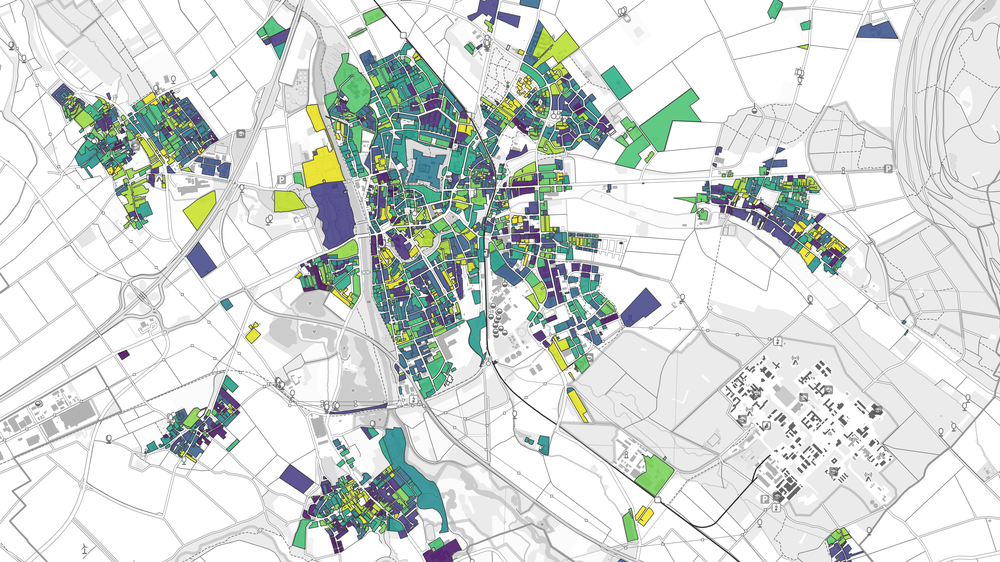
The first step in setting up a local heat or sector-coupled energy system is to define and delineate the energy cells. The German Aerospace Center (DLR) has created a basis for this with the idea of "Urban Energy Units" (UEUs). UEUs are easily identifiable minimum units, i.e. small groups of buildings with similar energy requirements. These units are suitable for a joint energy supply, for example through a heating network or individual heat pumps.
Jülich energy cells
Sketch of the concept of energy cells and exchange between them at Jülich.
Using the city of Jülich as an example, the project team is developing a method of how the assembly of energy cells from UEUs can be ideally organised. The project participants are analysing which criteria influence the quality of the cells. For example, they assess whether similar buildings with comparable heating requirements should be considered together, or whether different types of building complement each other better.The project team is also assessing the importance of proximity to heat sources such as the new data centre at Forschungszentrum Jülich and the Brainergy Park with its innovative local heating network. The aim is to optimally integrate the limited amount of renewable heat sources into the urban energy system.
Expertise from Jülich combined
Pre:JuCells combines the expertise of Forschungszentrum Jülich in model-based optimisation, simulation and planning of energy systems with the practical experience and local roots of Stadtwerke Jülich. In addition, the innovative energy system of the Brainergy Park and the methods developed at the DLR Institutes of Solar Research and Networked Energy Systems for the large-scale classification and modelling of heat and electricity requirements in existing districts are incorporated.
The main aim of the project is to develop digital tools. These should enable the planning and operation of local energy communities and their technical implementation as energy cells. In particular, the Institute of Solar Research is investigating how a city can be divided into local energy cells. It is also examining how the concept can help to optimise the use of new heat sources for future heat supply.
Jülich as an example for other cities and municipalities
The PreJu:Cells project and its results should not only accompany the city of Jülich on its path to climate neutrality, but also serve as an example for other cities and municipalities to show how energy cells or LECs can be helpful for their transformation. After all, Jülich's energy cells represent a large part of the German and European building stock – including commercial, public buildings and residential neighbourhoods. If the cellular energy system proves to be advantageous for Jülich, the consortium is planning the practical implementation of the energy system in a follow-up project.