Multimodal AI architecture for predicting solar irradiance
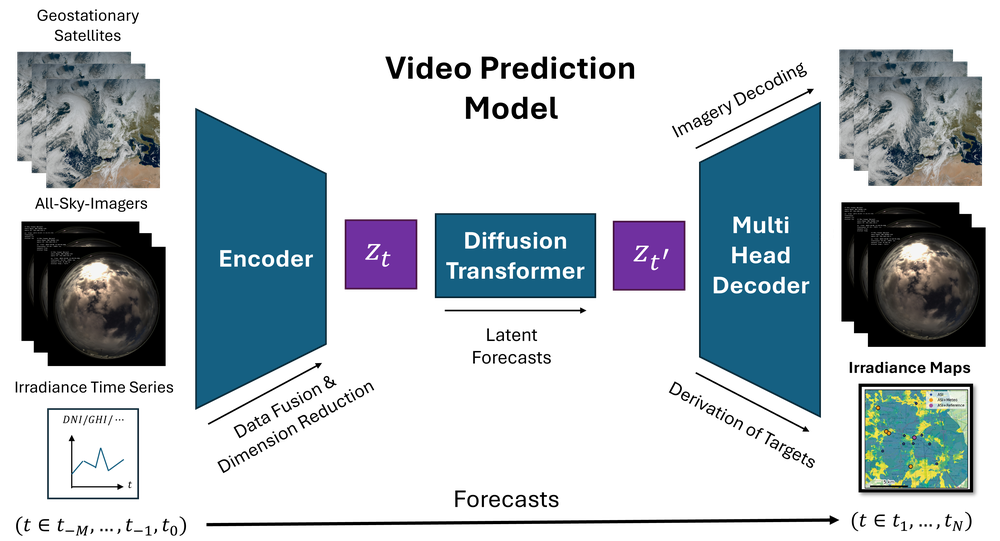
The diagram shows the processing chain for the forecasting models developed at DLR. Satellite data (MTG) and SkyCam images are combined in a multimodal deep learning model. The model generates high-resolution forecasts of solar irradiance and reconstructs future satellite and SkyCam images as the basis for precise PV output forecasts.
High-precision solar irradiance forecasts for the energy system
Duration: 01.09.2025 - 31.08.2028
The PV-Reserve research project is developing new methods to forecast solar power generation with significantly greater accuracy. To this end, the DLR Institute of Solar Research is investigating AI-supported short-term forecasts of solar irradiance. The aim is to reliably predict rapid changes in solar irradiance and thereby enable new applications for photovoltaic systems – ranging from more cost-effective direct marketing to the provision of balancing energy. Funded by the Federal Ministry for Economic Affairs and Energy (BMWE), this collaborative project brings together research and industry to test the developed methods under real-world conditions.
AI for more accurate solar irradiance forecasts
Short-term changes in cloud cover are among the greatest challenges for forecasting solar power generation. Particularly rapid changes in output, known as ramp events, affect grid operation and energy trading.
The DLR Institute of Solar Research is therefore developing novel deep-learning models that combine images from SkyCam cloud cameras, satellite data from the new Meteosat generation (MTG) and ground-based irradiance measurements. The models provide high-resolution forecasts of solar irradiance and detect critical ramp events with significantly greater reliability than previous methods.
Research in collaboration with industry
PV-Reserve is a joint project involving the DLR Institute of Solar Research, the DLR Institute of Networked Energy Systems and the industry partners energy & meteo systems GmbH (EMSYS), CSP Services GmbH (CSPS) and BayWa r.e. AG. While the Institute of Solar Research is developing the AI-based forecasting models, the Institute of Networked Energy Systems is contributing its expertise in satellite-based energy meteorology and the Eye2Sky network. The industry partners are integrating the models into PV production forecasting systems, operating the necessary measurement technology and evaluating their application in the energy market.
Demonstration under real-world conditions
The methods developed are being tested on commercial photovoltaic plants under real-world operating conditions. The aim is to achieve the first-ever pre-qualification of a photovoltaic plant for the provision of balancing energy. At the same time, the forecasting models are being integrated into photovoltaic output forecasting and tested for direct marketing as well as for use in the balancing energy market.
Benefits and outlook
Credit:
BMWE
The methods developed in the project lay the foundation for a new generation of high-precision solar irradiance forecasts. They improve the integration of photovoltaic systems into the energy system, increase grid stability and open up new marketing opportunities for operators and direct marketers. In this way, the project PV-Reserve makes an important contribution to a climate-neutral energy system and to the increased use of renewable energies for system services.