Heat from concentrating solar collectors for Spanish brewery
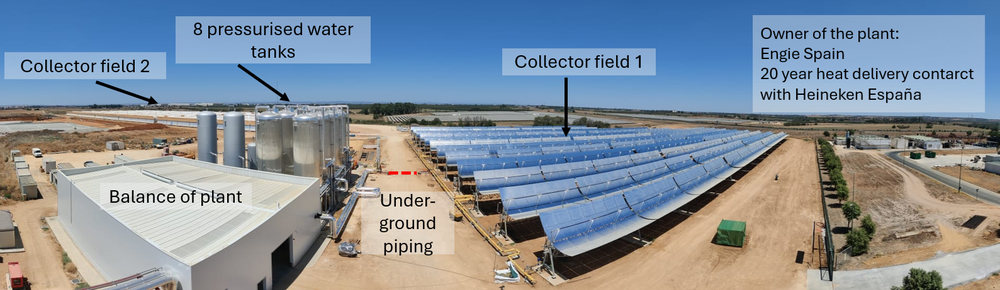
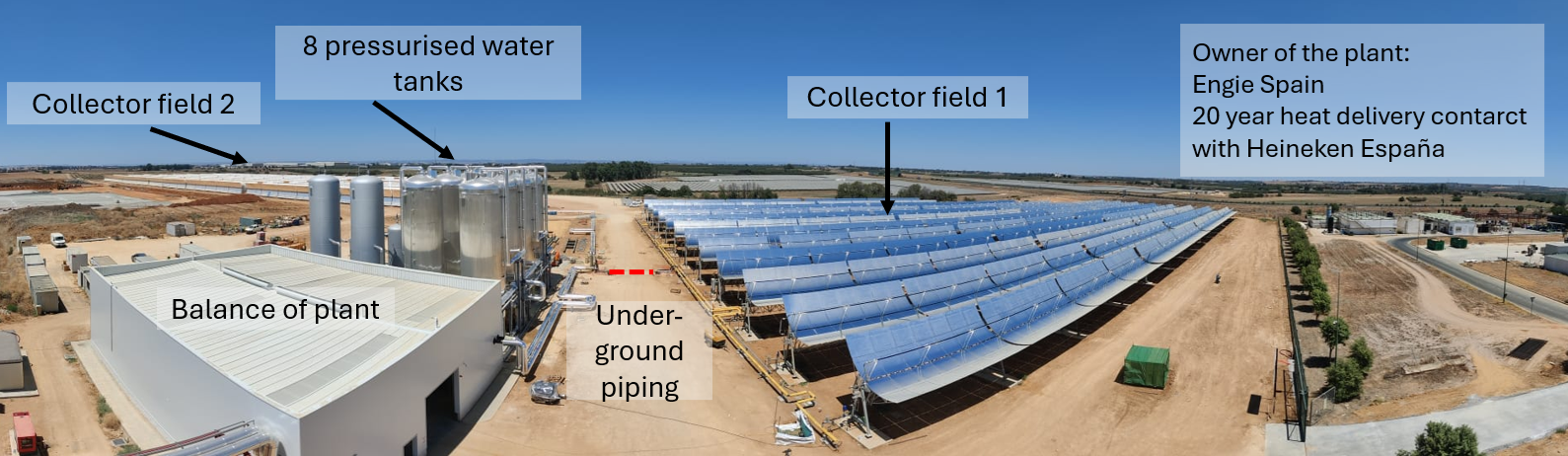
View of the solar process heat plant at the Heineken brewery in Seville, Spain, with the storage tanks and balance of plant on the left and one of two parabolic trough fields on the right.
Since the summer of 2023, around half of the heating demand at the Heineken brewery in Seville has been covered by solar energy. This groundbreaking solar concentrating installation is owned and operated by energy provider ENGIE España, under a 20-year heat supply agreement with Heineken. The project marks a significant step toward climate neutrality at the brewing site.
Largest solar process heat plant in Europe
The Seville installation is a flagship project in several respects. It was delivered in record time, with only 13 months between groundbreaking and commissioning. With a capacity of 30 megawatt, it is the largest solar process heat plant in Europe. Most importantly, Heineken reports a high level of satisfaction with both the plant’s performance and and its day-to-day operation.
The parabolic trough modules are similar in size and design to those used in large solar thermal power stations for electricity generation, measuring 12 metres in length and × 5.77 metres in width.
Pressurised water is used in the solar circuit of this system. This eliminates the environmental and disposal risks associated with the use of oil.
The storage volume consists of eight stratified, pressurised steel tanks with a total volume of approximately 800 cubic metres.
The installation of the solar field was jointly managed by the Belgian companies Azteq and Solarlite Spain and carried out by an Andalusian construction company.
Plant specifications at a glance
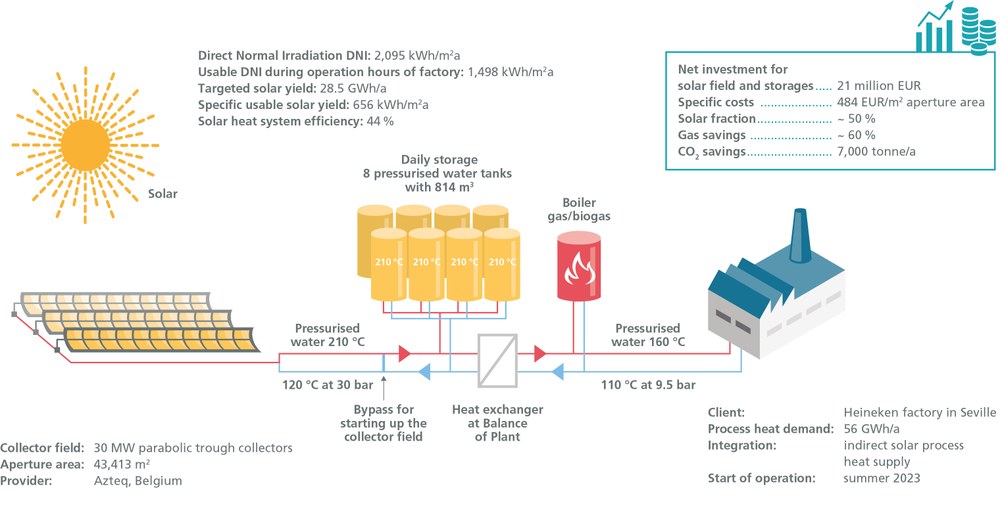
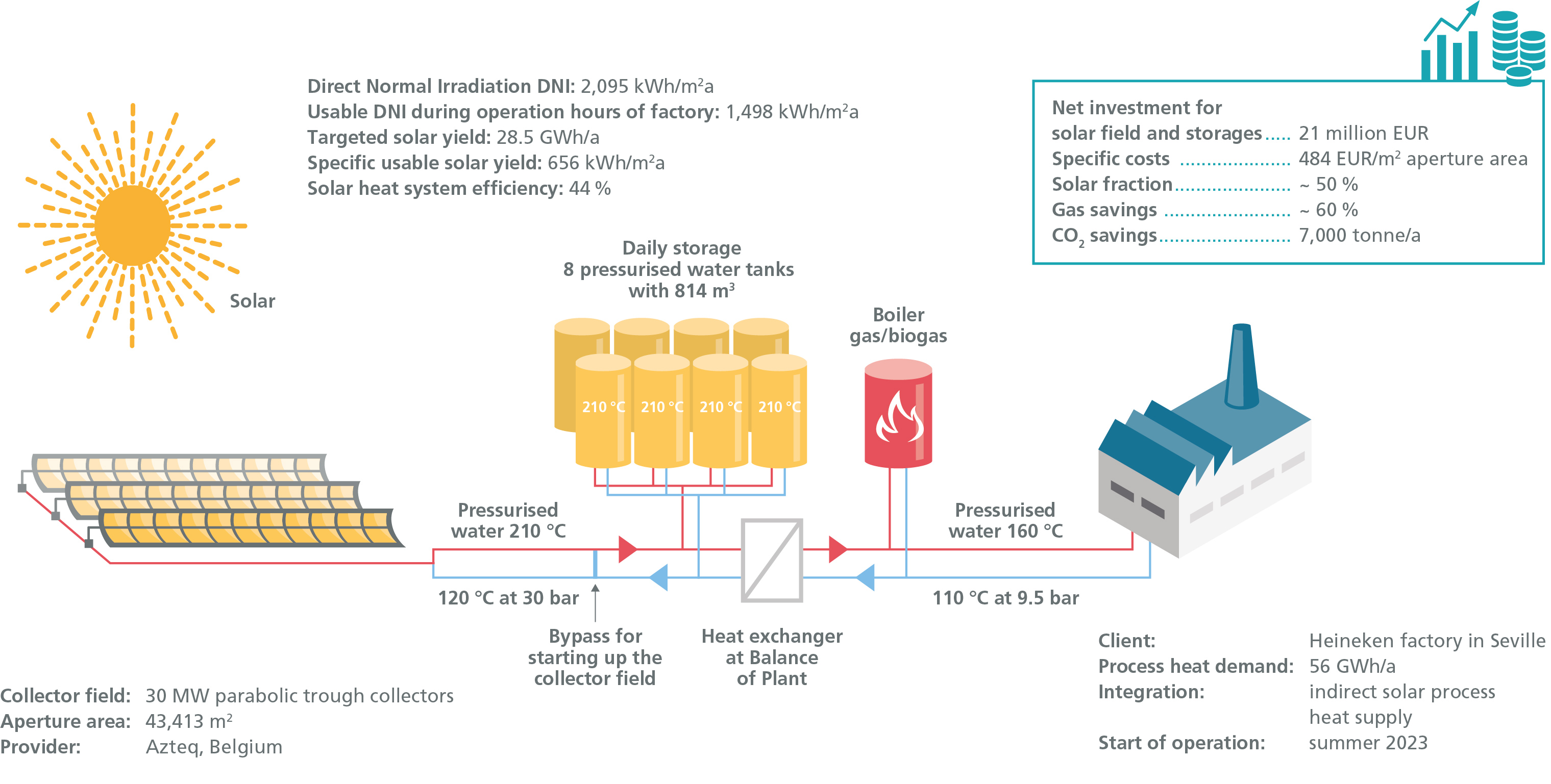
The following diagram shows the seamless integration of the solar thermal system into the existing infrastructure of the brewery. A heat exchanger separates the solar collector field from the customer's heat distribution system and ensures the hydraulic separation of the two circuits. This allows the generated solar heat to be integrated into the existing heating network according to the customer's heat demand.
Additionally, a bypass in the solar circuit enables the heat transfer fluid to circulate through the collector field until a sufficient temperature is reached. Due to the design of the heat exchanger, the solar field and the storage system can supply the heat exchanger inlet within a flexible temperature range of 170 °C to 210 °C. This reliably ensures the constant supply temperature required by the customer, ranging from approximately 130 to 160 °C.
Technical and economic data on the parabolic trough field at Heineken Spain in Seville
The solar process heat plant is designed to deliver an annual usable solar yield of 28.5 gigawatt-hours, covering approximately 50 percent of the factory’s total heat demand of 56 gigawatt-hours per year. The brewery works five days a week.
With such a high solar fraction of around 50 percent, there may be excess heat during the sunny summer months. For this reason, the parabolic troughs at Heineken were arranged in an east–west direction. This orientation was chosen for two main reasons:
Firstly, it enables a slightly higher annual useful heat supply to the customer, as heat production is better matched to the load profile and excess heat generation during summer is reduced.
It allows for a more compact and optimised fit within the available land size and shape.
Although the plant achieves its highest yields around solar noon and comparatively less during sunrise and sunset than a north–south facing field, the east–west configuration was ultimately the best match for the site-specific constraints and the brewery’s load profile.
Contact
Dr.-Ing. Eckhard Lüpfert
Head of Concentrating Solar Technologies Department