Solar thermal energy converts direct sunlight into heat and is therefore subject to seasonal and hourly fluctuations that can vary depending on the position of the sun and the weather. Hybridising solar thermal systems with other technologies enables them to adapt well to different weather conditions, consumption profiles and heat requirements, and leads to greater robustness against seasonal fluctuations. This allows heat demand to be met as completely and climate-friendly as possible.
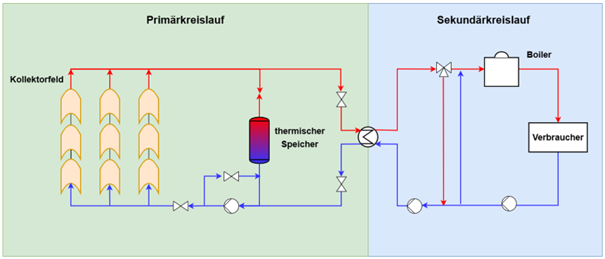
Thermal storage tanks are used when heat is needed at night or in winter and solar thermal collectors cannot provide any or sufficient heat. If there is a heat surplus, i.e. the collector field supplies more heat than is needed by the consumer, the excess heat is fed into a heat storage tank (e.g. a pressurised water storage tank or a solid storage tank) and stored there. The heat can be released to the consumer as needed.
If the storage tank is empty, a boiler can provide the remaining heat so that heat can always be supplied for the process. Boilers are usually already installed on the consumer side and can therefore continue to be used as a fallback solution.
Flow diagram for a system with a liquid medium
Simplified flow diagram for a system with a liquid medium in the primary circuit and a heat exchanger.
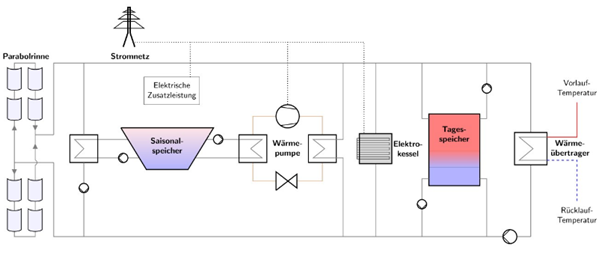
Solar thermal energy can also be combined with a heat pump, with a solar thermal system covering most of the heat supply. One possible combination here would be to connect the heat pump to a heat storage tank (in this case, a seasonal storage tank in the form of an earth basin storage tank). In conventional earth basin storage tanks, the maximum storage temperature is around 80 degrees Celsius, which can be increased with the aid of a heat pump. This combination is particularly suitable for heating networks that require higher flow temperatures.
Concept of a system diagram for the year-round supply of a district heating network
Concept of a simplified system diagram for the year-round supply of a district heating network with parabolic troughs, seasonal storage, daily storage, electric boiler and a heat pump. The aim here is to supply the heating network with 100% renewable energy. The electricity from the grid should also come from 100% renewable energies.
Biomass coupling is also possible, as is the case with the plant in Brønderslev, Denmark. If the solar thermal plant supplies sufficient heat, the heated thermal oil is used directly for electricity generation or district heating. In periods of low solar radiation, the biomass boilers automatically take over the heat supply. Ideally, these heat the same thermal oil so that all downstream components can continue to operate without interruption.
Hybrid systems, which supplement the heat from concentrated solar thermal energy with that from direct electricity generation via photovoltaics, enable efficient use of the available space. Here, photovoltaics can be installed on surfaces that cannot be used by parabolic trough collectors (e.g. sloping surfaces such as roofs). The simultaneous generation of electricity and heat can offer advantages. For example, the heat generated by concentrated solar thermal energy can be stored effectively, while photovoltaics supply electricity during the day. The use of both technologies can therefore increase security of supply and reduce fluctuations.
Contact
Dr.-Ing. Eckhard Lüpfert
Head of Concentrating Solar Technologies Department