The Institute of Solar Research develops plant concepts, models them using specialized simulation tools, evaluates their performance and energy yield, and uses this information to derive well-founded economic analyses.
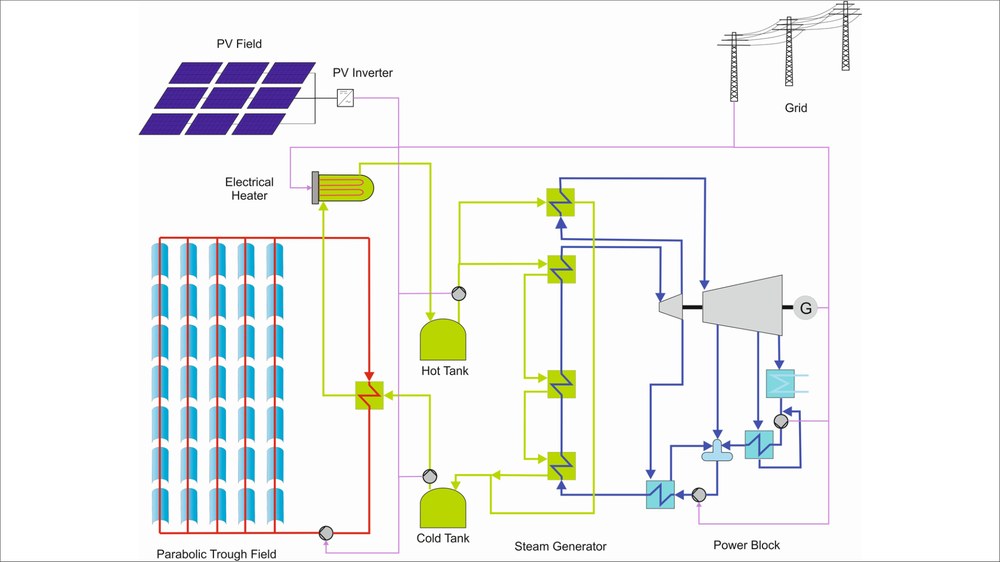
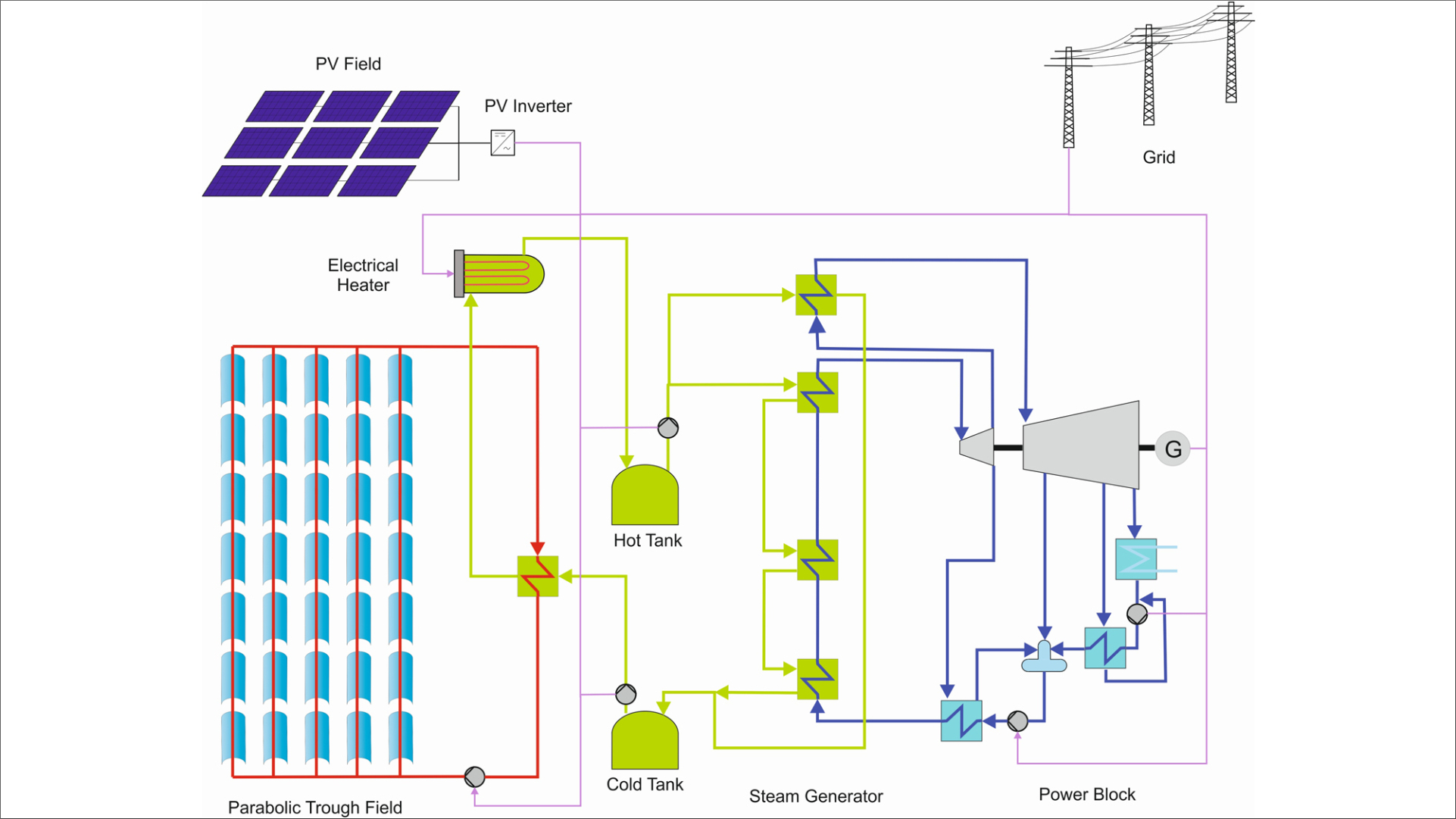
The majority of solar thermal systems installed today are stand-alone units for electricity production in the 50 to 150 megawatt output class. Hybrid systems are increasingly replacing this system concept. They add a photovoltaic (PV) system to a solar thermal power plant with heat storage. This combination makes it possible to produce solar power around the clock and at the same time reduces the average costs of power generation.
During the day, the electricity comes mainly from the PV system, which is cheaper to operate at that time, and at night from the power plant section of the solar thermal system, which draws on stored solar heat for this purpose.
In the course of increasing industrialisation worldwide, a higher demand for electricity and process heat is to be expected. Additional systems are needed to cover the increasing demand for energy from sustainable sources. Plants that can produce both green electricity and process heat are an interesting alternative. The provision of heat for industrial processes poses major challenges in terms of plant design, as the heat generation systems must be tailored precisely to the heat requirements of the production processes.
Graphic of a hybrid system
Depiction of a hybrid system consisting of a solar thermal power plant and photovoltaics with an electrical booster.
Simulation tools for the design of systems and heliostat fields
Scientists at the institute develop concepts for such systems. They model them in simulation tools, calculate performance and yield and carry out profitability analyses.
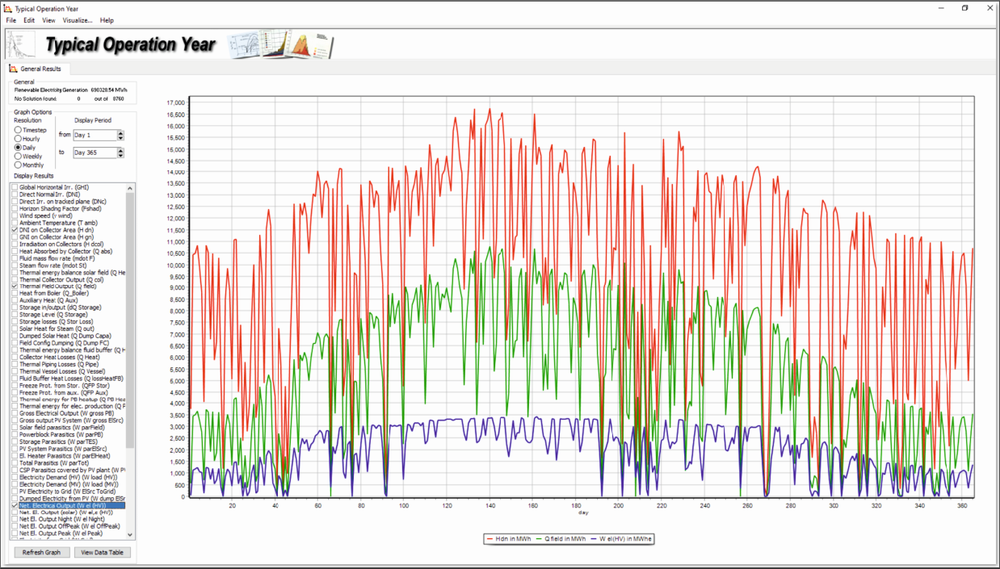
The Institute of Solar Research uses various tools for the design and yield calculation of solar thermal systems. The software greenius, which was developed by the institute and is also freely available, enables annual calculations to be carried out for a large number of configurations within a few minutes. The tool is continuously being expanded to include new configurations.
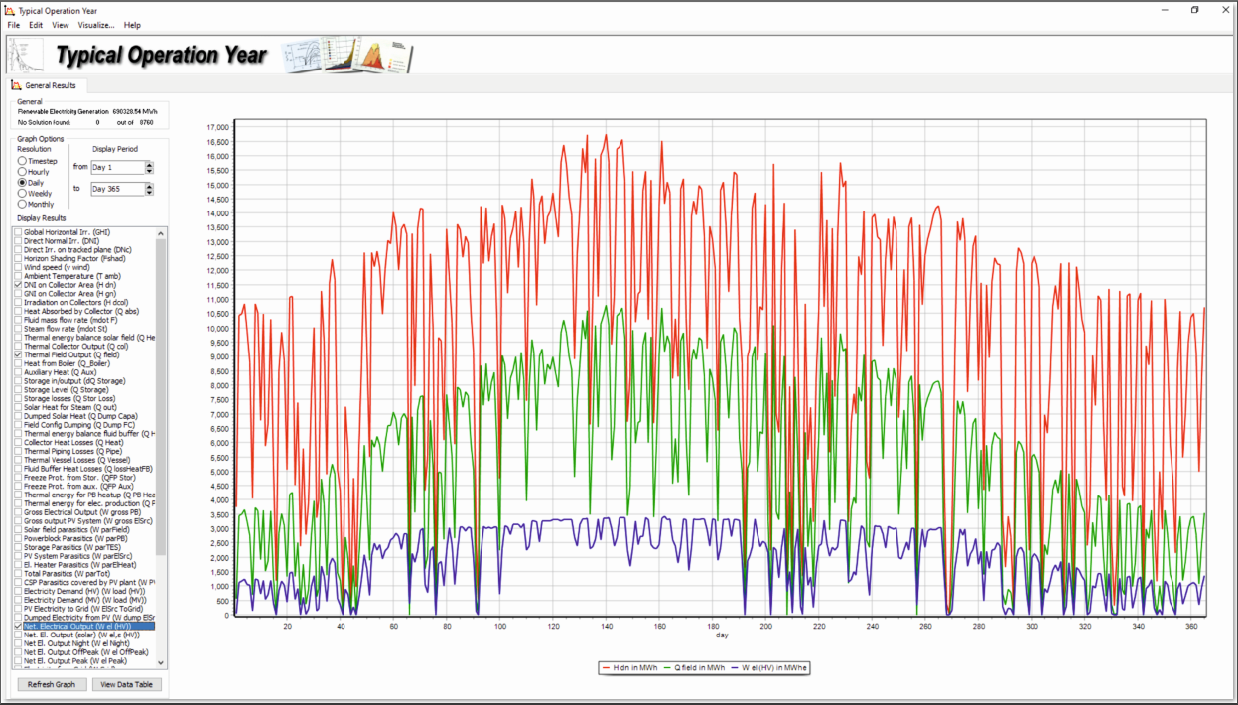
Softwaretool greenius
The greenius yield calculation tool shows irradiation (red), solar field output (green) and electrical generation (blue).
More complex tasks with novel interconnections or very specific operating concepts can be simulated and optimised with our in-house tool YACOP. The program package created in Python can be flexibly expanded and thus used for scientific questions, for example for coupled design and application optimisation.
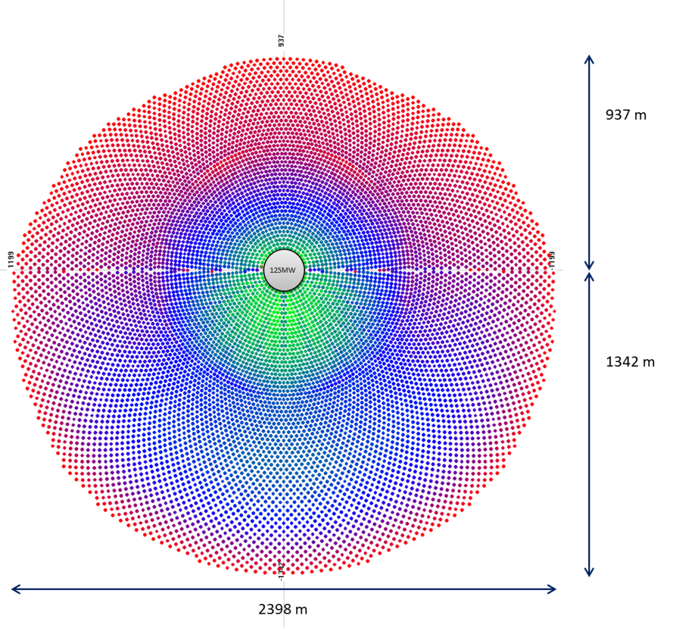
Heliostat field design from HFLCAL for a 125 megawatt plant
HFLCAL is a program for designing and optimising heliostat arrays of central receiver systems on the basis of an annual power calculation. The calculation time for the power estimation is saved by using a simplified mathematical model for the concentrator optics: The reflected image of each heliostat is described by a circular normal distribution.
The heliostat field design tools HFLCAL and STRAL are available for solar tower systems. These are used in particular for the simulation of innovative receiver concepts in order to optimally adapt the heliostat field to the respective receiver.
The services provided by the Institute of Solar Research
The Institute of Solar Research offers advice and tools for different contexts in which system design and simulation are necessary or helpful.
For innovative solar thermal concepts, for example, it makes sense to calculate the yield potential at an early stage so that development work can be correctly aligned from the outset. In the case of market-oriented technologies, the institute supports companies in building up their own modelling expertise. The institute also offers companies and research institutions an independent assessment of yield and profitability data for innovative concepts.
In addition, the institute works on potential studies for solar thermal technologies . In doing so, researchers liaise with technology development experts in order to take the latest developments into account.