On everyday journeys in Berlin, people are exposed to various environmental stressors (noise, air pollution) that influence health, well-being and behaviour. As part of a doctoral thesis, we are therefore investigating the difference between perceived and actual exposure on everyday routes.
How do people perceive their exposure to noise and particulate matter on everyday routes and does this lead to a change in their behaviour?
As road users, we are influenced by our environment on our everyday journeys through the city. It affects our well-being, our mobility decisions and our choice of route. Environmental stressors such as particulate matter pollution and traffic noise pose a health risk to city dwellers. This campaign was therefore dedicated to the topic of health in urban mobility.
Awareness of particulate matter and noise pollution on everyday routes is still low. More intensive communication and the visualisation of routes that are hazardous to health can encourage users to adopt avoidance strategies such as a different choice of route and at the same time highlight hotspots where action is needed for planning and policy. In order to counter health risks on everyday journeys, the study investigated how these are perceived and managed, how everyday mobility is organised in the context of digital communication and what influence knowledge of personal risks has on mobility behaviour.
Realisation
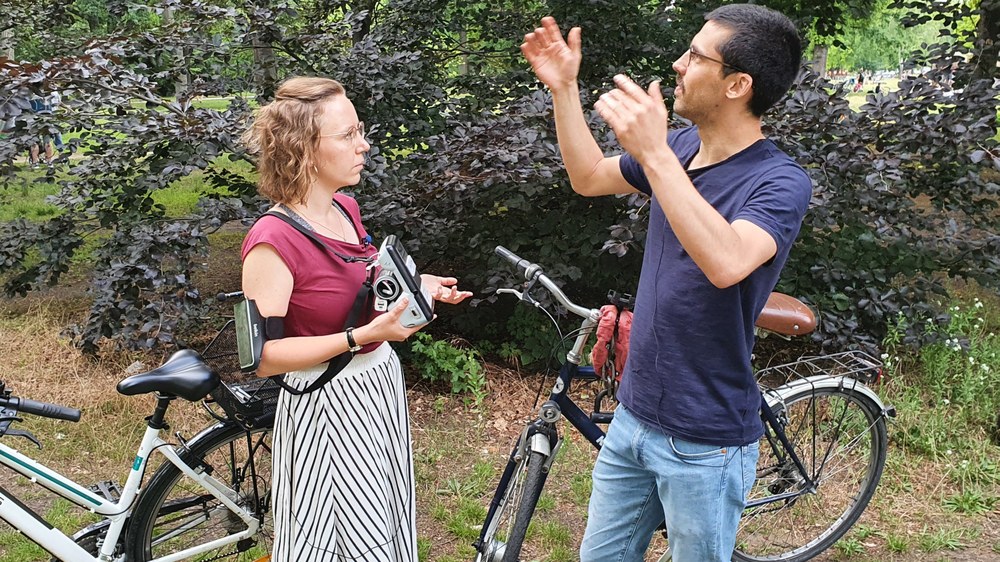
In the project Gesunde Mobilität (healthy mobility), cyclists and public transport users were accompanied on their everyday journeys, with particulate matter and noise pollution being recorded using personal sensors. During the walk and ride-alongs, the participants talked about their perceived exposure, health, choice of route and their knowledge of avoidance strategies. They then documented their routes for a week using the MovingLab app and answered questions about their well-being. The MovingLab was therefore a central method in the project.
Tracking in the MovingLab app (symbolic image)
Participants in the campaign were asked to record their journeys and the resulting feelings.
The MovingLab app collects data on the following aspects, among others:
Type of route planning
Subjective stress
Sources of stress
The study also looked at how digital information that is available on the go, for example on particulate matter or noise pollution, could contribute to healthier mobility and which other factors multimodal road users included in their choice of route and mode of transport.
The data collected was visualised using the DataLab and discussed in two focus group workshops. Based on these visualisations, the participants reflected on their choice of route, discussed the influence of knowledge about their personal stress levels and considered what alternative and healthier routes would have been possible.
Results
Tracking and timely evaluation of routes in the MovingLab app proved to be particularly advantageous, as perceptions could be recorded directly after the route had been travelled. The tracked routes were then reflected on together in group discussions at the DataLab. This made it possible to identify places that were perceived as stressful and discuss healthier alternative routes.
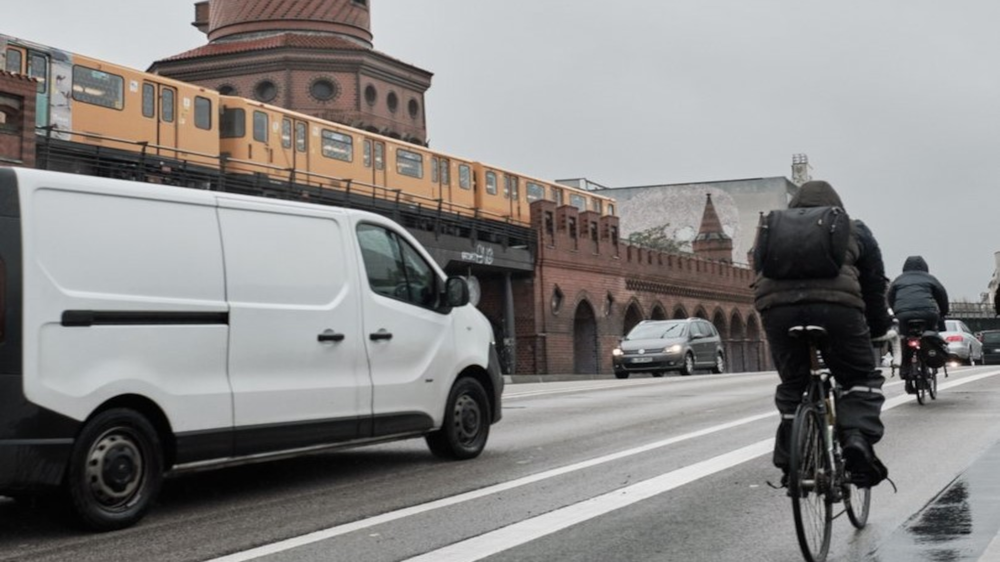
The Oberbaumbrücke in Berlin
Mobility behaviour was measured at highly frequented locations such as the Oberbaumbrücke in Berlin.
It became clear that particulate matter and noise pollution occurred primarily in the vicinity of emitters and on footpaths and cycle paths along busy roads, while separated cycle paths showed lower levels of pollution. Street canyons also showed higher values than wider streets. At the same time, it became apparent that green spaces with visual, auditory and olfactory stimuli, such as trees, birdsong or the scent of flowers, could have a positive influence on health perception. Even small green elements contributed to a better perception in highly polluted areas.
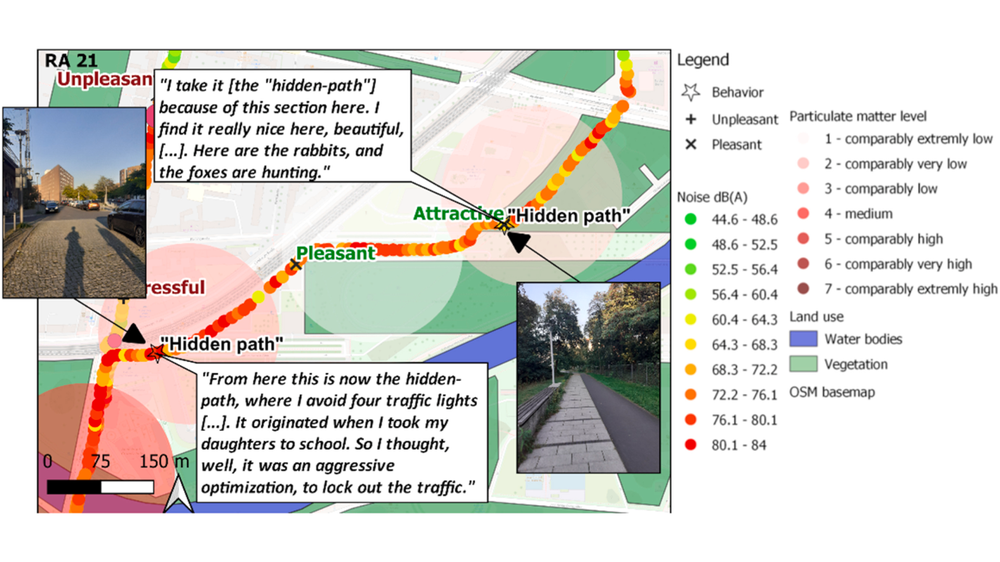
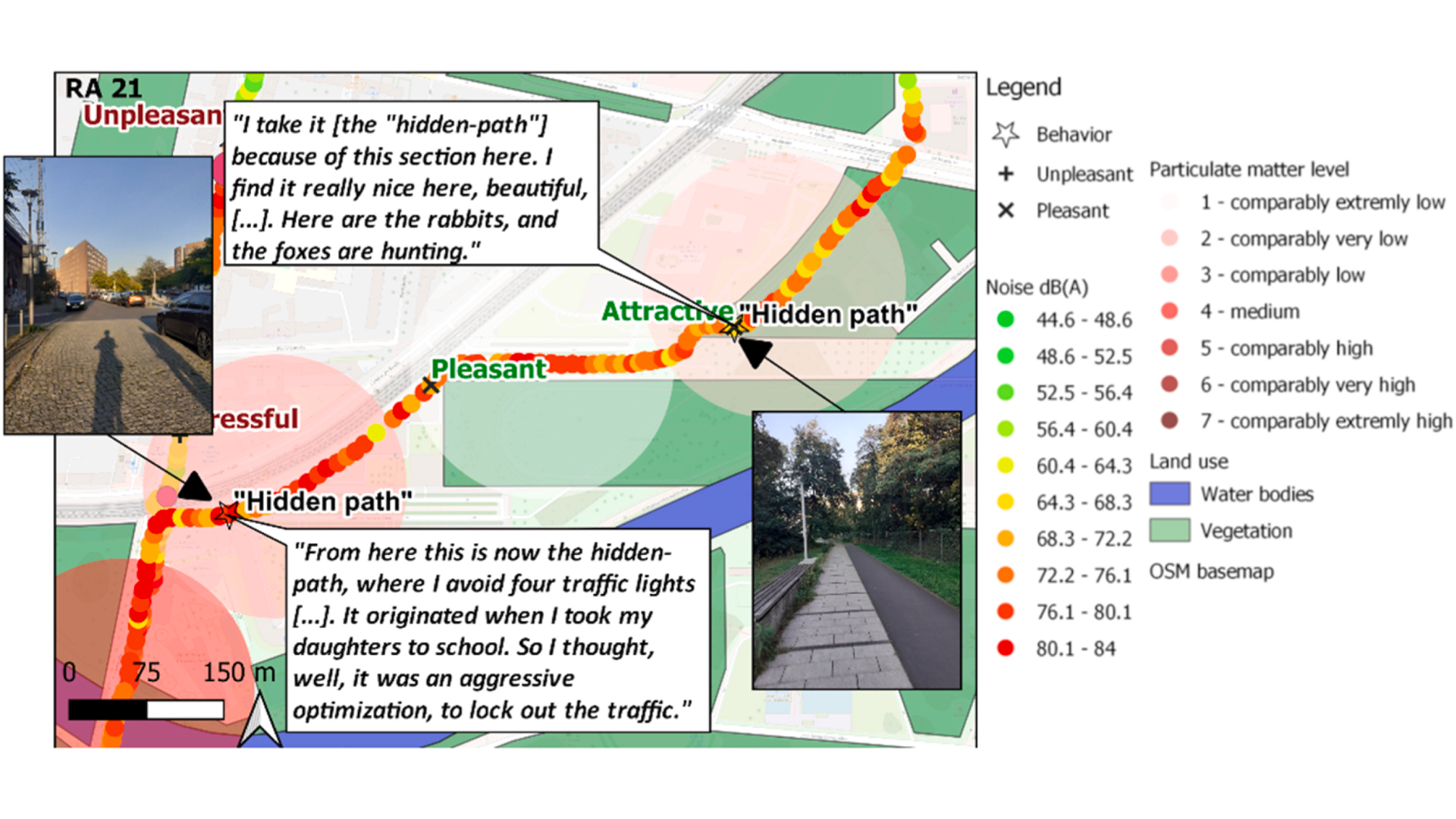
Tracked route
An example of the tracked data of a participant, including the shortcuts taken and the noise pollution.
At the same time, it became clear how challenging it was to choose a healthy route in urban areas: many participants took informal shortcuts to avoid busy main roads, which was clearly demonstrated by the MovingLab.
Overall, it was shown that the visualisation of personal stress was an effective tool for communicating healthier route alternatives and making the need for action in the urban space visible.
Campaign details
Runtime:
1 month
Methods:
Data recording via MovingLab app, in-app survey, visualisation with MovingLab dashboard at the DataLab