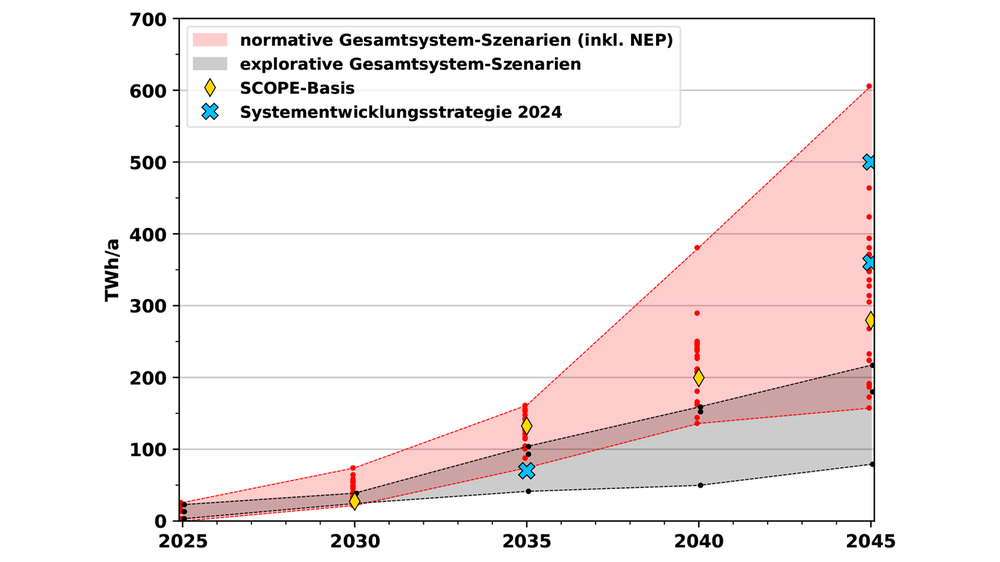
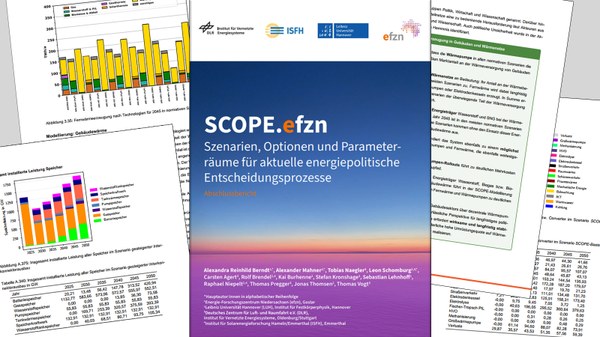
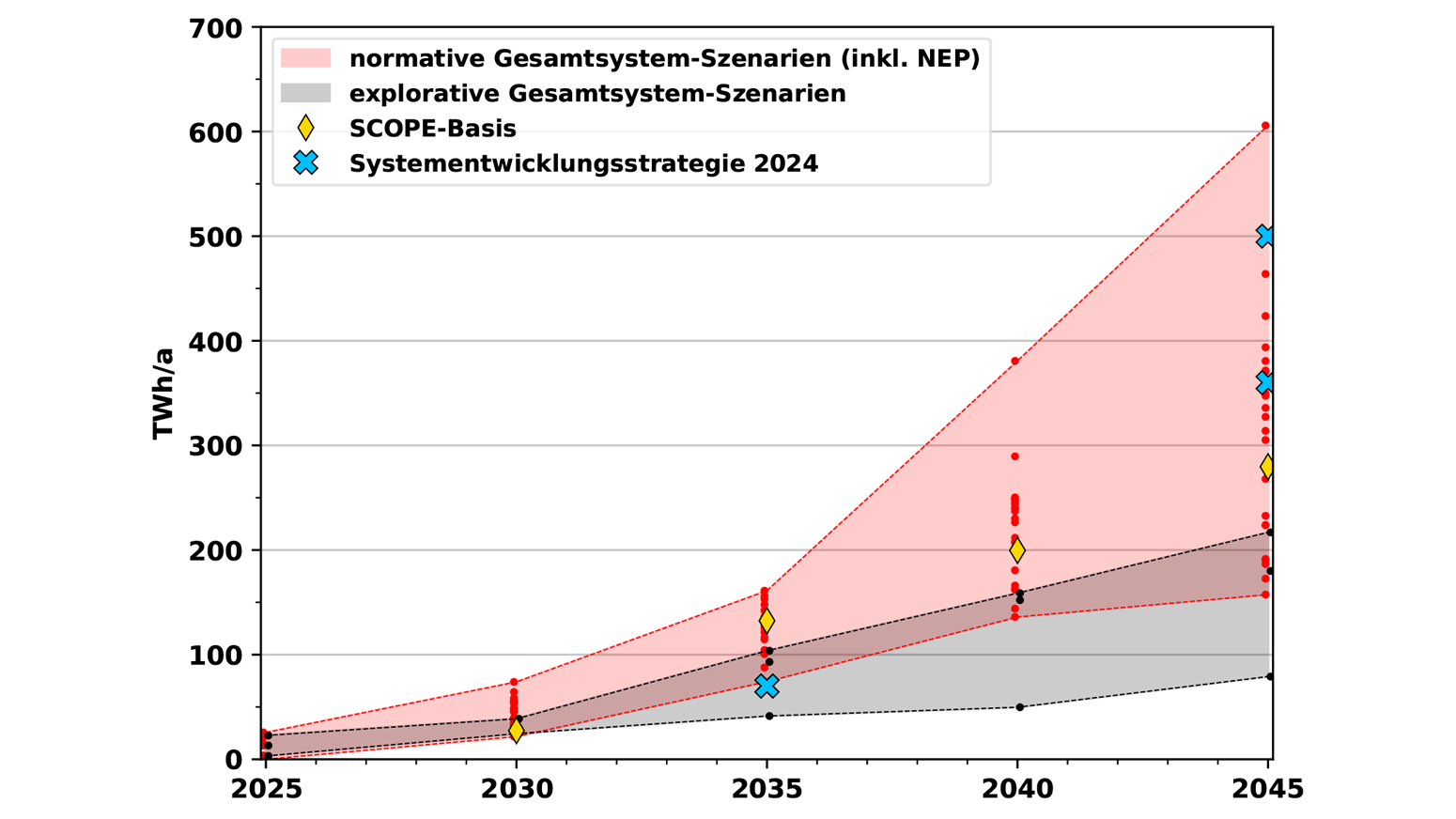
Meta-studies, such as those developed for current energy scenarios for Germany in the SCOPE.efzn project, can be used to consolidate existing knowledge in a structured manner – for example, on the basis of selected transformation scenarios for the energy system. Widely diverging individual results are not attributable to calculation errors, but to the underlying methodology. Exploratory scenarios examine what might happen under certain conditions, whereas normative scenarios are based on specific policy objectives. The example shown here clearly demonstrates how markedly the assumptions on future hydrogen demand diverge accordingly.
In meta-studies, the Institute of Networked Energy Systems compares existing studies and analyses and compares their key findings, as well as their methodological approaches. Meta-studies, such as those created for current energy scenarios for Germany in the SCOPE.efzn project, are considered an efficient and targeted method for structuring existing knowledge. Robust findings can be derived wherever there is high consistency in results across studies. At the same time, areas of significant uncertainty can be identified. This provides decisions in politics and business with a more reliable and evidence-based foundation.
But why do established scenario studies sometimes produce significantly different results in the first place? While all currently available transformation scenarios for the energy system or transport sector are generally based on solid methodological foundations, they can still yield different results because the models use different assumptions, parameters, and objectives, and because of differences in model structures, the level of detail, and system boundaries. Regarding objectives, for example, a distinction is made between “explorative” and “normative” scenarios:
Explorative scenarios investigate what could happen under certain conditions, for example under constant energy policy conditions. No specific political goal is predefined. They serve to map the spectrum of possible developments, analyse the impact of interventions, and highlight uncertainties.
Normative scenarios, on the other hand, start from concrete political objectives, such as CO2 reduction targets or expansion quotas for renewable energies. They describe what system design and which transformation processes are necessary to achieve these goals. This allows them to provide policy recommendations.
To ensure political decisions are based on a common knowledge base, four aspects are decisive:
Transparency: The methodological approach, data basis, and assumptions made must be transparent and comprehensible.
Fitting accuracy: The model must fit the specific problem statement. For instance, a cost-optimising model is not automatically the right tool if social or ecological side effects are to be in focus.
Systemic and holistic perspective: The increasing interconnection of the electricity, building and process heat, and mobility sectors requires systemic solution approaches that adequately consider all sectors. A holistic assessment, which analyses economic, ecological, social, and geopolitical prerequisites as well as the consequences of transformation, prevents one-sided conclusions and allows potential transformation obstacles to be identified in advance.
Awareness of modelling uncertainties: Those who wish to draw energy policy-relevant conclusions from model results must be aware of the uncertainties and limitations resulting from the model structure, modelling approach, and choice of input variables.
In the SCOPE.efzn project, the Institute of Networked Energy Systems relied on a broadly based scientific assessment based on this. The DLR researchers placed explorative and normative scenarios side by side and compared their results critically and constructively. As a result, the Institute was able to lay the groundwork for consensus-based, evidence-based energy and transport policy together with all project partners.