
New Collaborative Research Centre AgiMo Receives DFG Funding
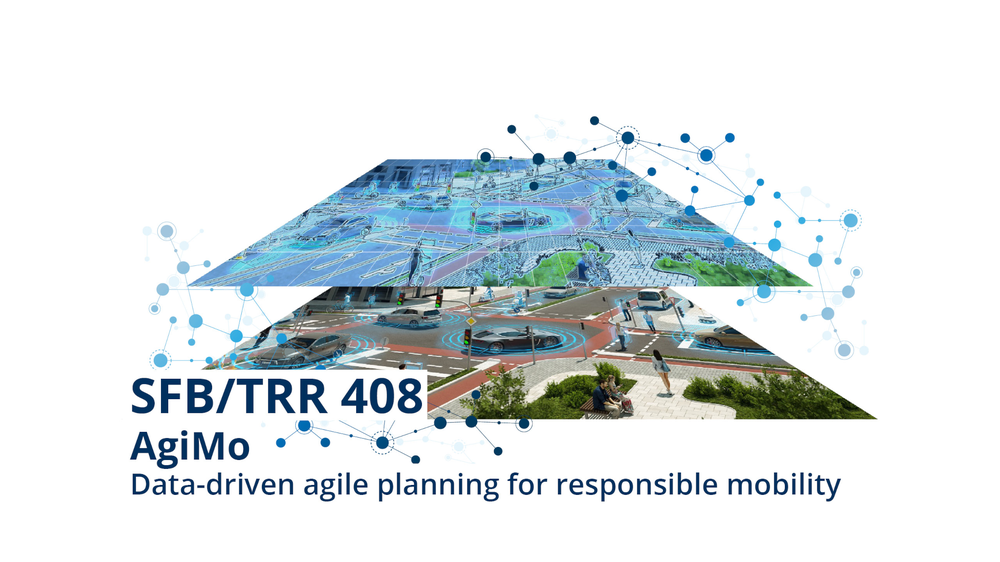


- The Deutsche Forschungsgeselllschaft (DFG, German Research Foundation) has approved funding for the Collaborative Research Centre "AgiMo: Data-driven agile planning for responsible mobility".
- The research project pursues an integrative approach.
- TU Dresden, TU Munich, TU Berlin, TU Braunschweig and the German Aerospace Center (DLR) are consortium partners.
- 12.7 million euros in funding will be available over the four-year funding period.
The Deutsche Forschungsgemeinschaft (DFG, German Research Foundation) has approved the new Collaborative Research Centre SFB/TRR 408 AgiMo: Data-driven agile planning for responsible mobility.
AgiMo will be implemented by the Technical University of Dresden, the Technical University of Munich, the Technical University of Berlin, the Technical University of Braunschweig and the German Aerospace Center (DLR) and is the first interdisciplinary DFG research programme in mobility and transport research.
The researchers have defined four goals to make mobility planning of the future possible:
1. New planning methods: In addition to data and models on mobility behaviour, methods for the planning and management of transport systems are being developed. These will take different modes of transport into account, from walking to motorised traffic.
2. New criteria for responsible mobility: Based on the "4F principles" (function, form, fairness and forever), new criteria for responsible mobility are to be formulated and integrated into future planning methods.
3. Digital twin: The researchers want to develop a digital twin as an open-source application that provides current network-wide assimilated mobility data as well as the models for generating this data.
4. Participatory planning methods: For the development of evidence-based future scenarios for responsible mobility, new participatory planning methods are to be designed that reflect the preferences of relevant stakeholders.
AgiMo is the first time that a multidisciplinary network of researchers from leading research institutions is working on the mobility planning of the future as part of a coordinated DFG programme. The two largest German academic centres for transport research, TU Dresden and TU Munich, submitted the proposal. In the consortium with the partner institutions TU Berlin, TU Braunschweig and the German Aerospace Centre (DLR), the experience and innovative strength of the participants will be pooled in order to realise this ambitious and unique project.
The DFG has approved funding totalling 12.7 million euros for the entire consortium over the four-year funding period.