Innovative solutions for electromobility: multiple use of supermarket car parks
October 14, 2025 | Project results from Retail4Multi-Use
Innovative solutions for electromobility: multiple use of supermarket car parks
Presentation of the project results in Berlin
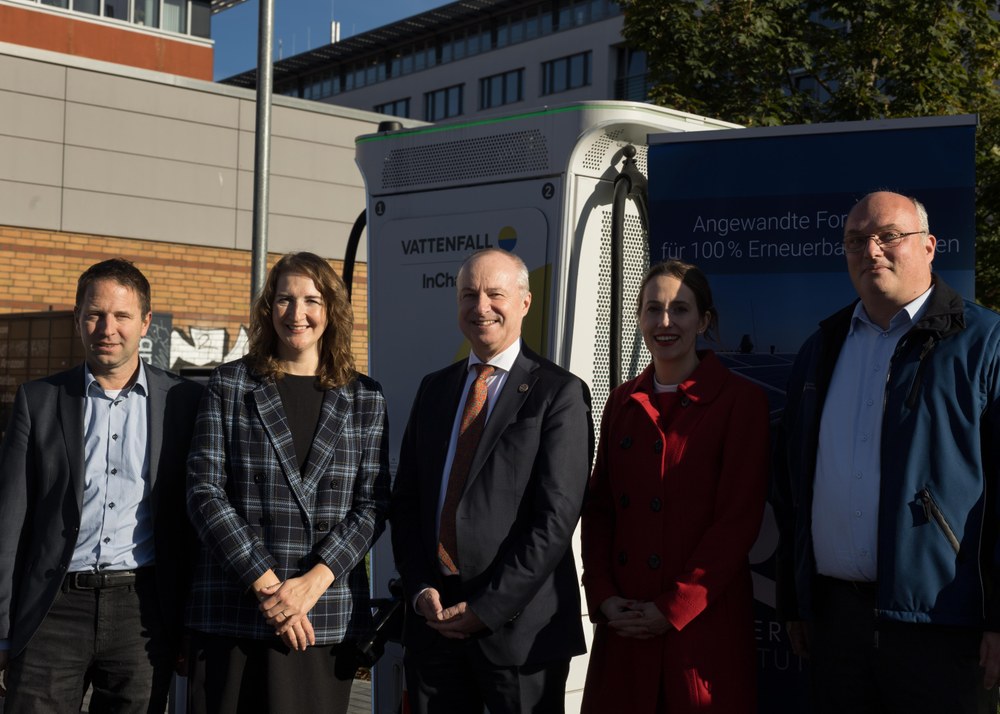
From left to right: Prof Dr Gernot Liedtke, Director of the DLR Institute of Transport Research; Prof Dr Kathrin Goldammer, Managing Director of the Reiner Lemoine Institute; Johannes Wieczorek, Head of the Department for Policy Issues at the Federal Ministry of Transport; Annemarie de Jong, Director Sales & Operations Vattenfall E-Mobility Germany and Volker Lengnick, Team Leader Vehicle Service Berliner Wasserbetriebe.
Credit:
RLI/Pinja Saarela
Presentation of the results by the project participants in Berlin on 13 October 2025
Multiple utilisation increases efficiency and reduces the need for infrastructure expansion
Criteria for transparency in a multiple utilisation concept
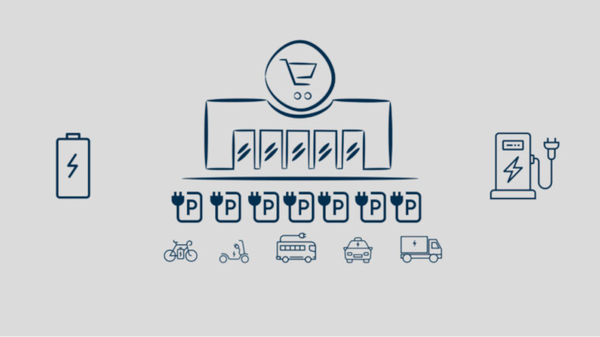
The Institute of Transport Research at the German Aerospace Centre has been researching low-emission and intelligent road transport for over ten years. Together with the Reiner Lemoine Institute (RLI), researchers have developed multi-use concepts for electromobility in a research project. The Retail4Multi-Use project investigated the possibilities of using charging infrastructure in retailers' car parks when they are closed. This additional use can improve the availability of charging infrastructure for users and the efficiency of using existing charging points. The researchers found that by using these car parks as charging locations, the expansion of the charging infrastructure can be reduced by up to 17 per cent. It is also possible to increase the efficiency of existing charging points by up to 255 per cent.
Requirements for multiple uses
Our research focussed on identifying requirements for additional use. For example, almost two thirds of the 46 fleet operators we surveyed mentioned their interest in charging at retail outlets. However, there is a need for charging not only at night and on Sundays and public holidays, but also during the day and at off-peak times. This creates a conflict of interest between the players, as retailers generally want to make these charging points available primarily to their shopping customers. In order to clarify the various interests and identify possible conflicts, we conducted expert interviews with representatives of the retail trade and charging point operators as well as an online survey of fleet operators from the commercial transport sector. The results of this empirical research were criteria that, from the point of view of these three stakeholders, must be taken into account in multiple utilisation concepts. Eighteen relevant criteria were identified and assigned to five categories: Availability, Location, Safety, Environment and Cost. These results were discussed with the associated partners in a project workshop and a multi-criteria evaluation procedure was applied. The evaluation revealed that the location and availability of charging points were each rated highest by around a third across all stakeholder groups. This is followed in this order by safety, costs and the environment, which therefore only appear to be as important as the other two categories in terms of the attractiveness of charging points, totalling one third.
Further developments desired
In order to reduce obstacles to the introduction of battery electric vehicles, our recommendation for a multiple-use concept for charging points in the retail sector is therefore: Once potential users and operators of the charging infrastructure have found each other, for example via a matching platform such as LOCALISER, they should agree regulations on the criteria identified in the project in order to define the framework for multiple use in the interests of both parties. This creates transparency and avoids problems in day-to-day practice. In order to achieve the greenhouse gas reduction targets in transport, however, a number of other application-orientated solutions are needed, for example to integrate bi-directional charging concepts in the future and thus increase the efficiency and resilience of the energy system.
Only in this way will it be possible to further develop the electricity grid in a user-friendly, robust and efficient manner and, above all, achieve criteria such as the availability and low cost of charging infrastructure. We would like to continue to contribute to this with our research work in the future.