In the MOBITAT 2050 project, researchers from the German Aerospace Center (DLR), together with project partners, developed tools to support municipalities and regions in decision-making for sustainable transport planning.
A novel modeling framework enables the visualization of changes in living, working, and commuting patterns up to the year 2050. Strategies to promote environmentally friendly and economically beneficial mobility have been compiled into policy packages to serve as practical guidance.
Focus: Mobility, sustainability, transport transition
Every day, millions of people in Germany commute to and from work. Sometimes only a few kilometers separate home and workplace. However, many commuters travel much longer distances. Although public transport has reached a high quality level, particularly in larger cities, and new mobility options such as pedelecs and on-demand services are increasingly used, most employees still rely on cars for commuting. According to the Federal Statistical Office, 68 percent did so in 2020. As a result, commuting currently accounts for around one third of all passenger car mileage in Germany. At the same time, new trends are influencing commuting patterns, including the digitalization and automation of the transport system as well as the continued influx of young people into cities. Workplaces and work processes are also becoming more flexible, as more and more people work from home at least part of the time.
The German Aerospace Center (DLR), the Institute for Energy and Environmental Research Heidelberg (ifeu), the ConPolicy Institute for Consumer Policy, the Institute for Urban Construction and Urban Transport (ISB) at RWTH Aachen University, and the Integrated Transport and Mobility Management Region Frankfurt Rhein/Main (IVM) all participated in the project. The DLR Institute of Transport Research specifically investigated how commuting patterns are changing in direct interaction with the aspects of housing and working. This was analyzed using the example of the Frankfurt Rhine-Main metropolitan region.
Home Office Reduces the Importance of Distance to the Workplace
Researchers surveyed commuters and found that the journey to work is an important criterion when choosing a place to live, but not the decisive one. When choosing a mode of transport, however, short travel time, high flexibility, and low cost were the most important factors.
Mobile working has only a limited effect on reducing the share of car use in commuting mobility. “Home office alone does not automatically reduce traffic volume,” explains Dr. Viktoriya Kolarova from the DLR Institute of Transport Research. “Although people commute less frequently when they work from home more often, they are also willing to accept longer travel distances. For the mobility transition to succeed, the spread of home office must be combined with attractive incentives for sustainable transport modes on the remaining commuting trips.”
Changed Commuting Flows with More Residential Development Outside Cities
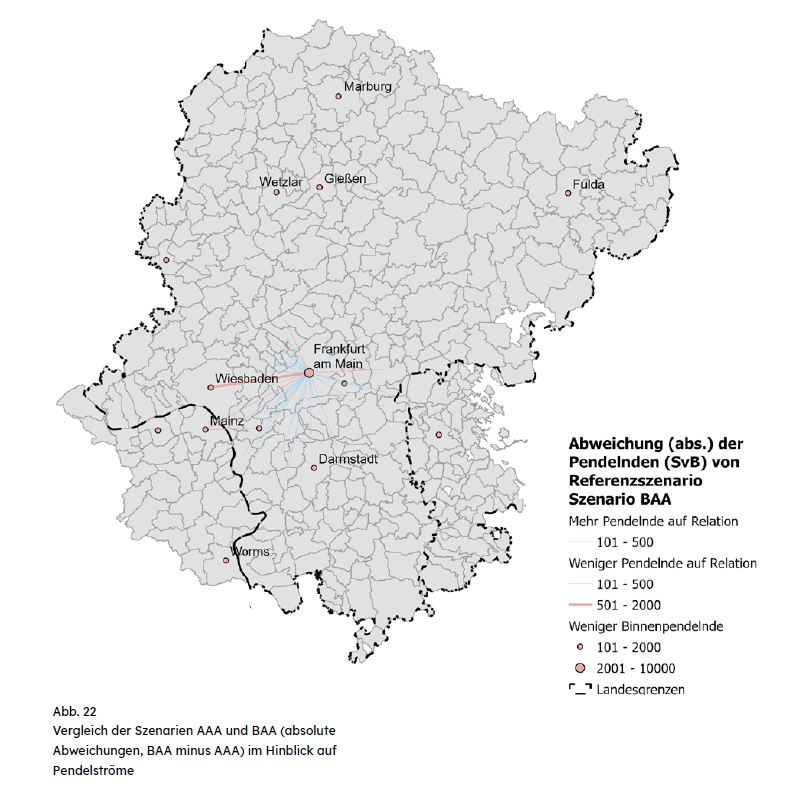
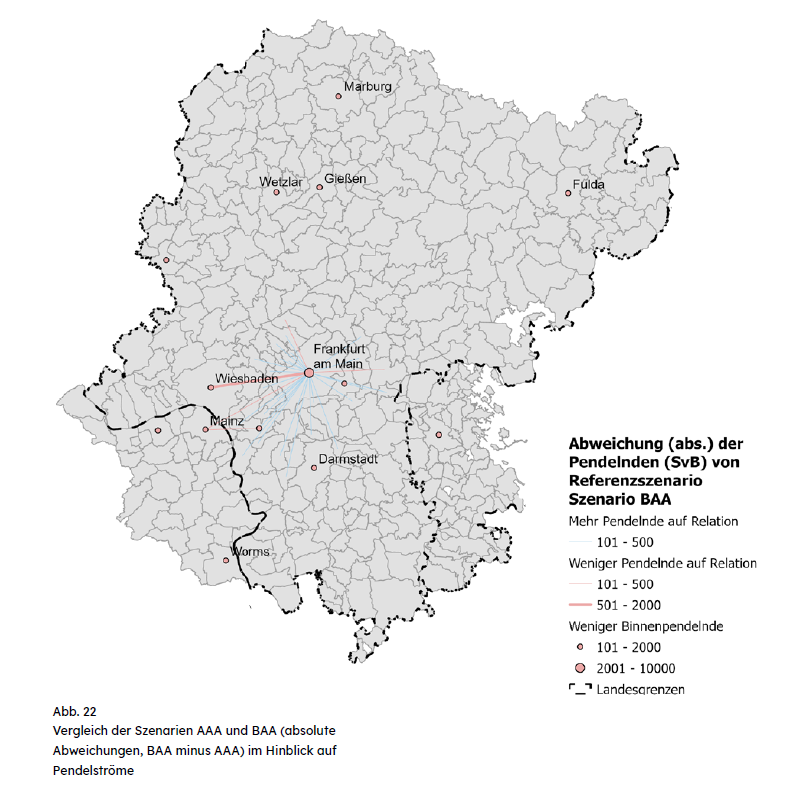
Changes in commuting flows give municipalities and regions the opportunity to plan transport measures in a more targeted way. The corridor between Wiesbaden and Frankfurt shows significantly fewer commuters when more people live outside the cities. Instead, commuting flows become more widely distributed and extend over longer distances.
The Mobility Transition Influences the Housing Market
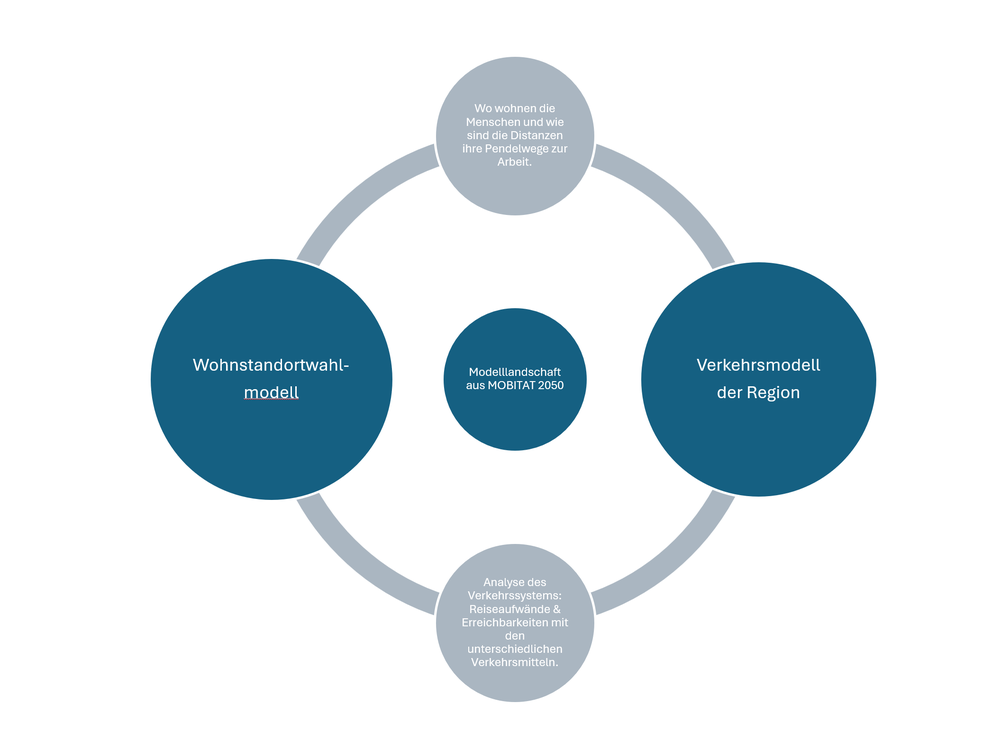
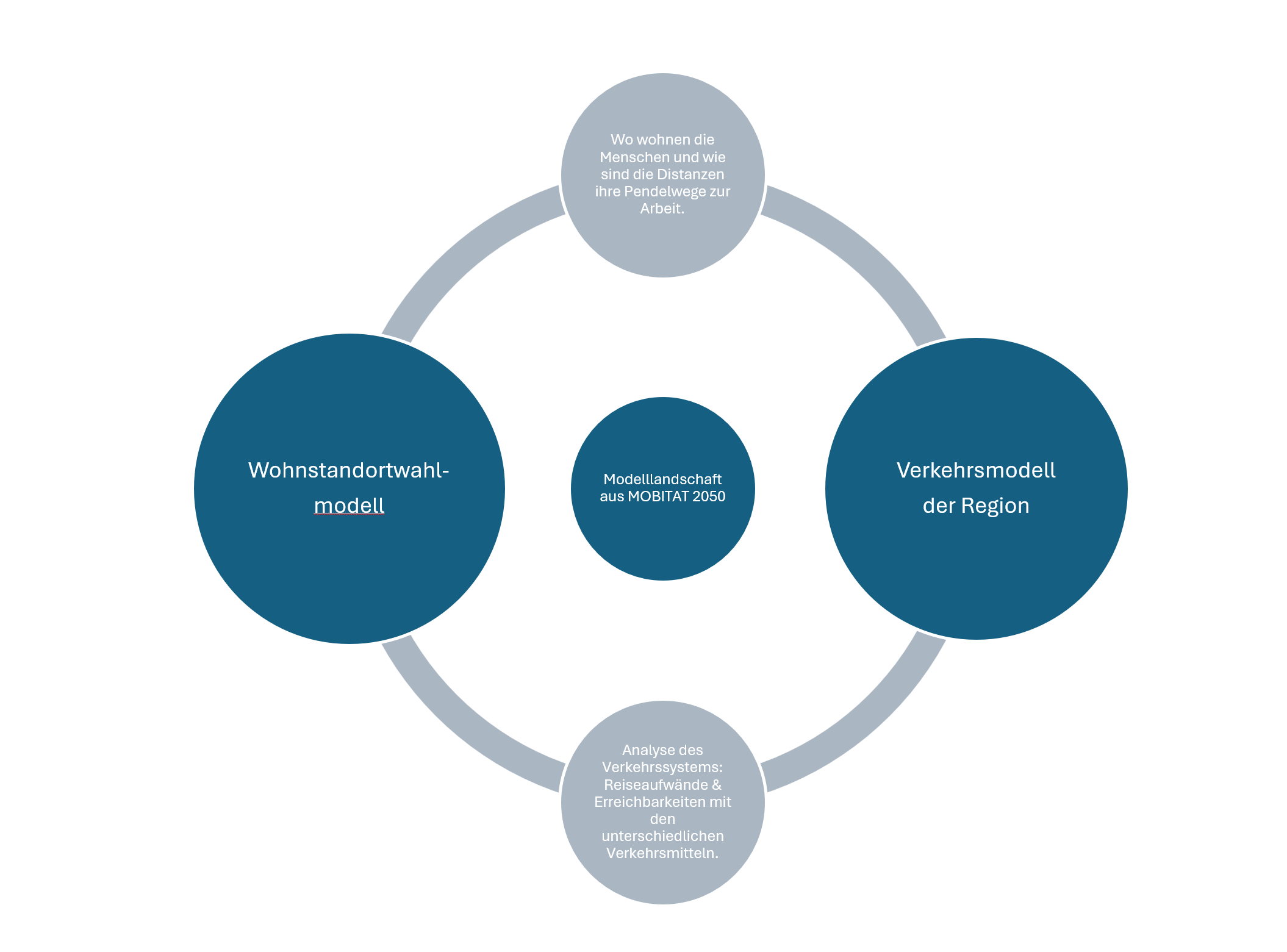
Evaluating the effectiveness of different transport planning measures is an important part of the research. Within MOBITAT, the project team combined residential and workplace locations and their connections to the transport system into a modeling framework. Together, the models can now forecast how the population in the region will develop, distribute it across households and municipalities, and simulate the effects that different measures may have on transport, housing, and employment.
Blueprint for Municipalities and Regions
The methods developed by the researchers to address the question “Where do we live, work, and commute?” can also be applied in other regions. The new modeling approach for residential location choice can be combined with other regional transport models via a newly developed interface.
The results from various future scenarios clearly show a complex interplay between three factors: settlement development, the expansion of home office work, and the overall development of transport.
For example, examining settlement development shows that shifting construction activity to peripheral areas contributes little overall to making commuting more sustainable. Instead, moving to rural areas tends to lead to longer commuting distances. At the same time, the living space per person increases, as people are more likely to live in houses or larger apartments. As a result, the car remains the preferred mode of transport for commuters unless additional transport measures are introduced. This remains the case even if the total number of trips decreases due to increased home office work. In addition, housing prices in areas surrounding major cities would rise. However, the already strained housing and price situation in metropolitan centers would not be alleviated,l housing would simply become more expensive overall.
If, instead of residential construction in the surrounding zones of large cities, housing supply were increased within the cities themselves, commuting distances would decrease. Combined with restrictive “push” measures, such as congestion charges, neighborhood road closures, or 30 km/h speed limits in urban areas, motorized individual transport could be significantly reduced. This would lower environmental impacts and decrease living space per capita. However, such developments would further exacerbate the already tense housing price situation, as illustrated in the Frankfurt example. Peripheral areas would also lose attractiveness as residential locations. As a result, social inequality between cities and surrounding municipalities could intensify, potentially leading to displacement effects for lower-income groups. A widespread introduction of mobile working could slightly mitigate this development, but not stop it.
It becomes clear that sustainable mobility planning extends beyond purely transport-related measures. Climate-friendly transport planning requires balancing complex demands from multiple sectors. Depending on how the necessary mobility transition is implemented, it may have significant impacts on housing. The good news is that numerous measures exist, which the MOBITAT 2050 research team has compiled and evaluated as sustainability-oriented policy packages.
Sustainable Commuting Mobility: Opportunities Through Tailored Solutions
The sustainability assessment of commuting mobility developed in MOBITAT 2050 provides municipalities and regions with an evaluation framework to review and adapt their plans and strategies according to four guiding principles and goals of sustainability:
Environment & resources
Just society
Quality of life
Sustainable economic activity
This approach considers not only ecological aspects but also social and economic dimensions. Within the sustainability assessment, there are both similarities and opposing dynamics among municipalities of different sizes and spatial contexts. There are no clear “winners” or “losers” in the regional sustainability comparison. Urban and rural areas alike, as well as large cities and small or medium-sized towns, perform better in some areas and worse in others.
Therefore, measures must be tailored individually depending on which objectives are particularly important for municipalities or regions. It is crucial to think about restructuring transport beyond transport measures alone. Thanks to the model-based approach, it is now possible to test region-specific, tailored solutions for the sustainable transformation of commuting mobility.