Mission Martian Moons eXploration (MMX)
MMX
The Martian Moons eXploration (MMX) mission, led by the Japanese space agency JAXA, aims to investigate the origin and evolution of the Martian moons Phobos and Deimos and to return samples of Phobos’ surface back to Earth. DLR is contributing a radiometer and a Raman spectrometer to the Idefix rover.
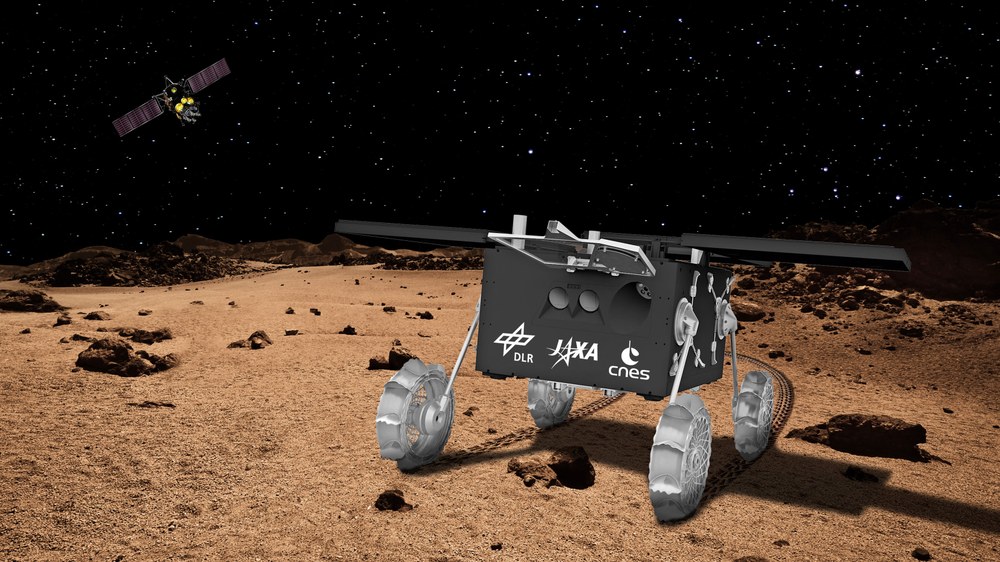
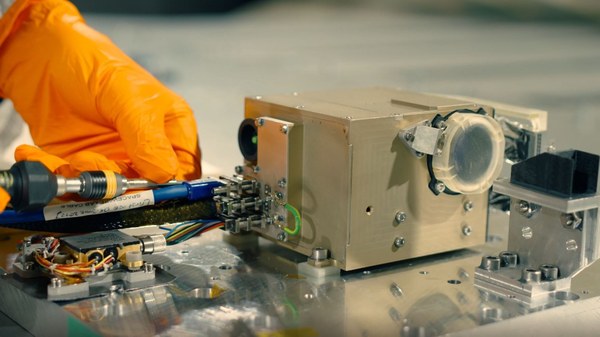
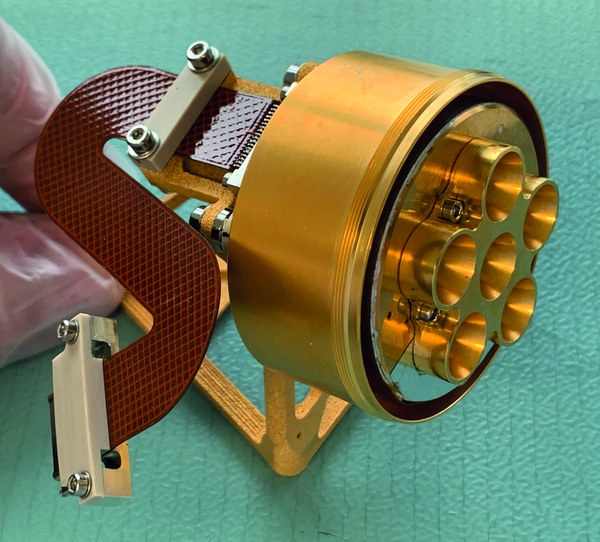
To be launched in October 2026 and inserted into Martian orbit in 2027, the Martian Moons eXploration mission (MMX) is a JAXA mission to Phobos and Deimos investigating the origin of the two Martian moons. While surface spectra indicate an origin from captured asteroids, the moons’ orbits favour formation scenarios involving the ejecta from a major impact early in Martian history. MMX will characterise the surfaces and subsurfaces of Phobos and Deimos in great detail using the MMX orbiter and lander with samples to be collected from Phobos in 2029 and returned to Earth in 2031. For in situ investigations the Centre National d’Etudes Spatiales (CNES) and the German Aerospace Centre (DLR) contribute a small rover, named Idefix, utilising a six-channel radiometer (miniRAD), a Raman spectrometer (RAX), stereo navigation cameras (NavCam), as well as two cameras imaging the wheel-surface interactions (WheelCam). The solar powered MMX rover will be delivered to the surface of Phobos from an altitude of less than 100 metres and will operate for three months. It will traverse several metres to hundreds of metres collecting data from multiple sites. The Rover delivery and operations are planned for 2027-2028.
The MMX rover Idefix will investigate questions relating to the mineralogical composition of the regolith and its thermophysical properties. In addition, high-resolution cameras will examine the regolith dynamics, mechanical properties, surface strength, cohesion, grain size distribution, and porosity. The scientific objectives of the rover thus complement those of the main probe, and the data from the in-situ investigation will serve as baseline data for the orbiter instruments. In addition, the rover data will provide context for the samples brought back to Earth. The DLR Institute of Planetary Research is involved in all aspects of the mission's data analysis, including preparatory studies on regolith properties and laboratory work to prepare for data analysis.
The collaboration between JAXA, DLR, and CNES will be further strengthened when an aliquot of the total mass of the samples collected by the MMX mission will be transferred to Europe. ESA will be coordinating a joint curation effort between the national agencies of Germany and France.
In preparation for this major effort, the DLR Institute of Space Research is working on the setup of a new analytical and curation facility in Berlin, between the German Aerospace Centre (DLR) and the Museum für Naturkunde (MfN). Within the analytical facility it will be possible to carry out the basic characterisation of the samples in controlled environmental conditions as preparation for more specialised facilities for more in depth examination. The curatorial expertise is being developed on the existing expertise from the Meteorite Collection based at the MfN and in collaboration with the JAXA curation facilities. Current curators, together with the younger generation are being trained and working on skillset exchange
Participating Facilities and Institutes