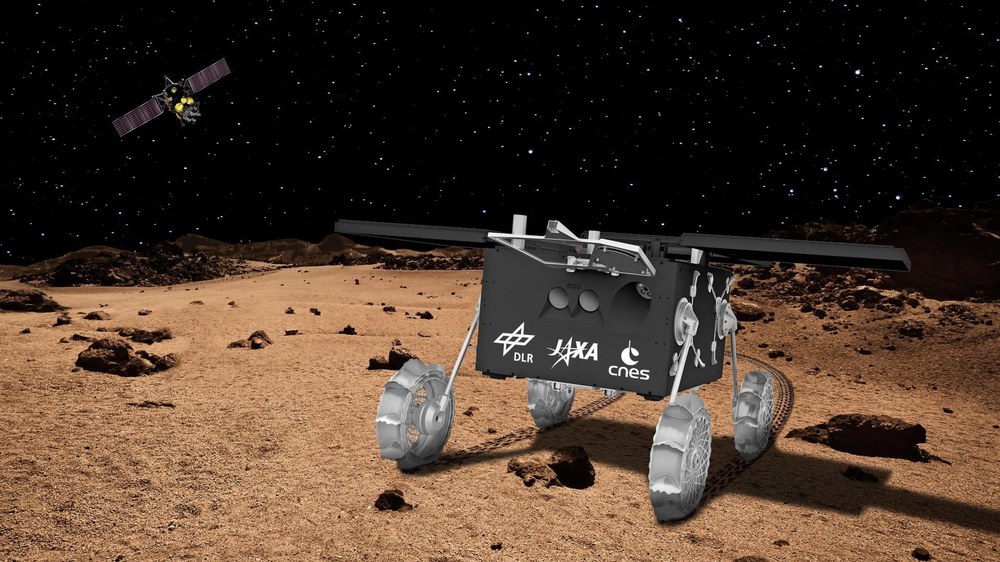
The two moons of Mars, Phobos and Deimos, are the target of the Japanese Martian Moons eXploration mission, or MMX for short. The German Aerospace Center (Deutsches Zentrum für Luft- und Raumfahrt; DLR) and the French space agency CNES (Centre national d'études spatiales) are contributing the Idefix® rover, which will spend several weeks exploring the surface of Phobos.
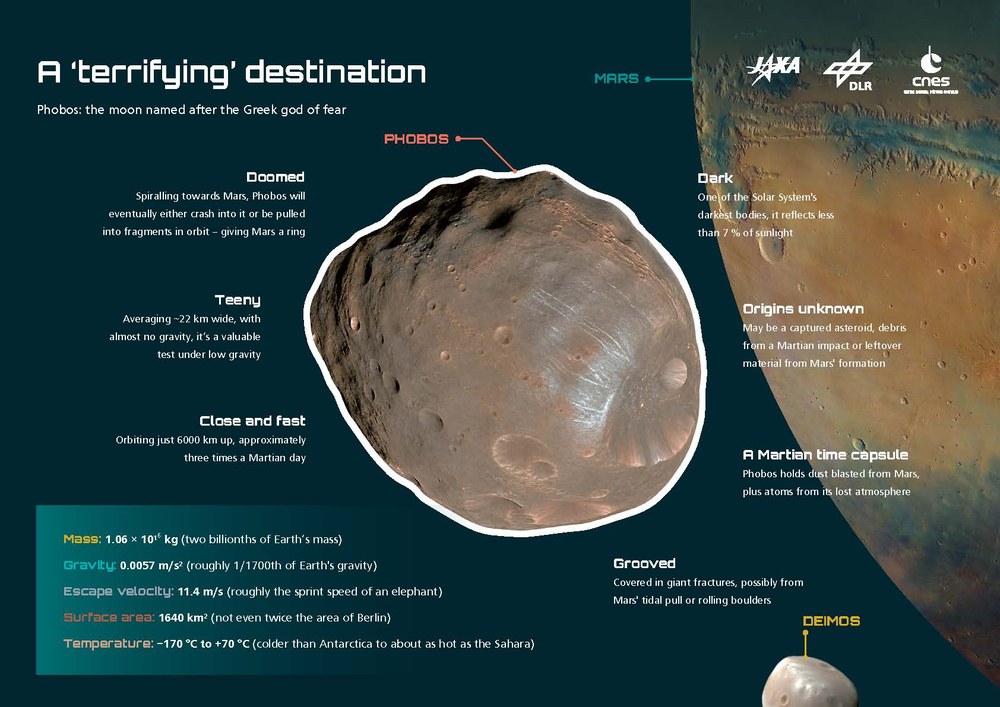
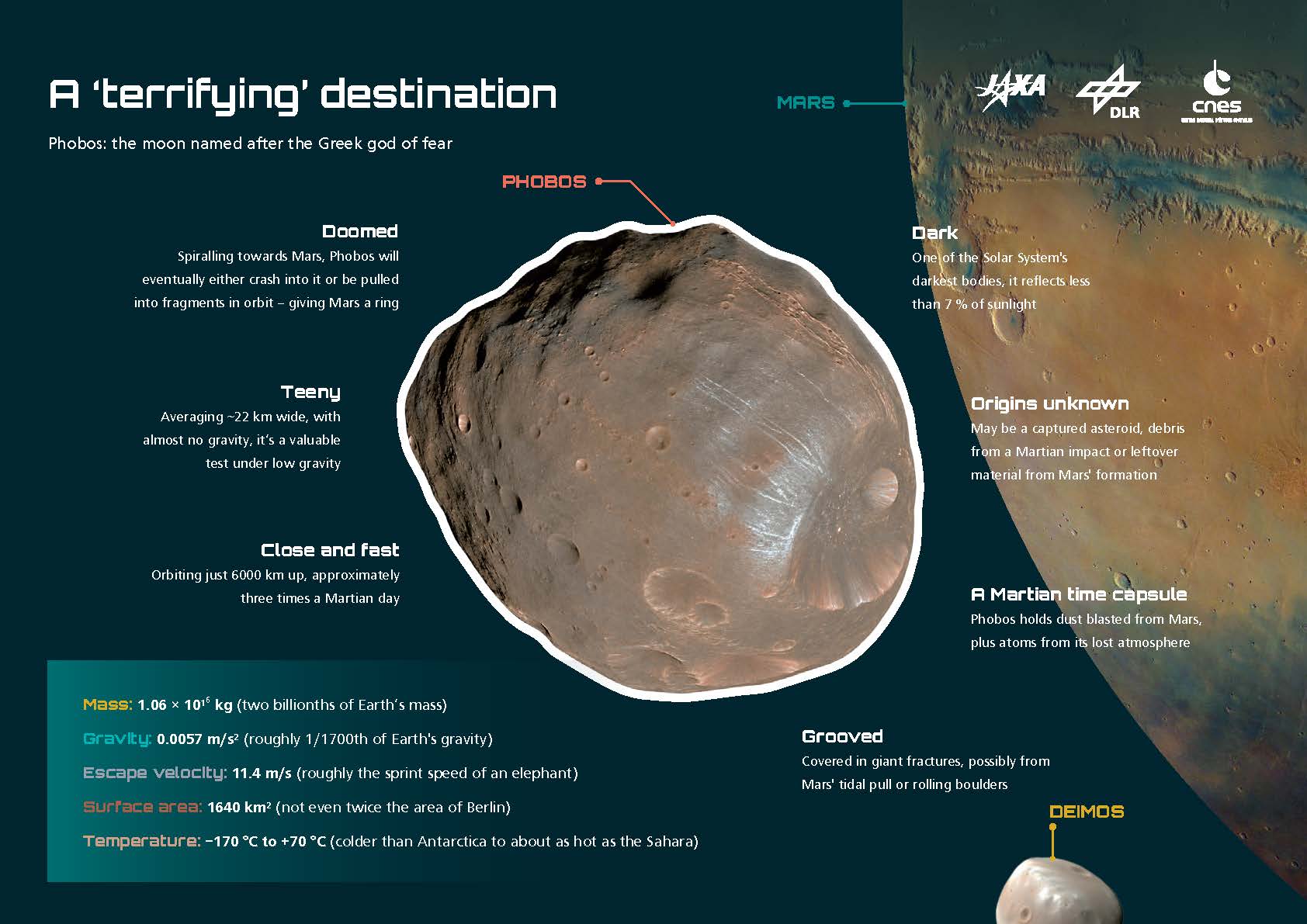
How did the moons form and what are they made of? This is the mystery that the international team of scientists aims to solve. Several US missions and the European missions Mars Express and ExoMars Trace Gas Orbiter have already provided data and images from Mars orbit that have helped researchers observe the moons. However, no mission has yet successfully landed on Phobos or Deimos, and little is known about their geological, mineralogical and geochemical properties.
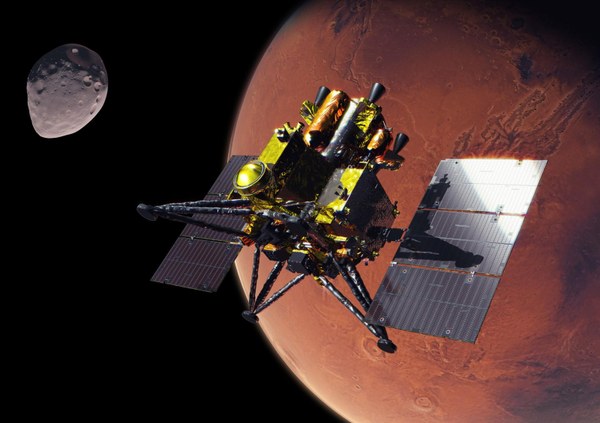
The Japanese space agency JAXA's MMX space probe aims to change this. It will study the Martian moons in detail from orbit and collect material samples from Phobos for the first time during a landing manoeuvre. Several grams of rock and regolith will be brought to Earth at the end of the mission for scientific analysis. MMX will also carry the Idefix® rover from DLR and CNES (Centre national d’études spatiales) and set it down on Phobos. The findings should help to better understand the formation of the Martian moons and the planets in the Solar System. The mission launched from Tanegashima Space Center on 19 October 2026.
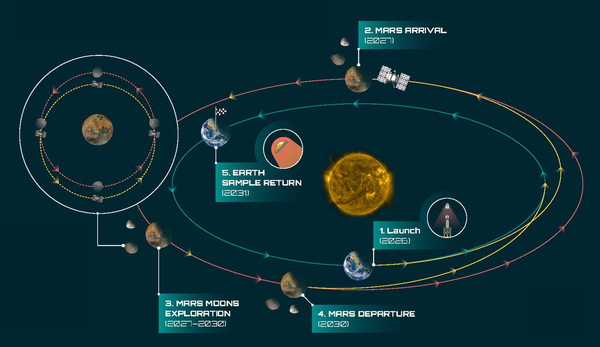
How did Mars' moons Phobos and Deimos form? The Martian Moons eXploration (MMX) mission aims to answer this very question. Developed by the Japanese space agency JAXA, the spacecraft will explore Phobos from orbit and collect samples from its surface. On board MMX is the Idefix® rover – a collaboration between DLR and the French space agency CNES. Idefix® will land on Phobos, analyse its surface properties and help select a suitable landing site for the MMX mothership. The MMX mission is scheduled to launch from Japan's Tanegashima Space Center in 2026. This animation shows the planned mission timeline – from the journey to Mars and its moons, the exploration of Phobos from orbit and on the surface with the Idefix® rover, to the sample collection by the mothership and its return to Earth.
Animation: MMX mission – The journey to the Martian moon Phobos
Your consent to the storage of data ('cookies') is required for the playback of this video on Youtube.com. You can view and change your current data storage settings at any time under privacy.
Animation: MMX mission – The journey to the Martian moon Phobos
How did Mars' moons Phobos and Deimos form? The Martian Moons eXploration (MMX) mission aims to answer this very question. Developed by the Japanese space agency JAXA, the spacecraft will explore Phobos from orbit and collect samples from its surface. On board MMX is the Idefix® rover – a collaboration between DLR and the French space agency CNES. Idefix® will land on Phobos, analyse its surface properties and help select a suitable landing site for the MMX mothership. The MMX mission is scheduled to launch from Japan's Tanegashima Space Center in 2026. This animation shows the planned mission timeline – from the journey to Mars and its moons, the exploration of Phobos from orbit and on the surface with the Idefix® rover, to the sample collection by the mothership and its return to Earth.
Europe's contribution to the mission – the MMX rover Idefix®
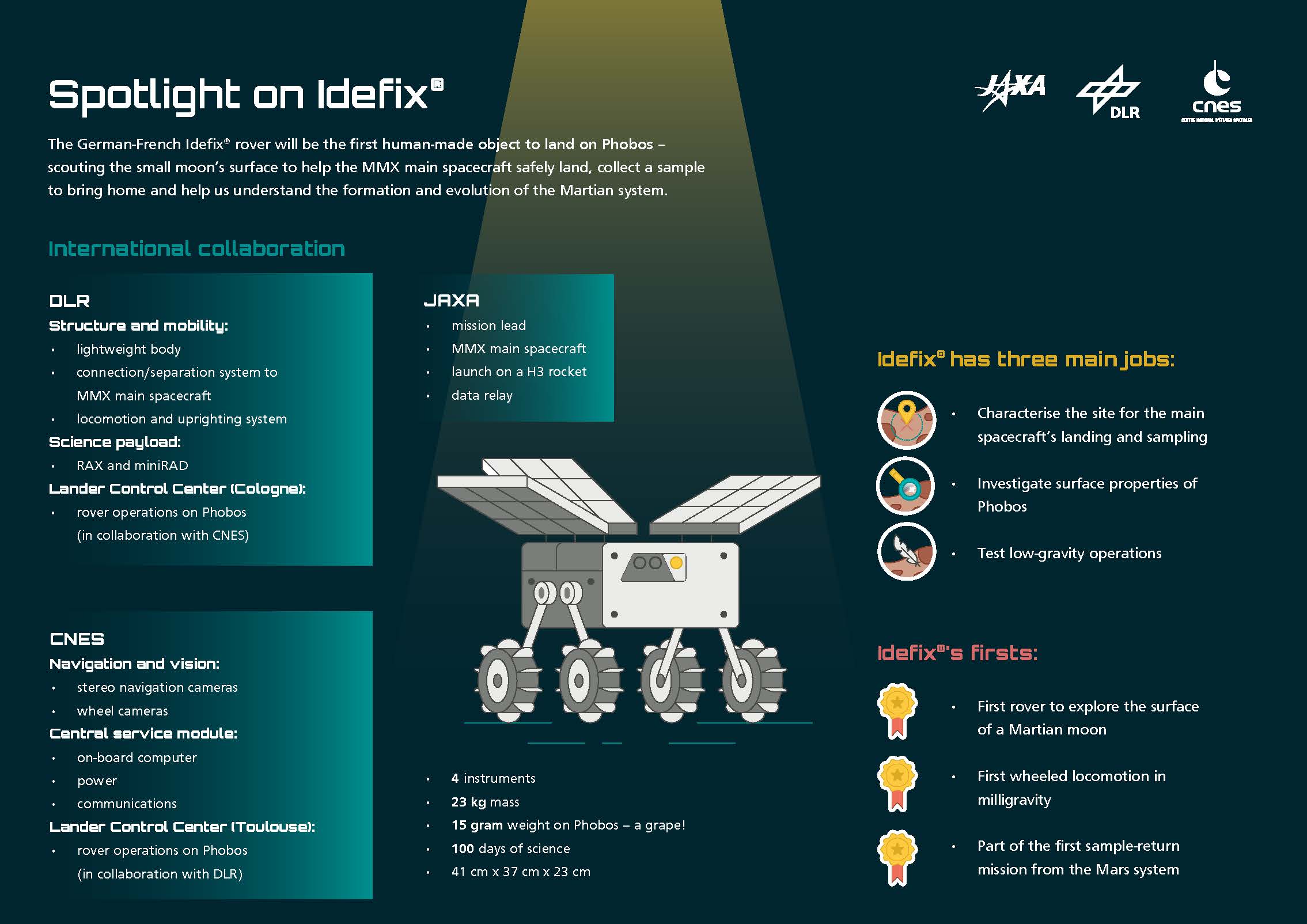
The MMX rover will fulfil two main tasks on Phobos: it will provide important findings in preparation for the main spacecraft's landing, and it will analyse the surface composition and texture at selected locations.
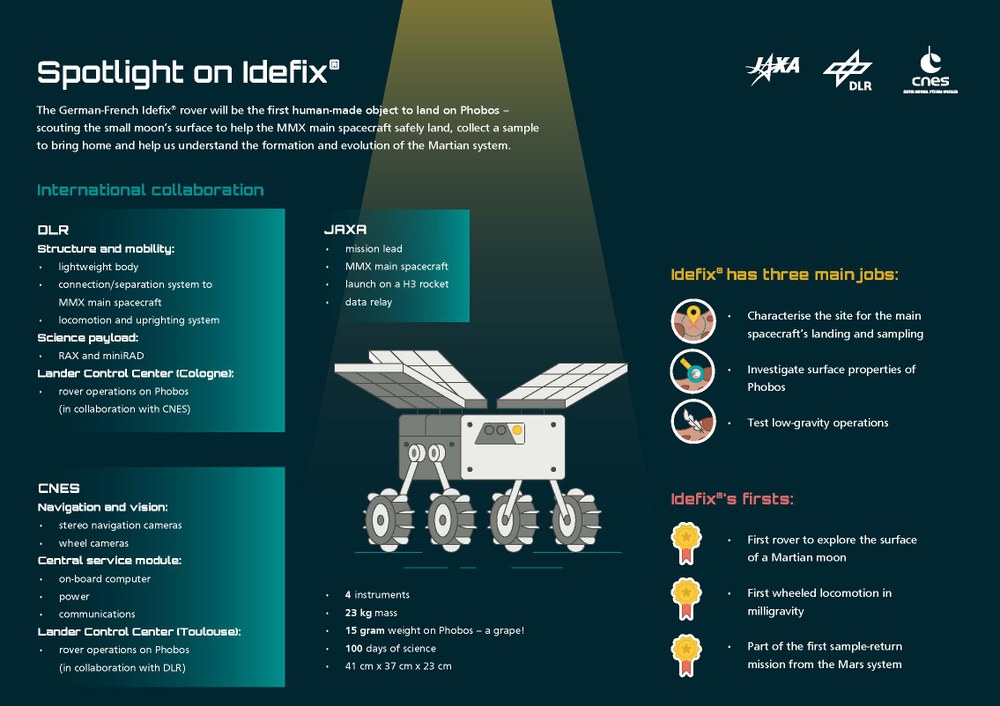
DLR and CNES worked closely together on the design and construction of the rover. Six DLR institutes and facilities from five sites have contributed to the rover: the Institute of Robotics and Mechatronics is responsible for the overall project management and – together with the Institute of Space Systems – for systems engineering. The Institute of Robotics and Mechatronics also developed a navigation pipeline to steer the rover autonomously across the surface of Phobos. Together with the former Institute of System Dynamics and Control, which has since been integrated into it, the Institute of Robotics and Mechatronics was responsible for the uprighting and locomotion system of the 25-kilogram rover. The Institute of Software Technology supported the development of the navigation and locomotion system software.
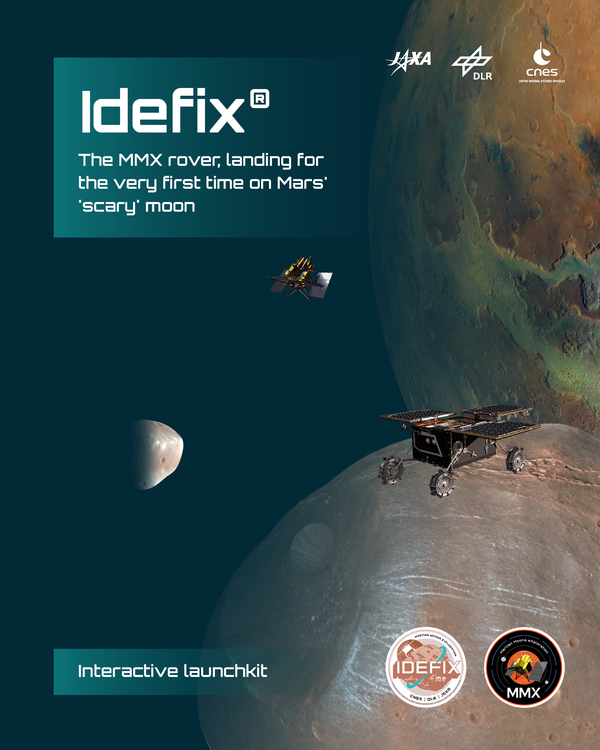
The Idefix® rover will land on and move across the Martian moon Phobos as part of the Martian Moons eXploration (MMX) mission – exploring it despite its extremely low gravity. The Japanese MMX mission targets both moons of Mars, Phobos and Deimos. The MMX probe will explore both moons and eventually collect samples from Phobos and return them to Earth.
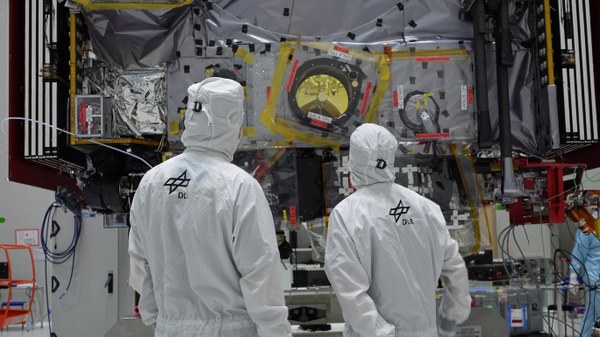
Testing, assembly and preparation of the German-French rover Idefix® for the MMX mission
Your consent to the storage of data ('cookies') is required for the playback of this video on Quickchannel.com. You can view and change your current data storage settings at any time under privacy.
Testing, assembly and preparation of the German-French rover Idefix® for the MMX mission
The Idefix® rover will land on and move across the Martian moon Phobos as part of the Martian Moons eXploration (MMX) mission – exploring it despite its extremely low gravity. The Japanese MMX mission targets both moons of Mars, Phobos and Deimos. The MMX probe will explore both moons and eventually collect samples from Phobos and return them to Earth.
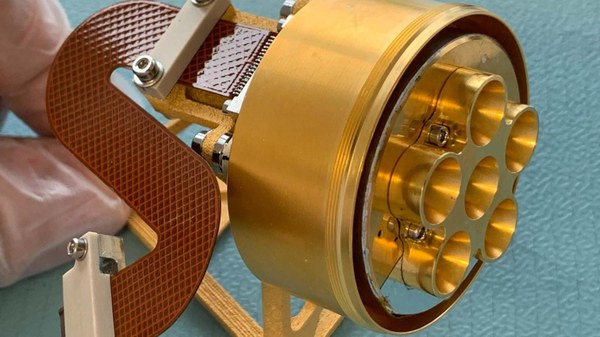
The carbon-fibre-reinforced structure was developed under the direction of the Institute of Lightweight Systems. The former Institute of System Dynamics and Control also conducted extensive simulations of the surface conditions on Phobos and of the safe locomotion of the rover. DLR's part of the rover was integrated and tested under realistic conditions at the Institute of Space Systems in Bremen. The Institute of Space Research – merged from the Institute of Planetary Research and the Institute of Optical Sensor Systems – contributed the miniRAD radiometer and the RAX Raman spectrometer. The Microgravity User Support Center (MUSC) in Cologne, together with the Université Côte d'Azur in France, is the scientific lead for the rover and is responsible for payload management.
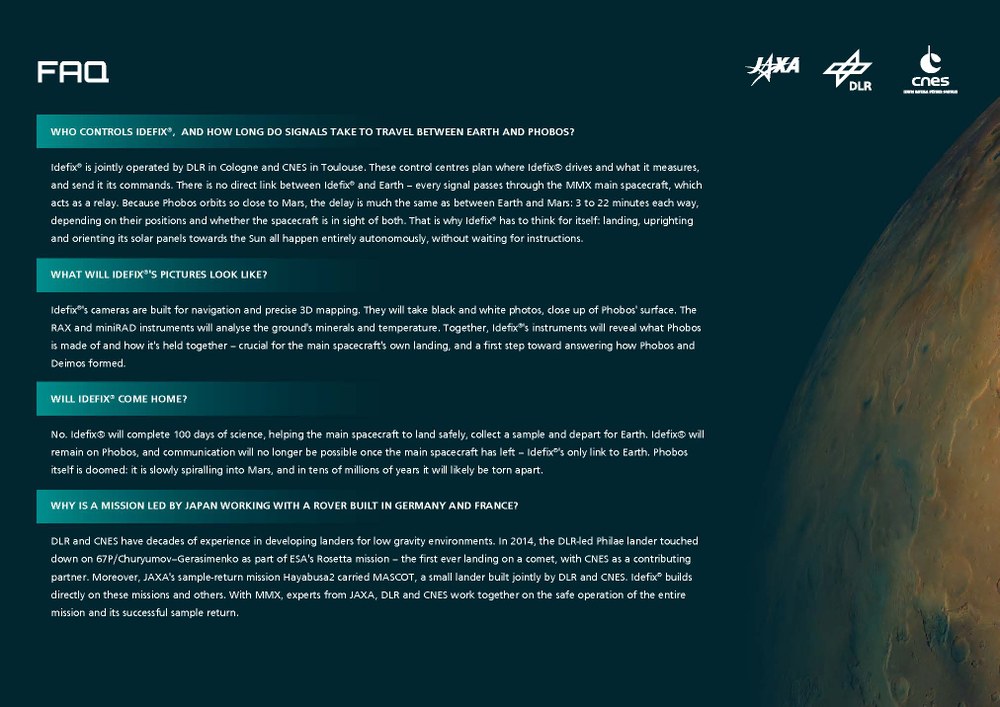
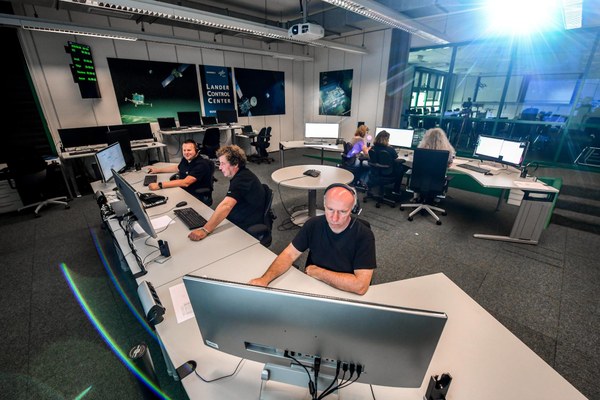
CNES has made significant contributions with camera systems for spatial orientation and surface exploration as well as for the investigation of mechanical ground properties. CNES also developed the rover's central service module, including the on-board computer and the power and communication system. Final integration and testing of the rover took place at CNES in Toulouse. After the launch of the MMX mission, the Idefix® rover will be operated from control centres at DLR's MUSC in Cologne and CNES in Toulouse, France.
MMX launched from Tanegashima Space Center on 19 October 2026 on board an H3 Launch Vehicle. After approximately one year of flight, MMX will reach Mars and enter its orbit. The eight scientific instruments on the exploration module will then begin mapping and characterising the surfaces of Phobos and Deimos.
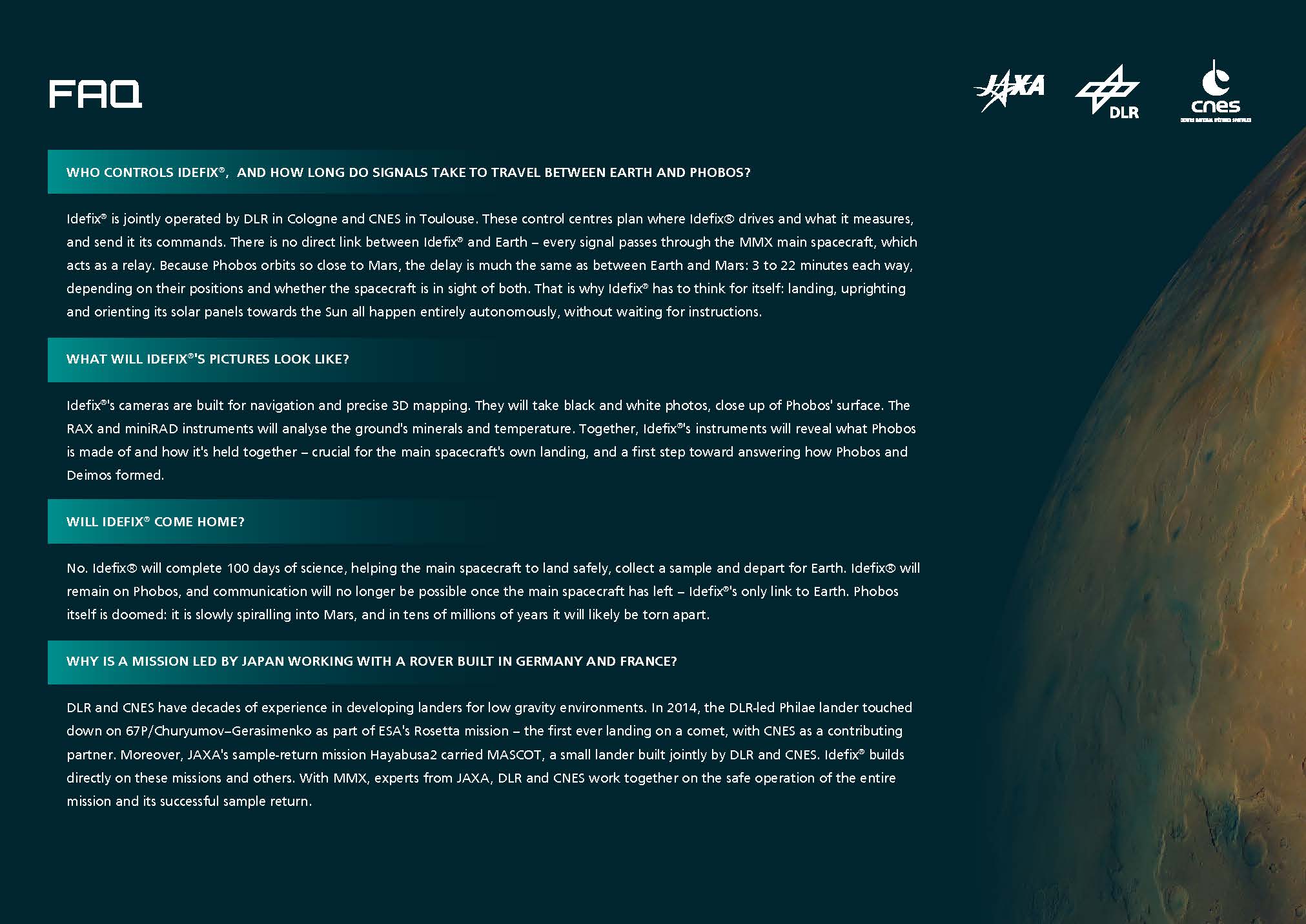
The rover is expected to land on Phobos in 2029. The orbiter will release it from a height of 40 to 100 metres above the surface. After landing – and presumably a few small bounces – the rover will right itself and be ready for operation. The measurement phase will then begin. Over approximately three months, the rover will approach various targets of scientific interest.
At the end of the mission, the orbiter/exploration module will collect soil samples, taking into account the knowledge gained by the rover. The return module will bring them back to Earth in 2031 for analysis in terrestrial laboratories. JAXA is ideally suited for such a demanding task: in 2020, the Hayabusa2 mission succeeded in bringing material from the asteroid Ryugu back to Earth. DLR and CNES were also involved in Hayabusa2, contributing the MASCOT lander.
From Hayabusa2 to MMX – international collaboration
MMX sees JAXA, CNES and DLR continue their successful collaboration in the exploration of small celestial bodies. Back in 2018, the German-French lander MASCOT touched down on the asteroid Ryugu as part of the Japanese Hayabusa2 mission. The probe returned samples from the asteroid to Earth in 2020. Idefix® builds on this experience and adds a new capability – the mobile exploration of a surface in extremely low gravity.
About the MMX mission and the Idefix® rover
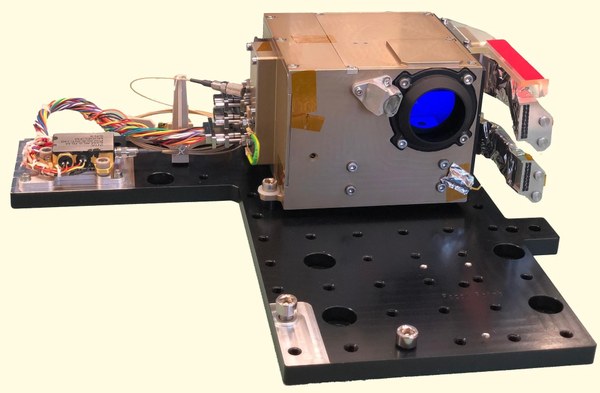
MMX is a mission from the Japan Aerospace Exploration Agency (JAXA), with contributions from NASA, the European Space Agency (ESA), the French space agency CNES and the German Aerospace Center (DLR). CNES and DLR are jointly contributing a 25-kilogram rover. The German-French MMX rover was designed and built under the joint leadership of both organisations. DLR was responsible in particular for developing the rover's running gear, including its carbon-fibre structure, and the uprighting and locomotion system. DLR also contributed the system that connects the rover to the mothercraft and separates it, as well as two scientific instruments: a Raman spectrometer and a radiometer. These will measure the composition, temperature and surface properties of Phobos.
CNES has made significant contributions with camera systems for spatial orientation and exploration on the surface, as well as for investigating the mechanical properties of the ground. CNES also developed the rover's central service module, including the on-board computer and the power and communications systems. Following the launch of the MMX mission, the rover will be operated from control centres at CNES in Toulouse, France, and at DLR in Cologne.
On the DLR side, the Institute of Lightweight Systems, the Institute of Space Systems, the Institute of Space Research, the Institute of Software Technology and the Microgravity User Support Center (MUSC) at DLR's Space Operations and Astronaut Training facility are involved, under the leadership of the Institute of Robotics and Mechatronics.