
MONA


Powerful Concept for Aeroelastic Assessment of Aircraft Configurations
MONA is an effective and reliable tool for developers, researchers, and engineers who need to make well-informed, rapid, and safe decisions during the early stages of developing new aircraft configurations. This is particularly important for innovative or unconventional aircraft designs.
MONA
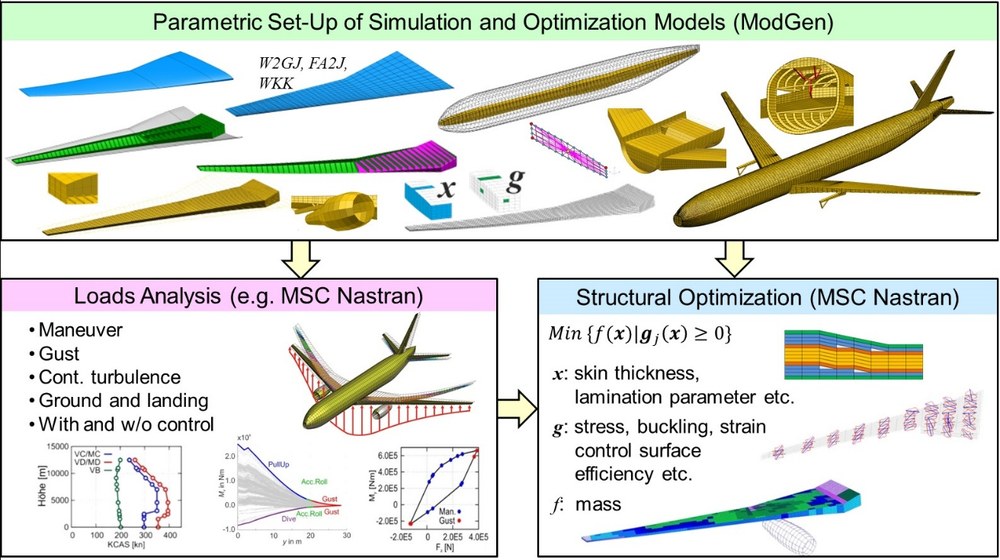
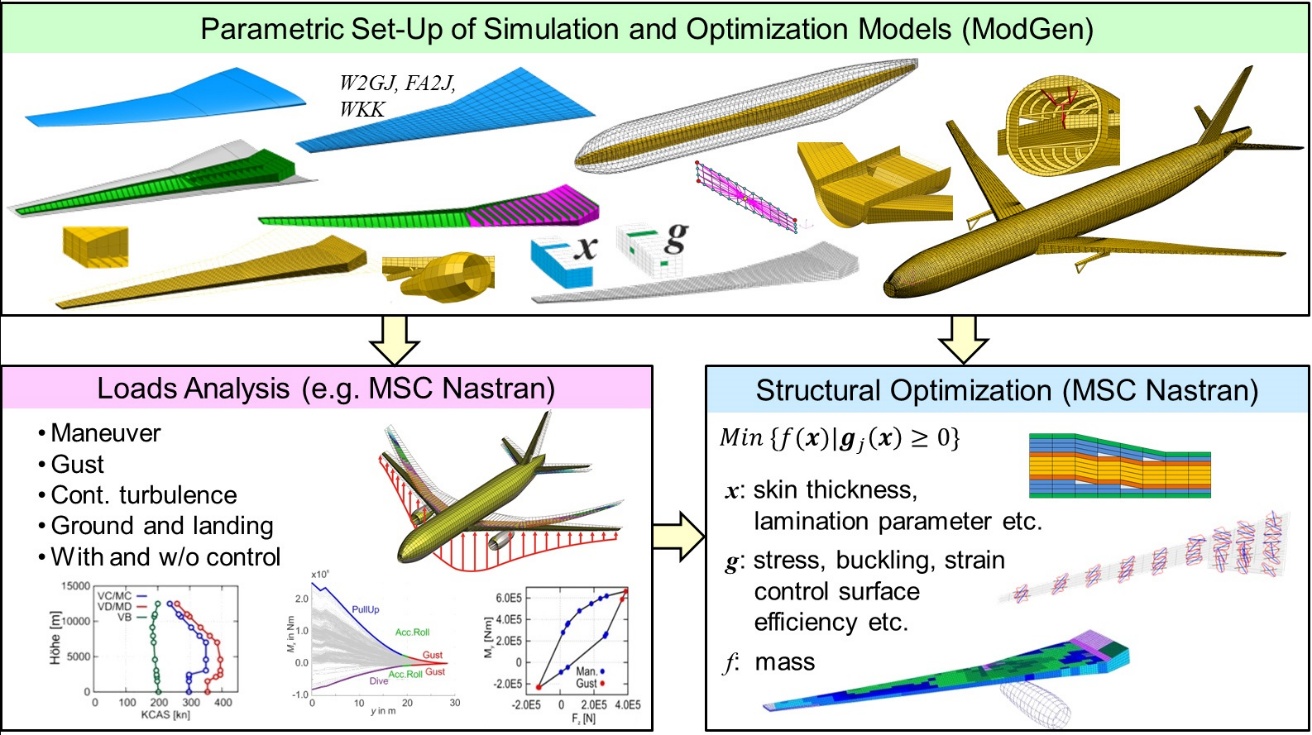
MONA is a design concept for the aeroelastic evaluation of aircraft configurations. It combines the parametric model generator ModGen with the Finite-Element-Analysis software MSC Nastran to create and evaluate design-oriented global finite element models (GFEMs) of aircraft. MONA enables physics-based load analysis and the evaluation of the structure regarding the resulting mass, taking into account the applied stresses/strains as well as the resulting deformations during cruise flight. In addition, MONA allows for the investigation of aeroelastic properties, including control surface effectiveness and stability predictions for the overall aircraft configuration. This enables the early, safe, and efficient design of complex aircraft structures – particularly for innovative concepts such as configurations with extremely slender and elongated wings or unconventional (hybrid) electric aircraft with distributed propulsion systems, where traditional empirical design approaches reach their limits.
Key Features
The MONA design concept is based on an integrated approach for the physics-based aeroelastic evaluation of aircraft configurations. It combines the parametric model generator ModGen with the commercial Finite-Element-Analysis software MSC Nastran. This process automatically generates global Finite-ElementModels (GFEMs) of aircraft structures, performs a comprehensive load analysis on the entire aircraft, and dimensions and evaluates the structure.
On this basis, precise conclusions can be drawn regarding:
- Component loads under various flight and operating conditions (e.g., due to maneuvers, turbulence, and landings),
- structural masses, stiffness distributions, and structural dynamic properties of structures and components,
- deformations of the wing for different flight points as well as loading and refueling conditions,
- aeroelastic evaluation of flutter limits or the efficiency of control surfaces.
With MONA, the structural design is no longer based on simplifications or empirical values, but rather on physics-based simulations and mathematical optimization methods. That is made possible by the combination of ModGen and MSC Nastran. The results are directly incorporated into component-by-component structural optimization, whereby stress, strain, buckling, or fatigue constraints of the components can be taken into account.
cpacs-MONA – the automated design process
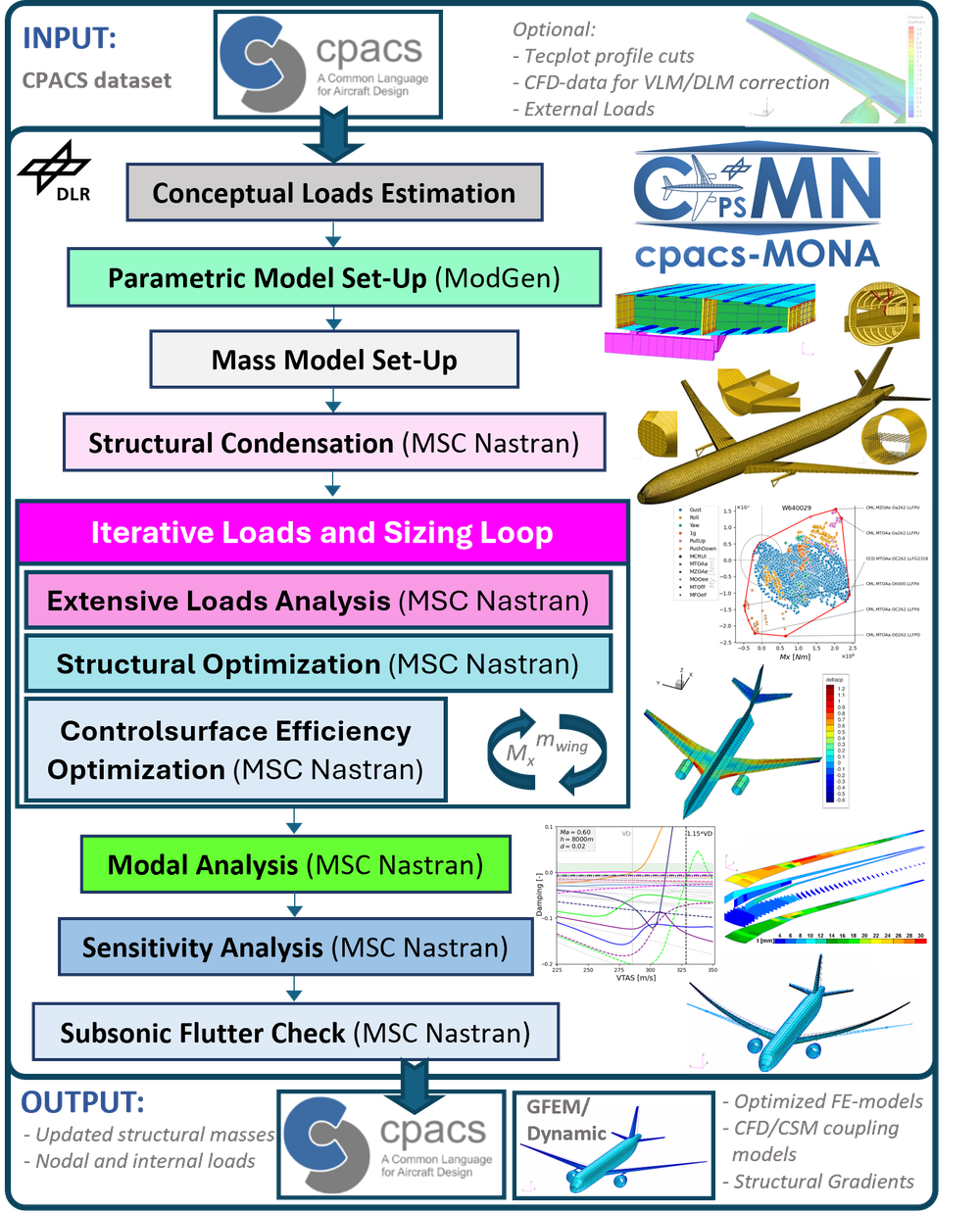
The closelay integration of CPACS (Common Parametric Aircraft Configuration Schema), ModGen, and MSC Nastran makes MONA a powerful tool: cpacs-MONA. Based on CPACS data-sets, it automatically generates aircraft structures (GFEM), analyzes their loads, and optimizes the structure. The integration of ModGen into the cpacs-MONA workflow significantly accelerates the creation of realistic, design-accurate structural models in early design phases. ModGen generates parameterized geometries and structures based on CPACS data, which are transferred directly into MSC Nastran. This enables rapid, physics-based simulations of the flexible load-bearing structure – including the dynamic interaction between aerodynamics and structure. cpacs-MONA is a key tool for the safe and efficient design of innovative aircraft concepts.
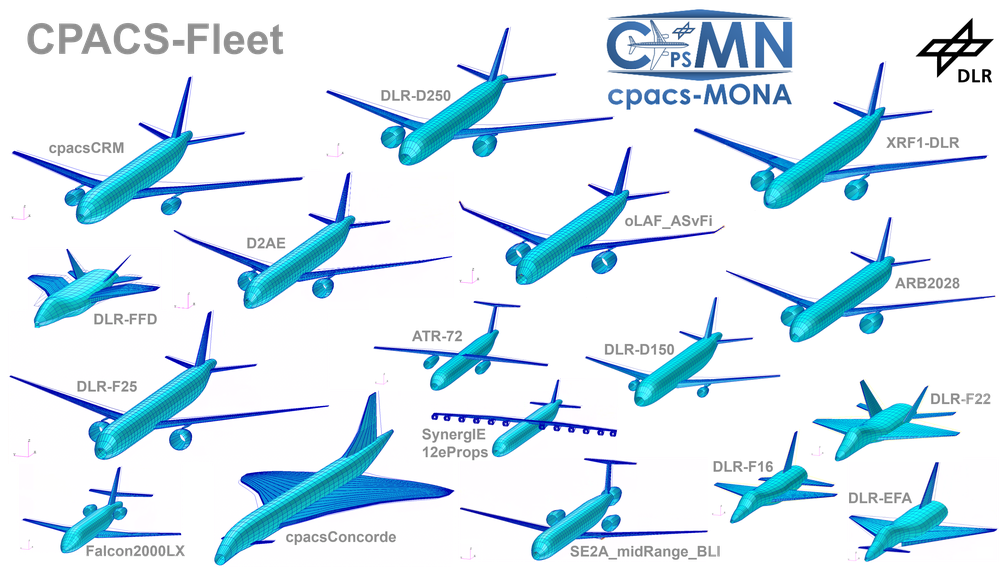
At DLR, as well as in numerous German and European research projects, cpacs-MONA is an established tool for determining loads, for building and sizing GFEM models in multidisciplinary optimization (MDO) workflows, and for the aeroelastic evaluation of a wide variety of aircraft configurations.
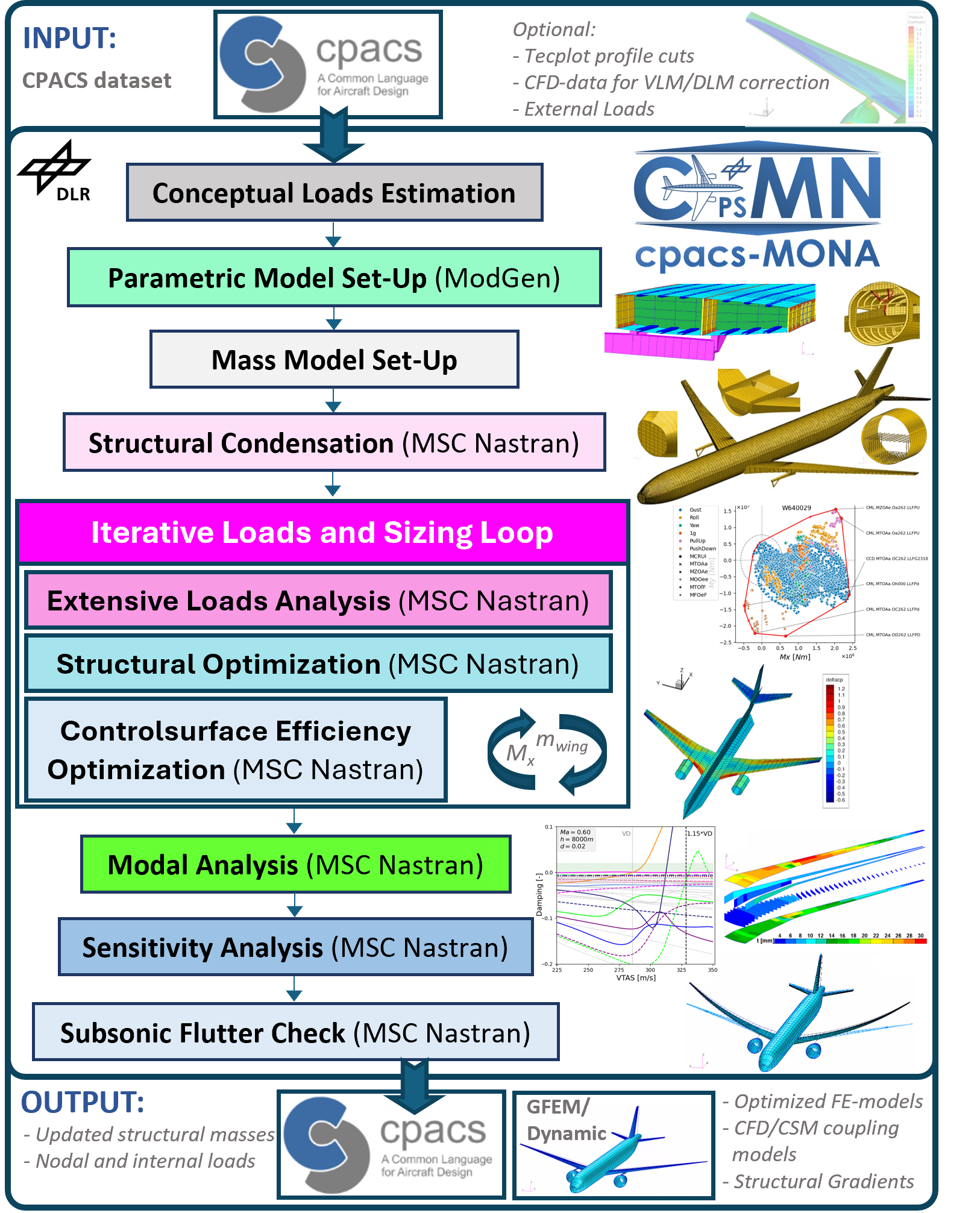
Applications
- A leading aircraft manufacturer wants to develop a new aircraft. Using MONA, the development teams can generate multiple planform variants within hours, perform load analyses, and optimize the structure – and significantly speed up the development process.
- A team at an aerospace company optimizes the aerodynamic performance of its wing for various flight conditions by coupling elastic GFEM models with CFD meshes. This allows them to minimize drag under realistic wing deflections while simultaneously evaluating the impact on structural weight and aeroelastic behavior. In addition, this approach can be used to determine the wing’s jig shape – all of this in a unified and integrated solution.
- A small startup is developing an eVTOL for urban air mobility. With MONA, the developers can determine the relevant loads for multiple configurations, design the structure, and analyze the aeroelastic properties within a few days. Thereby they can comprehensively evaluate the configurations – with the focus on the innovative design.
- A research team is developing a new concept for an electrically powered aircraft. Using MONA, the team tests various materials for the load-bearing structure and different propulsion concepts, analyzes control surface effectiveness, and optimizes mass distribution – all of this as part of a fully automated process.

Animation: cpacs-MONA
Your consent to the storage of data ('cookies') is required for the playback of this video on Quickchannel.com. You can view and change your current data storage settings at any time under privacy.