Passenger Rail - HVAC and Eco-Materials

© DLR/Marek Kruszewski
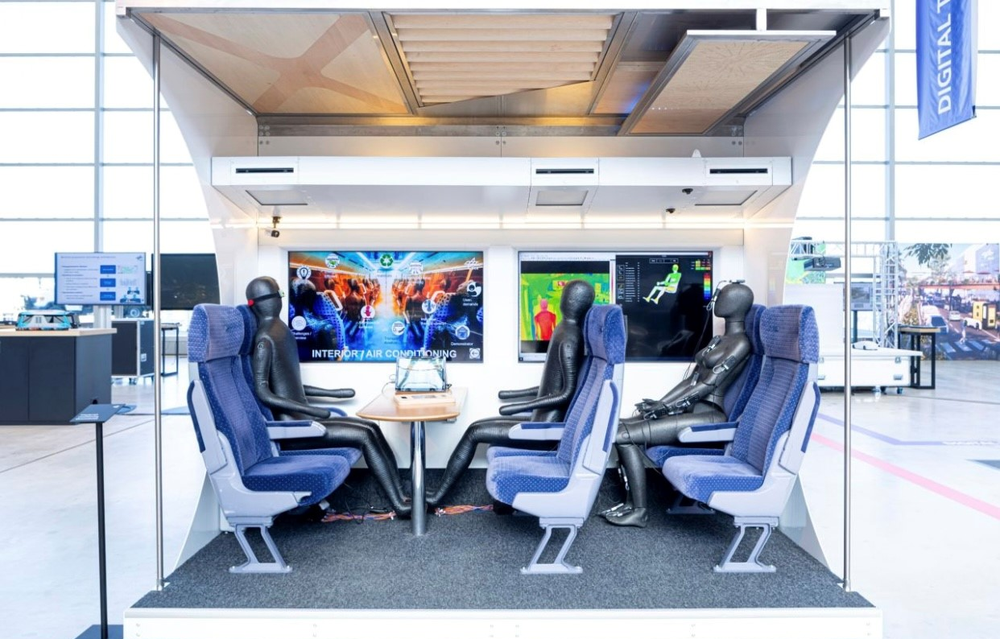
German Aerospace Center (DLR) is conducting research into energy-efficient, comfortable and healthy air-conditioning systems for rail vehicles.
Individual thermal comfort zones, reduced aerosol dispersion, antimicrobial surfaces and functionally integrated structural elements made from renewable raw materials –DLR is working on this with an interdisciplinary team comprising engineers, physicists, psychologists, microbiologists and transport researchers from four institutes.
The combined exhibit showcases expertise in microbiological analysis (e.g. antimicrobial surfaces), psychological assessment (e.g. subject trials on thermal comfort), the design and evaluation of ventilation concepts, e.g. tailored to the individual demand or optimized for the most efficient removal of exhaled aerosols, and functionally integrated construction using eco-efficient, renewable raw materials, e.g. structural elements for wooden ceilings. The exhibition focuses on:
- Healthy rail travel: reduced risk of infection through efficient removal of aerosols and the integration of antimicrobial surfaces
- Increased resilience during heatwaves through easily retrofittable, individual air vents to reduce the perceived temperature
- Personalized thermal comfort: seat heating, infrared panels and air vents controllable via an app
- Eco-efficient construction: use of renewable raw materials and the integration of functions into structural elements
The presented measurement technologies and ventilation concepts were also applied and investigated together with our cooperation partner, Deutsche Bahn Systemtechnik GmbH, in a real-world test environment for the next generation of passenger comfort and climate technologies (called “DIRK”).
DIRK is a decommissioned car of a German long-distance high-speed train, now available as stationary laboratory.
Publications
Futher information
The work presented at the demonstrator is partially performed in the Rail4Earth Project of the Europe’s Rail Joint Undertaking.
Partially funded by the European Union. Views and opinion expressed are however those of the author(s) only and do not necessarily reflect those of the European Union or the Europe’s Rail Joint Undertaking. Neither the European Union nor the granting authority can be held responsible for them. The project FP4-Rail4EARTH is supported by the Europe’s Rail Joint Undertaking and its members.