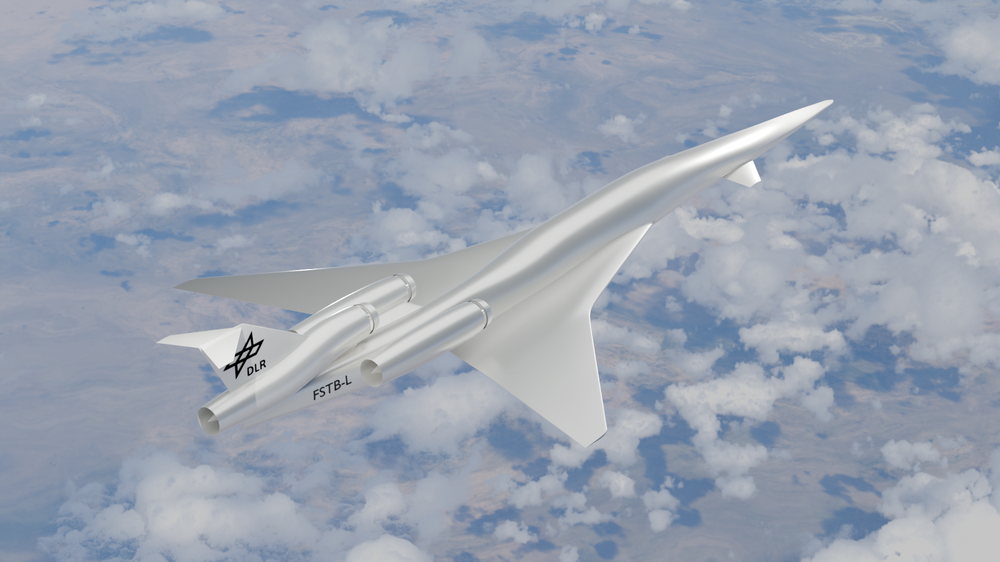
Civil supersonic aviation has the potential to significantly reduce the travel time on many routes through increased cruise speeds. However, there are currently no generally applicable certification regulations for civil supersonic aircraft. Manufacturers therefore have to make key design decisions without confidence that they will meet future international standards. At the same time, certification authorities face the challenge of developing regulatory frameworks for aircraft for which only limited data is currently available.
This creates a strong need among national and European authorities for independent, scientifically based advice on the environmental impacts of civil supersonic aircraft. In the predecessor project STORMIE, an integrated platform for the design and assessment of civil supersonic aircraft configurations was established between 2023 and 2026. The aim was to reliably predict environmental impacts such as
take-off
landing noise emissions
and sonic boom.
Further development of design and assessment methods
In STORMIE-2, we are systematically expanding these design and assessment capabilities. Acting as a “virtual manufacturer” at the interface between industry and authorities, we are further developing and analysing the three configurations designed in the predecessor project using higher-fidelity aerodynamic and flight-mechanical methods. In addition, we investigate design variants to systematically assess sensitivities and uncertainties and quantify their impact on environmental effects.
Furthermore, we analyse:
Fleet and airport scenarios to better understand the impact of supersonic aircraft on the air transport system as a whole.
Flight characteristics and pilot visibility in the AVES flight simulator together with the DLR institutes involved in the project. .
The findings are contributed by the nominated DLR experts to the work of the ICAO Committee on Aviation Environmental Protection (CAEP) to scientifically support the definition of future certification requirements for civil supersonic aircraft.
Our institute leads the project and is responsible for the conceptual design, aerodynamic design and assessment of sonic boom characteristics. The work uses, among others, the institute’s own flow solver TAU as well as the CFD software CODA developed by ONERA, DLR and Airbus. STORMIE-2 opens up a wide range of opportunities for international collaboration. In compliance with export control regulations, we share designed configurations and selected results with interested partners.
Project
STORMIE-2 - Supersonic Transport Open Research Models and Impact on Environment
Term
1/2026 - 12/2028
Project Participants
DLR Institute of Aerodynamics and Flow Technology (Leader)
DLR Institute of Propulsion Technology
DLR Institute of Flight Guidance
DLR Institute of Flight Systems
DLR Institute of Air Transport Systems
DLR Institute of Aerospace Medicine
DLR Institute of System Architectures in Aeronautics