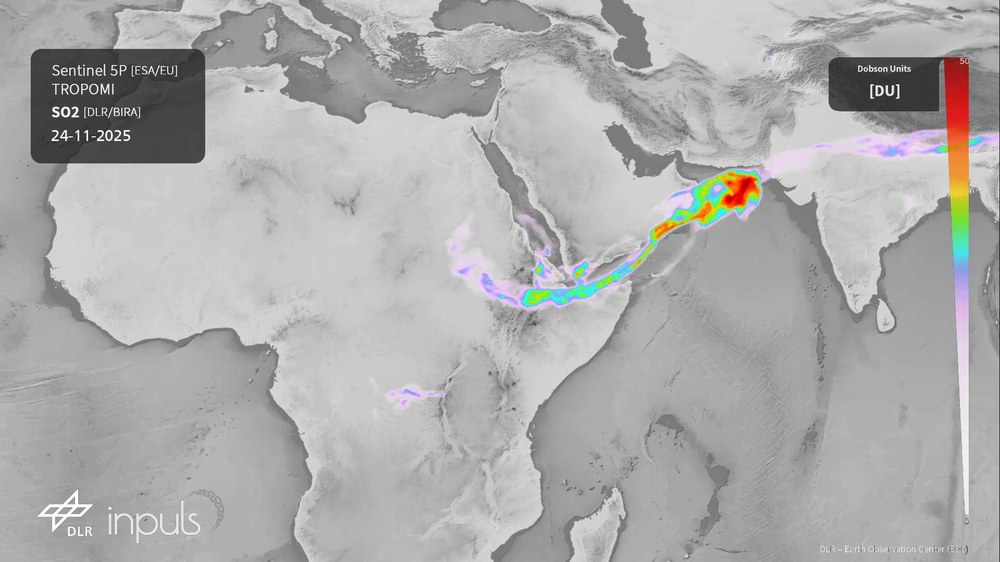
On November 23, 2025, the Hayli Gubbi volcano in Ethiopia erupted unexpectedly – the first known eruption since the end of the last ice age. Data from the INPULS project shows that large quantities of ash, smoke and gases were released into the atmosphere at altitudes of more than 14 kilometers during the eruption. At around 10:15 a.m., the TROPOMI sensor on S5P provided the first measurements of the SO2 cloud over Ethiopia, which have been continuously analyzed ever since. At the time of the measurement on November 23, the amount of SO2 emitted into the atmosphere was already approx. 43 kT. The SO2 cloud covered an area of 53,000 km². In the following days, the amount of SO2 emitted increased to over 160 kT and decreased again in the days that followed due to dispersion as well as chemical and mechanical processes. The SO2 cloud moved eastward after the massive eruption and reached India on November 25. It was still measurable until December 1.
Hayli Gubbi volcanic eruption in Ethiopia
Your consent to the storage of data ('cookies') is required for the playback of this video on Quickchannel.com. You can view and change your current data storage settings at any time under privacy.
Hayli Gubbi is a shield volcano in the northern Afar Basin of Ethiopia, near the Erta Ale volcanic chain, and is located at about 13.51°N, 40.72°E. Geologically, it belongs to the East African Rift Zone, where the earth's crust is pulling apart and liquid magma can rise to the surface.
The animation of the data from the INPULS project shows the spread of the SO2 cloud in the days following the eruption, which was measured by TROPOMI. The UVN spectrometer has a spatial resolution of 3.5 × 5.5 kilometers and measures other trace gases in the atmosphere such as ozone and nitrogen dioxide in addition to SO2 on a daily basis.
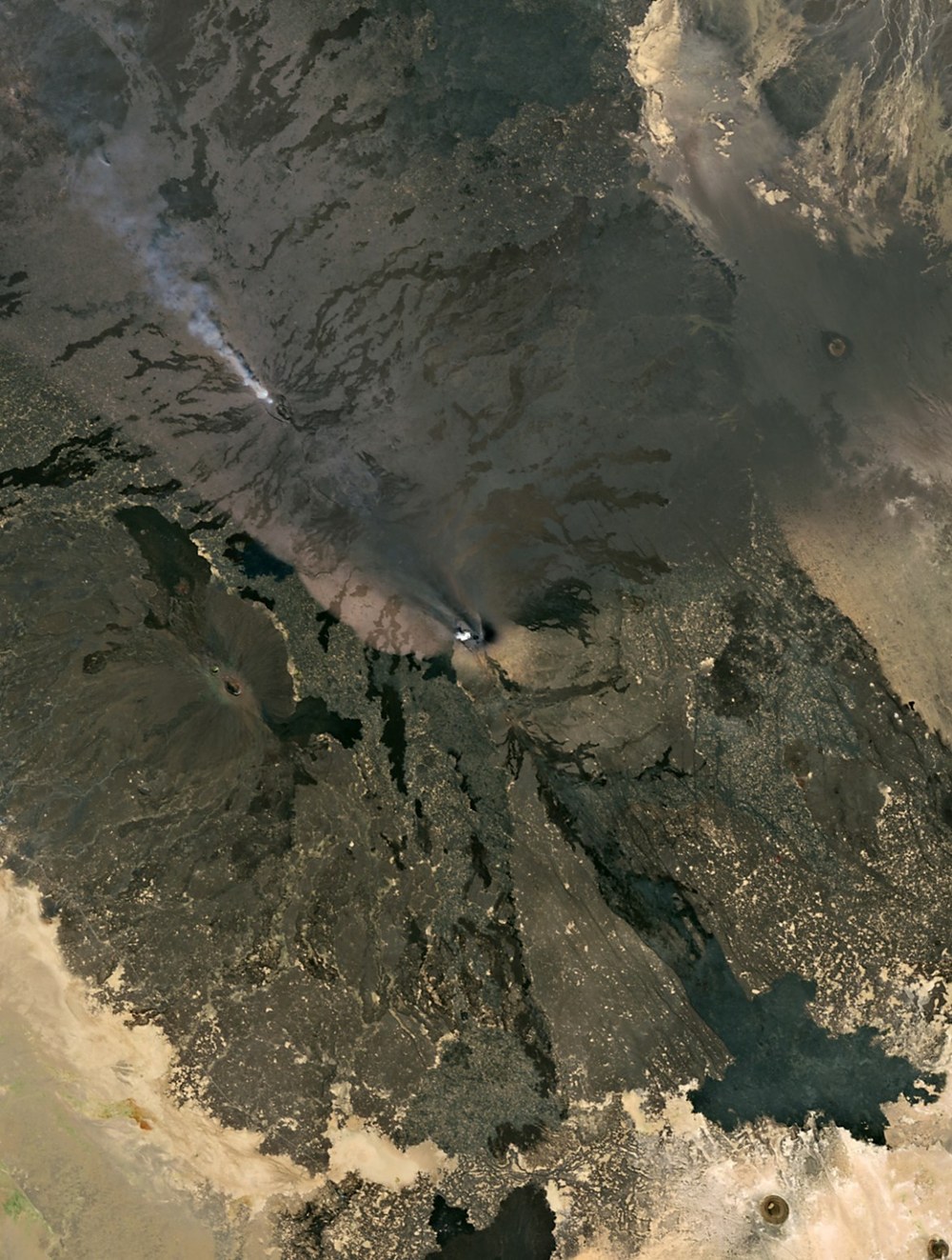
Although the eruption was short and explosive, satellite images, such as this scene from the Enmap satellite on November 30, 2025, and seismic data show that the region remains active and that scientists are monitoring it closely.
EnMAP data 30.11.2025
True color channels 45-28-9 = 647nm - 550nm - 459nm The volcano Hayli Gubbi is located in the middle of the image.