
Project kick-off TwinChain: digital twins for the analysis of complex systems
At the beginning of the year, the new collaborative project TwinChain officially kicked off. The project aims to develop a methodological foundation for the use of digital twins that enable the simulation-based analysis of complex transmission and impact chains in real-world systems. TwinChain’s partners will work on scalable, data-driven modeling and simulation approaches that support the assessment of risks and measures in safety-relevant application areas. While potential application areas are diverse, pandemics in particular require the protection of both critical infrastructure and the population.
TwinChain brings together an interdisciplinary research community from mathematics, computer science, engineering, software technology, as well as epidemiology and public health. The project is funded by the German Federal Ministry of Research, Technology and Space and is part of the MONID Network – Modeling Network for Severe Infectious Diseases.
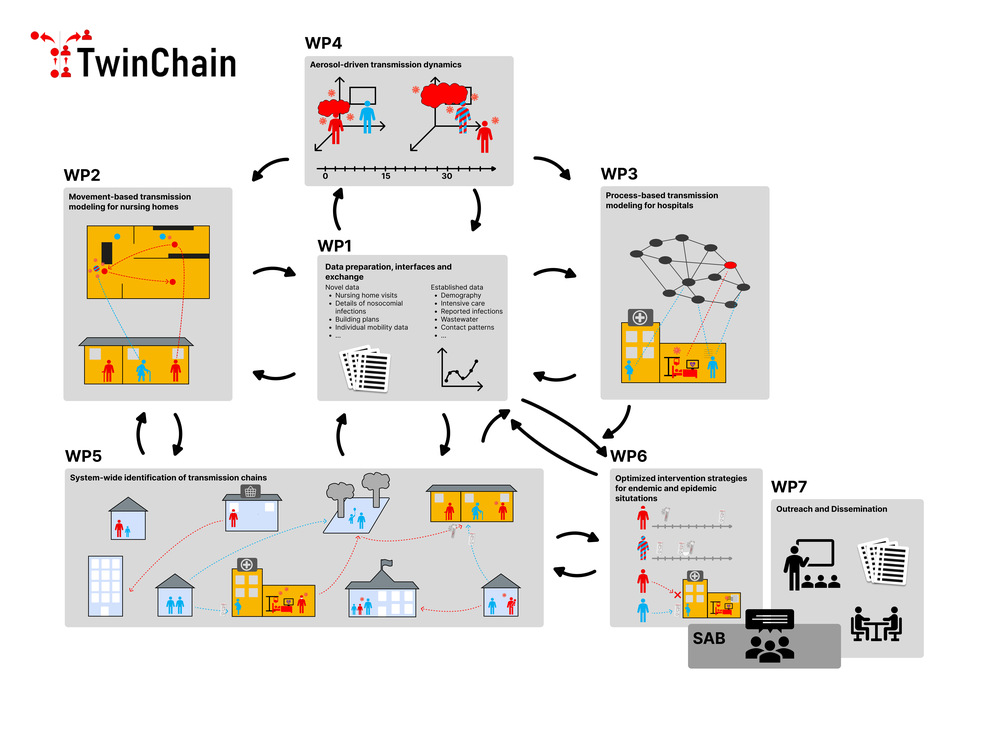

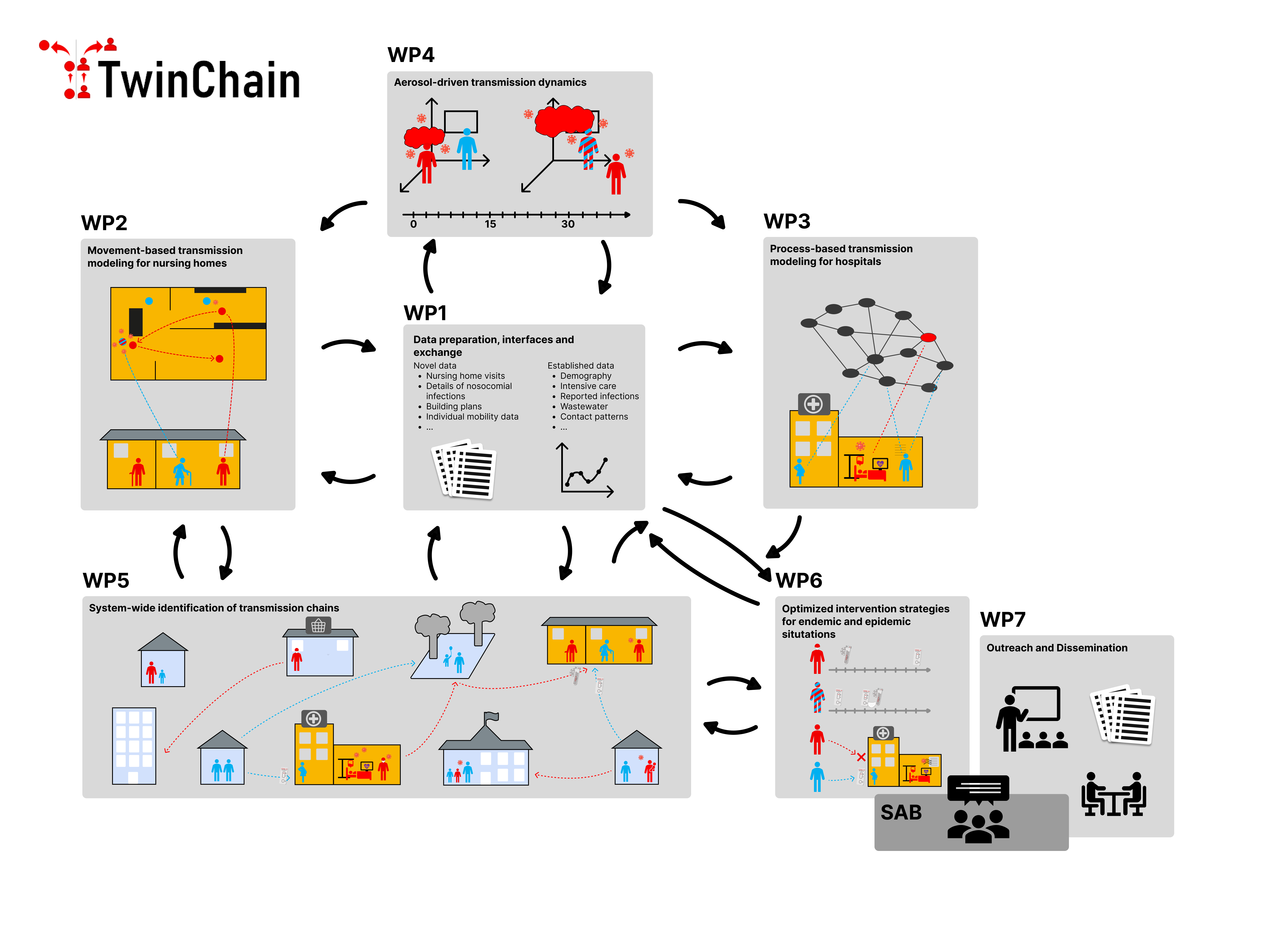
Digital twins as software-based simulation methodology
Digital twins make it possible to represent real systems in the computer based on data and to study their behavior under different assumptions and scenarios. In the TwinChain project, existing modeling approaches are being advanced and different model domains are being integrated into a common simulation framework. The goal is to systematically analyze interactions and propagation processes, providing robust decision support.
At the core is a multi-stage modeling approach that combines agent-based simulations, physics-based models, and artificial intelligence methods. The software-based integration allows complex processes to be represented realistically, multiple perspectives on a system brought together.
Demonstrator application: analysis of transmission chains
The application of the developed methodology will be demonstrated with the simulation of infection and transmission chains, for example to study the spread of respiratory diseases. Beyond this use case, the approach is transferable to other areas of civil security, such as mobility systems, energy supply, or other critical infrastructures, where complex interactions and propagation processes play a key role.
Strong network in research, data provision, and application
Project leader Dr. Martin J. Kühn from the DLR Institute of Software Technology highlights the interdisciplinary network assembled in TwinChain: “With such a broad range of partners, we ensure meaningful results in the TwinChain project. The University of Münster contributes its expertise in epidemiological modeling, developing microscopic agent-based models to describe individual infection dynamics. The HM Hochschule München University of Applied Sciences complements the project with its skills in computer science, particularly agent-based modeling and software architectures. TU Berlin provides simulations from computational fluid dynamics and AI-based surrogate models that consider aerosol propagation and environmental factors.”
“What also strengthens the reliability of our project results are the real, extensive datasets from the healthcare sector made available to us,” adds Kühn. The datasets are provided by Europe’s largest university hospital, Charité Universitätsmedizin Berlin, and one of Germany’s largest public health departments, the Cologne Public Health Department.
Outlook
TwinChain will advance the use of digital twins for the analysis of complex propagation and impact processes. The developed methods are intended to support decision-makers in safety-relevant areas over the long term, helping them plan and evaluate measures based on evidence.
Further information:
Contact
Sofia Wagner