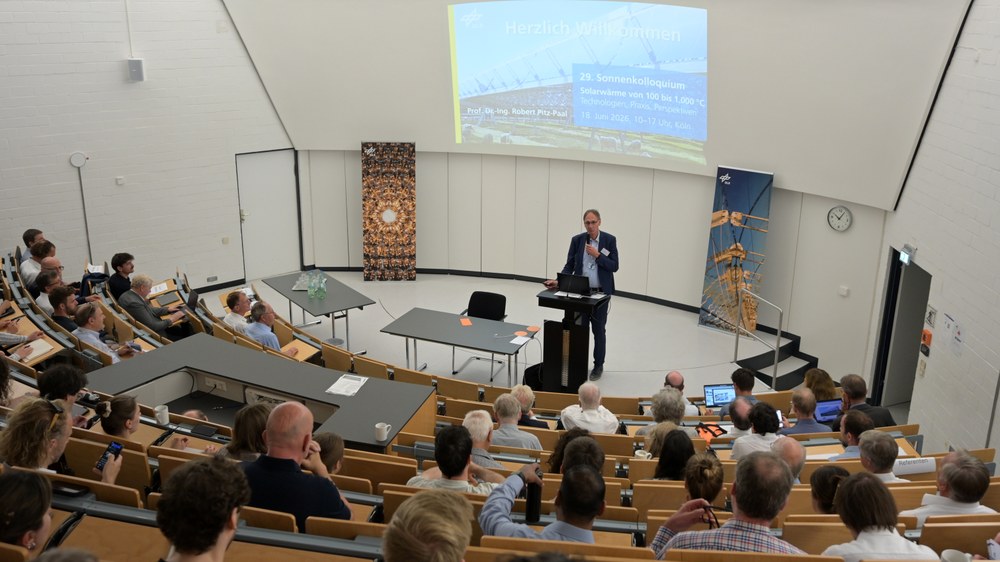
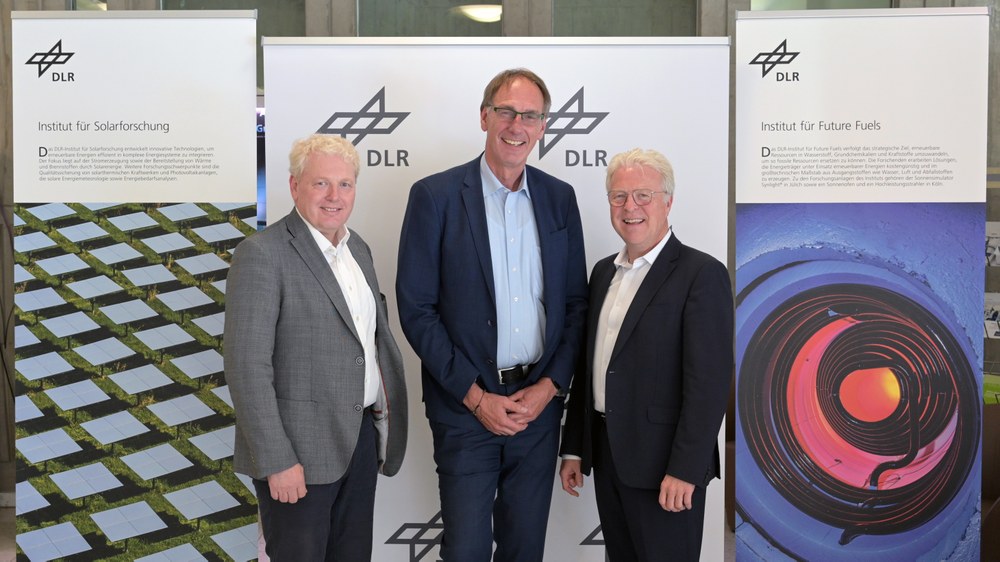
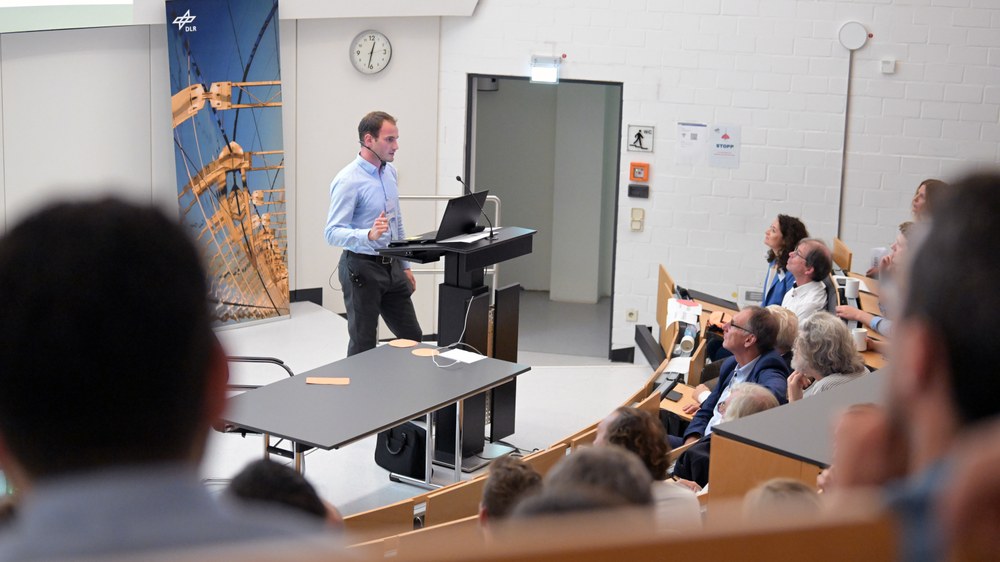
The DLR Institutes of Solar Research and of Future Fuels jointly organised the 29th Solar Colloquium in Cologne. The event was hosted by Prof. Dr Christian Sattler, Prof. Dr Robert Pitz-Paal and Prof. Dr Bernhard Hoffschmidt.
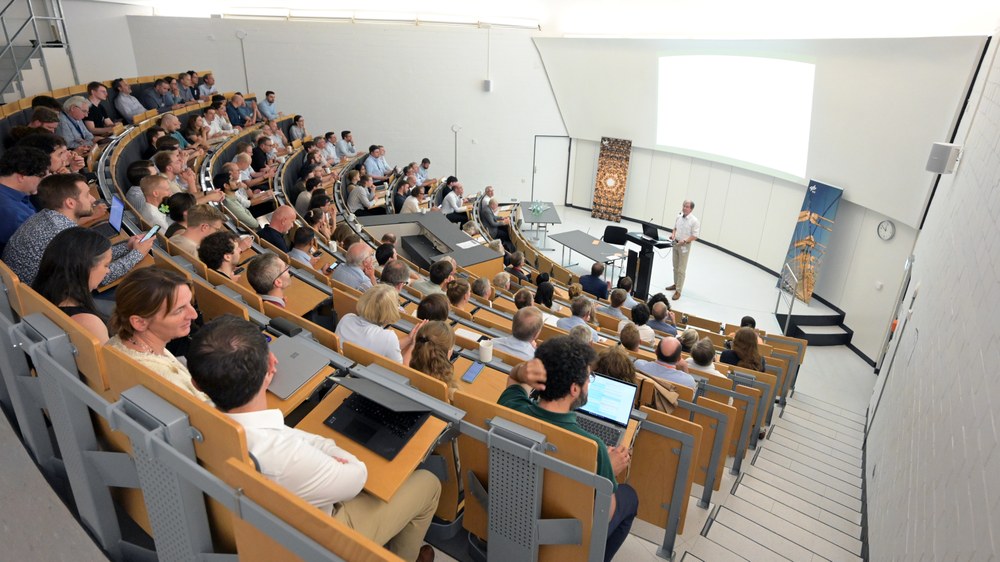
The 29th DLR Solar Colloquium took place in Cologne under the theme ‘Solar heat from 100 to 1,000 degrees Celsius – technologies, practice, prospects’, with 140 participants.
Every year, the event brings together experts from industry and research to discuss new methods, tools and technologies in solar thermal energy.
The 29th DLR Solar Colloquium took place in Cologne on Thursday 18 June, attended by 140 participants. The DLR Institutes of Solar Research and Future Fuels had organised the event under the theme ‘Solar heat from 100 to 1,000 degrees Celsius – technologies, practice, prospects’.
Solar heat ranging from 100 to 1,000 degrees Celsius opens up a wide range of applications: these range from the building sector, through local and district heating networks, to industrial process heat and high-temperature systems. During the event, technological solutions for buildings and neighbourhoods, solar process heat using parabolic troughs, solar heating networks, as well as high-temperature solar thermal systems and solar tower systems were discussed.
The annual Solar Colloquium brings together experts from industry and research to examine the latest developments in solar energy and exchange ideas.
Buildings and neighbourhoods
Following a welcome address by Prof. Dr Robert Pitz-Paal, Director of the DLR Institute of Solar Research, Dr Benedikt Kölsch of the DLR Institute of Solar Research led the first session on the topic of buildings and neighbourhoods.
To begin with, Dominik Bestenlehner from Ritter Solartechnik GmbH & Co. KG provided an insight into how solar thermal energy can be designed to be efficient and cost-effective, emphasising in particular its space efficiency as well as the regional economic benefits generated by manufacturing the solar collectors and system components in Germany and the European Union.
29th Solar Colloquium
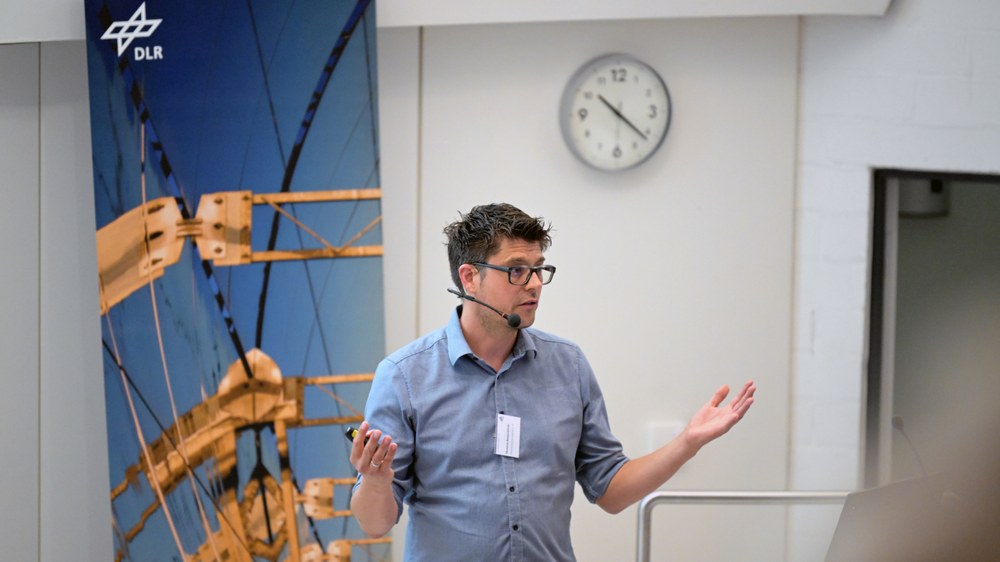
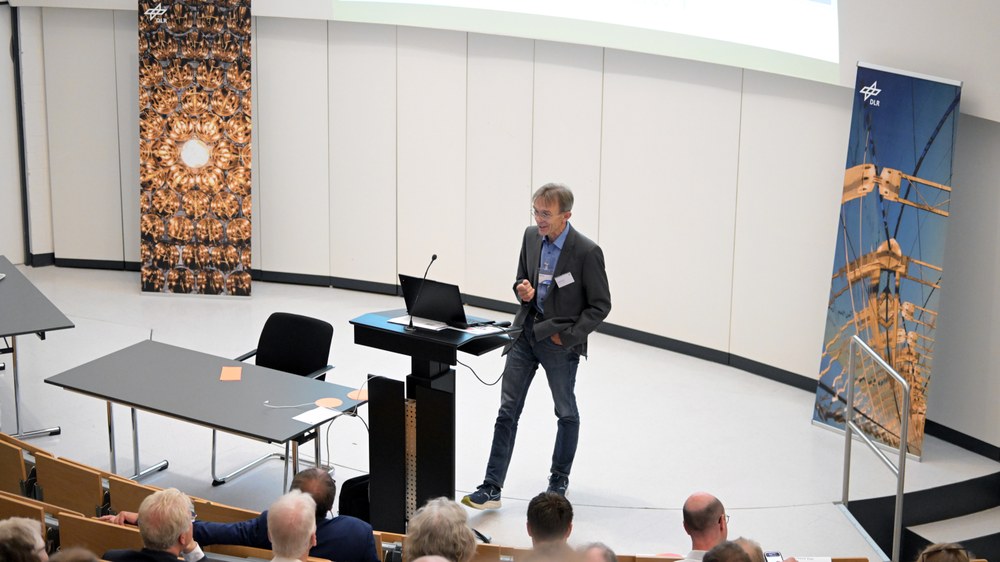
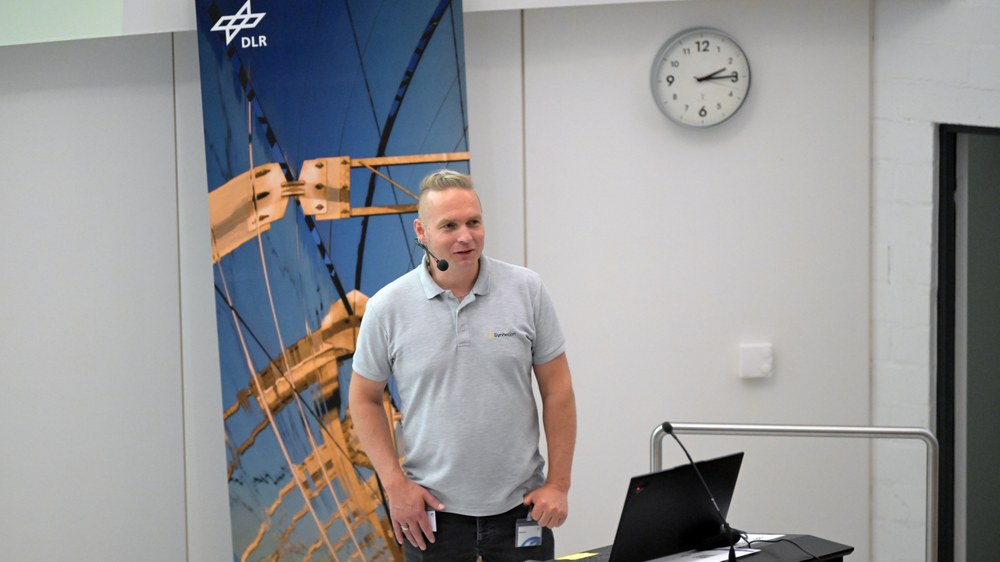
Dominik Bestenlehner, of Ritter Solartechnik GmbH & Co. KG, speaks on the topic ‘Solar thermal energy – efficient, cost-effective and simply excellent’.
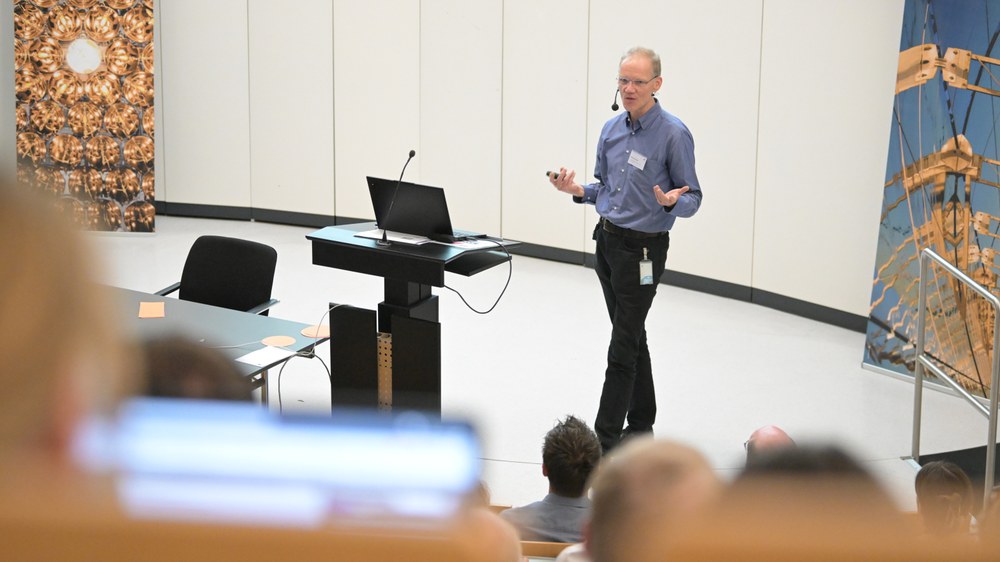
Dr Harald Drück, from the Institute for Building Energetics, Thermal Engineering and Energy Storage (IGTE) at the University of Stuttgart, will speak on ‘Research perspectives on solar thermal energy for buildings and neighbourhoods’.
Dr Harald Drück from the Institute for Building Energetics, Thermotechnology and Energy Storage (IGTE) at the University of Stuttgart then offered a fresh perspective on research into solar thermal energy for buildings and neighbourhoods. The research topics ranged from multi-purpose, highly efficient heat storage systems and integrated energy supply systems to knowledge transfer and market establishment.
Solar process heat using parabolic troughs
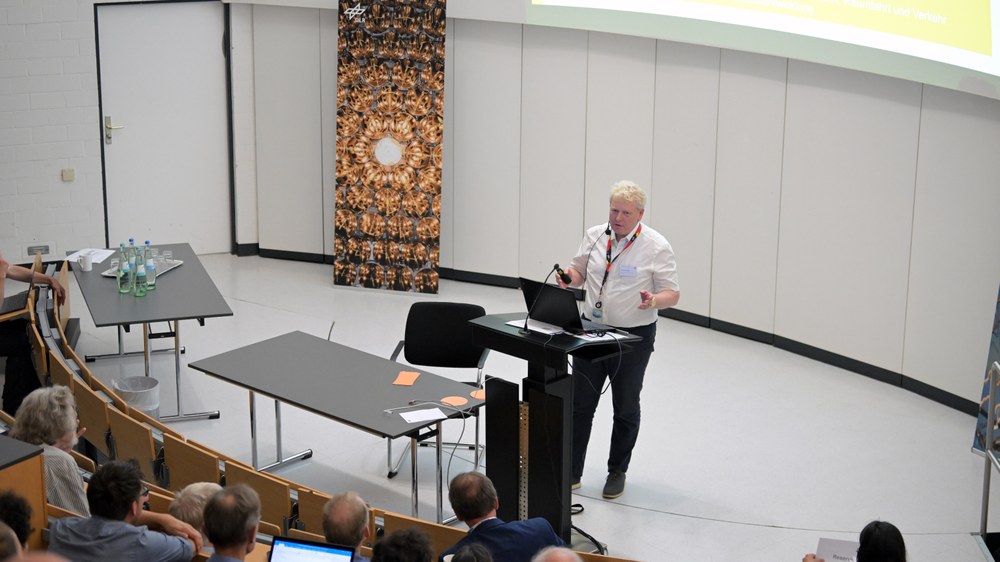
Navina Konz from the DLR Institute of Solar Research introduced the topic of solar process heat using parabolic troughs. Dr Eckhard Lüpfert from the DLR Institute of Solar Research presented a case study from Protarget AG. The company has built a steam power plant using concentrated solar thermal (CST) technology and parabolic trough collectors, including a thermal energy storage (TES) system, for the Heineken brewery in Patras – Greece’s largest brewery.
Dr Gerhard Weinrebe of GlassPoint then provided an insight into industrial process heat in an international context, emphasising the value of solar energy, particularly in light of the conflicts in the Middle East.
29th Solar Colloquium
Dr Gerhard Weinrebe, from GlassPoint, gives a talk on the topic of ‘Industrial process heat in an international context’.
Dr Eckhard Lüpfert, from the DLR Institute of Solar Research, discusses a case study by Protarget AG in which a steam power station was built for the Heineken brewery in Patras, Athens.
Dr Stefan Wilbert, from the DLR Institute of Solar Research, then explored the topic of condition monitoring and nowcasting in process heating plants in greater depth, and explained why they are important for the safe and efficient operation of such plants.
Solar heating networks
Dr Jana Stengler from the DLR Institute of Solar Research chaired the session on solar heating networks, during which Silas Tamm from Solites began by speaking about projects and prospects for solar thermal energy in heating networks. He presented, for example, Germany’s largest solar thermal plant for heating networks in Leipzig and provided an overview of plants that are currently in operation, under construction or in the planning stage in Germany.
Matthias Loevenich, from the DLR Institute of Solar Research, presented tools and concept studies for innovative supply solutions using parabolic trough collectors and highlighted that, in a technology comparison, solar supply solutions using parabolic trough collectors have the lowest heat production costs.
High-temperature solar thermal systems and solar towers
The final topic of the day was presented by Dr Nicole Neumann from the DLR Institute of Future Fuels: high-temperature solar thermal energy and solar towers. Patrick Hilger from Synhelion AG gave the audience an insight into solar thermochemical fuel production by presenting Synhelion AG’s business model and its current developments.
29th Solar Colloquium
Patrick Hilger, from Synhelion AG, gives a talk on ‘Solar thermochemical fuel production’.
Dr Mathias Kuhl from the DLR Institute of Solar Research spoke about the autonomous operation of high-temperature solar thermal systems, using the Jülich plant as an example. He presented the Solar Energy Autopilot (SOLEA) project, in which an overall system-wide architecture was first established and autonomous operation subsequently demonstrated; this concept can now be applied to other CST plants, power stations and industrial process heating systems.
To round off the colloquium, the Institute’s Director, Prof. Dr Christian Sattler, discussed the Institute of Future Fuels’ areas of research in more detail and outlined the outlook for the coming years.
Tour of the LUNA Moon facility
Following the technical part of the Solar Colloquium, participants had the opportunity to visit the new LUNA Moon facility – a joint research and training facility run by the German Aerospace Center (DLR) and the European Space Agency (ESA) in Cologne, where future lunar missions are prepared and tested under realistic conditions here on Earth.
The opportunity that followed for some in-depth networking and professional discussion in the sunshine provided a fitting end to the day.
We would like to thank all the speakers and guests for taking part and for their inspiring expert contributions, and we look forward to the 30th anniversary of the Solar Colloquium in 2027!