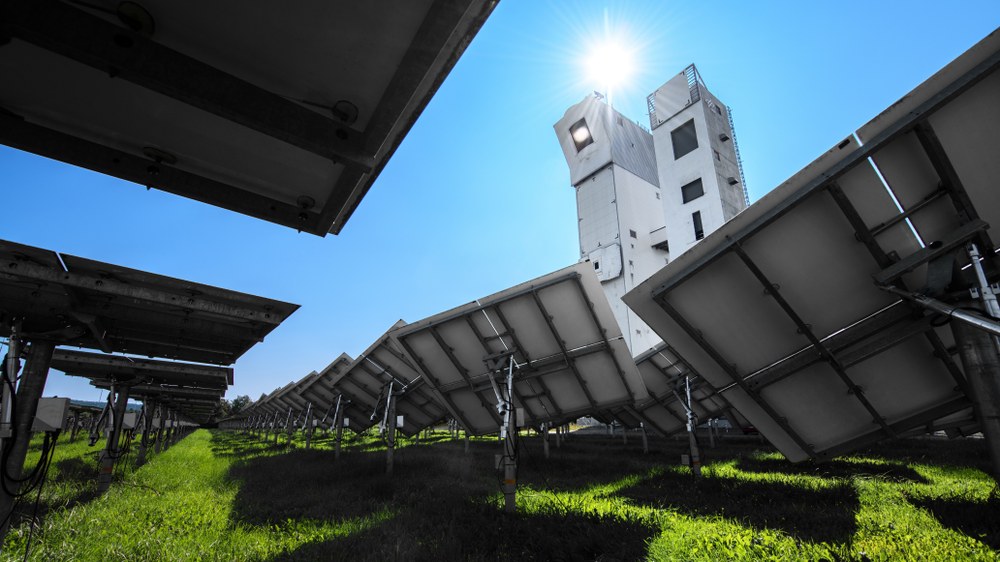
The Jülich Solar Tower is a solar thermal power plant operated by DLR. At the facility, the DLR Institute of Solar Research investigates and tests the use of concentrating solar power for generating electricity, heat and fuels. A large number of movable mirrors, known as heliostats, concentrate sunlight onto a solar receiver. The efficiency of the power plant depends to a large extent on the alignment of the mirrors and the control of the receiver. The aim of the project is to have these control and regulation mechanisms managed by an AI (artificial intelligence) agent. To achieve this, the plant's environmental parameters and state variables must be recorded in real time and evaluated by the AI agent.
Expansion of the sensor system and data platform as a foundation
The demonstration of the autonomous operation of the solar power plant will be carried out in three phases. In the first phase, the plant’s sensors and measurement systems will be expanded to capture environmental conditions such as cloud cover and the distribution of solar irradiance. At the same time, the measurement systems for the heliostat field, the solar receiver and the power plant technology will be enhanced to provide the most accurate possible assessment of the condition of the individual components.
All state variables will be stored centrally on a data platform. This platform was specifically developed by the DLR Institute of Solar Research for energy technology systems and is used by researchers to automate processes. The centralised data repository extends the physical sensors with virtual sensors, making previously unknown states of individual components visible.
The first milestone is the demonstration of automated power plant operation using the enhanced, partly virtual measurement and control systems.
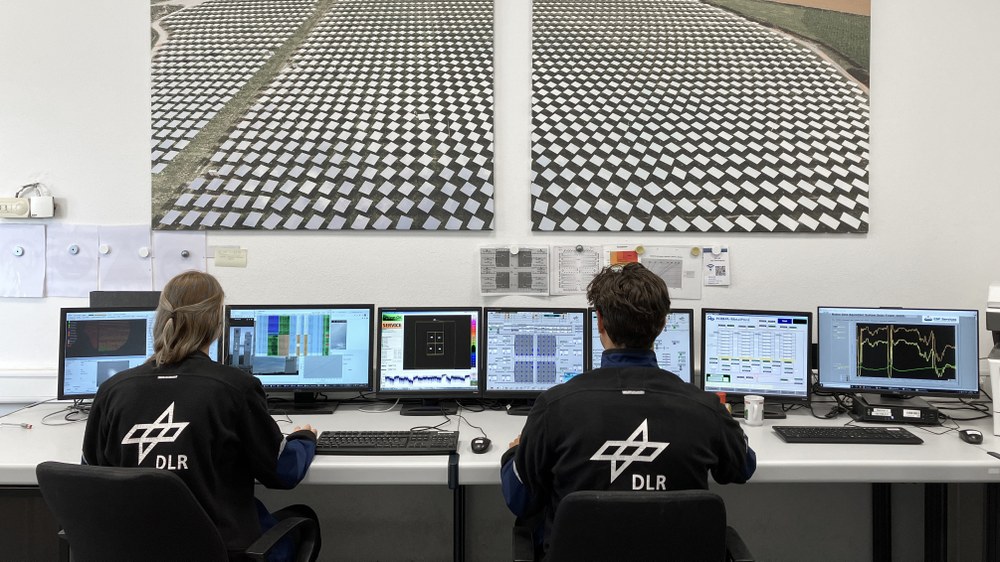
Control centre in the solar tower
Controlling the autonomous operation of the solar power plant in Jülich from the control centre in Jülich.
In the second phase, the autonomous operation of the power plant will be demonstrated. Intelligent process steps will replace the intervention of the power plant operator. Based on the current state of the power plant components, the automation system will set the appropriate control parameters. The alignment of the heliostats will be determined according to cloud cover and solar irradiance. The concentrated radiation distribution at the receiver will determine the required cooling mass flow rate. Depending on the level of the thermal storage system, it will either be charged or the thermal energy will be supplied to the steam power cycle. Autonomous operation will be tested over several consecutive days at the Jülich Solar Tower in summer 2025.
AI-assisted operational optimisation
In the third and final phase, the optimised and autonomous operation of the power plant will be demonstrated in 2027. To this end, the researchers are developing algorithms and methods to predict future operating states. Digital twins and machine learning methods will be used for this purpose. They calculate and compare a large number of possible operating strategies for a defined time horizon. Criteria such as energy yield and component lifetime are used to select the optimal operating strategy in each case.
Outlook: Benefits for Industry and Applications
The project aims to demonstrate how modern automation technology and AI agents can help reduce the cost of renewable electricity. The automation technology developed in the project, together with the data platform, can also be transferred to other industrial sectors. The methods demonstrated in the project are suitable for complex industrial processes in which numerous components need to interact intelligently to ensure safe, efficient and cost-effective operation.