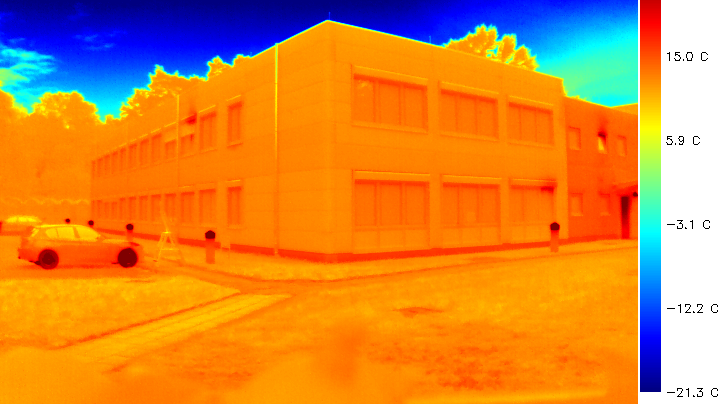
Municipal heat planning identifies opportunities for sustainable and efficient heat supply, thereby helping to reduce CO₂ emissions. This not only promotes climate protection, but also the use of renewable energies at the local level. However, municipalities can only develop realistic goals and concrete strategies as part of municipal heat planning or when creating integrated neighbourhood concepts if they have access to precise analyses of the present condition.
For this reason, employees of the Institute of Solar Research are developing a hardware and software solution for the large-scale recording of the renovation status of buildings as part of the GroSan project.
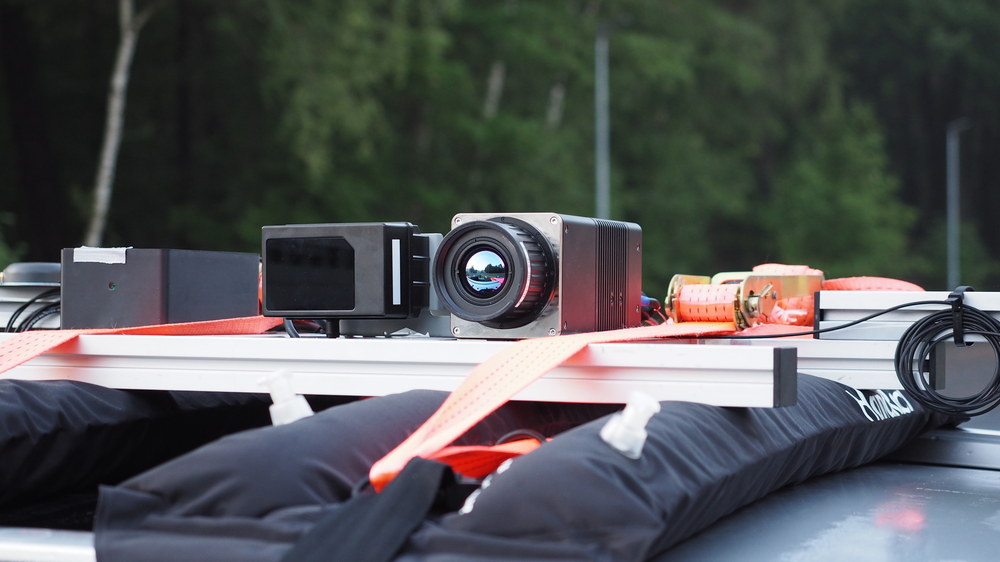
The hardware consists of several precise measuring instruments that are mounted on the roof of a car. While driving, the system records the houses that pass by. The software controls the measuring devices and processes the collected data. The project team collects and collates geodata as well as other publicly available information about the buildings. Missing information in the databases is automatically completed with the help of AI-supported algorithms.
One system combines many tasks
In the first stage of the project, the measuring system is planned, designed, installed and put into operation. The most important components are an infrared camera, a LiDAR sensor (Light Detection and Ranging), a high-precision Global Positioning Systems (GPS) and several small environmental sensors. The software developed in-house controls all the devices, which perform various tasks during the measurement run.
The infrared camera recognises weak points in the building envelope. This works particularly well on winter nights, when the temperature difference between inside and outside is at its greatest. The LiDAR sensor detects visual obstructions and building boundaries, while the GPS helps to allocate the images to the correct addresses during data post-processing.
Measuring instruments for analysing renovation conditions
During the journey, the system records the passing houses. The software controls the measuring devices and processes the collected data.
The unique feature of this approach lies in the linking of measurement data with processed geoinformation. Following the infrared survey, a largely automated evaluation is carried out, supported by artificial intelligence.
By comparing measurement results and processed data sets, the refurbishment status of individual buildings can be precisely determined. This provides local authorities and building owners with a quick and cost-effective assessment aid for potential energy savings.
Location: All over Germany
The prototype of the measuring system was tested in several trial runs in the summer of 2025 at the German Aerospace Center (DLR) in Cologne-Porz. At the same time, automated data processing is being developed so that the first measurement runs and analyses under real conditions in a pilot area will be possible by the end of the 2025/2026 heating period. In summer 2026, the project team will optimise the system for large-scale deployment. From winter 2026/2027 onwards, the system is expected to be ready for industrial use throughout Germany, providing local authorities and building owners with a quick and cost-effective initial assessment of potential renovation measures and energy-saving opportunities.
Project
TF-GroSan
Duration
1.10.2024 - 30.9.2026
Funding
German Aerospace Center
Contact
Dr.-Ing. Jana Stengler
Head of Sustainable Systems Process Engineering Department