
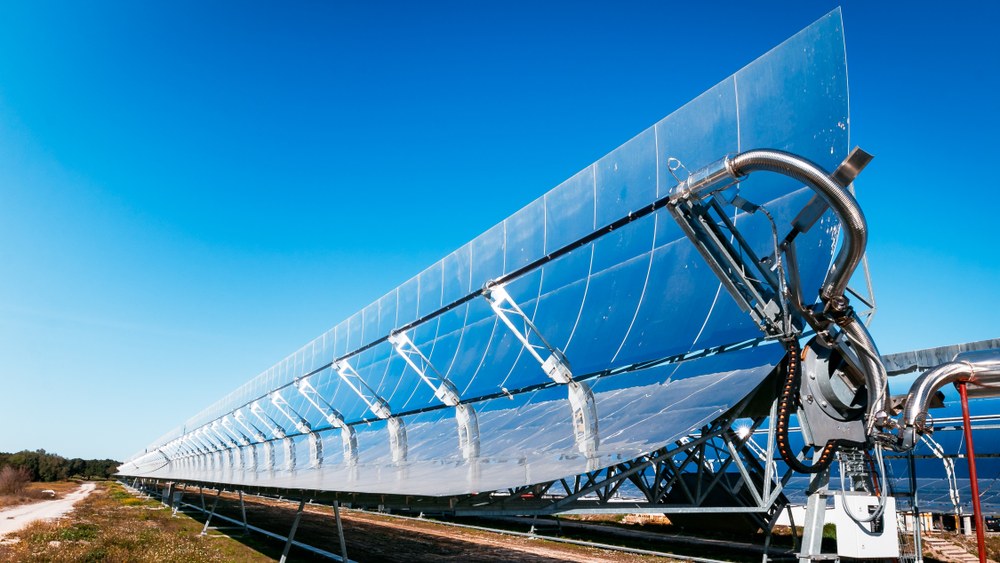

Parabolic trough technology has a success story spanning more than 40 years. As early as 1984, the first commercial power plants with parabolic trough collectors went into operation in California. In Europe, commercial deployment at utility scale started in 2008 with the Andasol power plant complex in Spain. Since then, the technology has been continuously further developed.
The DLR Institute of Solar Research makes a significant contribution to this progress. It optimizes both individual components and complete power plants – from collector geometry and heat-transfer media to control systems and techno-economic assessment. The main focus is on increasing efficiency, reducing costs through technological innovation and demonstrating the wide range of applications in large-scale research facilities. Whether for power generation at utility scale or for supplying industrial process heat – continuous research and development will enable parabolic trough technology to make an ever greater contribution to a sustainable and secure energy supply.
How parabolic trough technology works
Parabolic trough power plants use long, curved mirrors (concentrator mirrors) that track the sun around a single axis. In cross-section, these mirrors have a parabolic shape. This concentrates the nearly parallel direct beam radiation of the sun along a focal line. An absorber or receiver tube runs along this focal line. Inside the tube, a heat-transfer fluid flows and is heated by the concentrated solar radiation. Typical heat-transfer media are synthetic thermal oils, water/steam (direct steam generation) or – increasingly in research and demonstration – molten salts.
Thanks to decades of operating experience, parabolic trough plants are today regarded as the most successful and most widely used technology in concentrating solar power. This is due in part to their standardized design, which enables good market availability, a broad range of components and comparatively predictable costs.

Research focus areas at the Institute of Solar Research
- Molten-salt systems (as heat-transfer and storage media)
- Collector development (mechanical design, optics, tracking)
- Component development and testing (receivers, mirrors, seals, insulation)
- Industrial process heat and district heating (system integration, demonstration plants)
- Process optimisation and plant operation (measurement and control strategies)
- Further development of control and automation (including digital twins and AI-based operation)
- Techno-economic assessment (simulation tools, lifecycle analysis, levelised cost of heat, business models)
The aim of our research is to adapt parabolic trough technology and its components to different applications, reduce costs and further increase efficiency.
Current development trends
Molten salt as a heat-transfer medium
Molten salt allows operating temperatures above 550 degrees Celsius. This increases the efficiency of the downstream steam power cycle and significantly widens the possible fields of application for industrial heat supply – from power generation to high-temperature process heat. The DLR Institute of Solar Research is working intensively to establish this technology as a new standard for parabolic trough power plants. This includes demonstration plants in which large parabolic trough collectors are operated entirely with molten salt for the first time.
SHIP – Solar Heat for Industrial Processes
Besides power generation, an important and still often underestimated potential of parabolic trough technology lies in the supply of heat for industrial processes (Solar Heat for Industrial Processes, SHIP) and in the decarbonisation of local and district-heating networks . Where space is limited, rooftop solutions allow the installation of smaller, lighter collectors on industrial buildings. Their simpler design often creates additional cost advantages. Larger collectors and complete plants are typically installed on the ground and can provide process heat or district heat at large scale. To cover process-heat demand, direct heat generation with concentrating solar technology is a highly competitive option – even in Central European climates. In addition, thermal energy can be stored efficiently and at significantly lower cost than electrical energy in batteries.
Benefits for external users
External users – such as component manufacturers, power-plant operators, grid operators or companies with high heat demand – benefit from the research carried out at the DLR Institute of Solar Research in several ways:
- Cost reduction and market growth
By developing standardised, optimised components and plant concepts, parabolic trough systems become more economically attractive. Lower investment and operating costs support the market rollout of new projects.
- Planning security
Improved storage solutions and proven plant designs enable a more stable and predictable energy supply. They reduce the risk of operational outages and facilitate long-term supply contracts (for example “heat-as-a-service” models).
- Flexible fields of application
Thanks to different heat-transfer media and collector designs, a wide range of applications can be covered – from industrial process heat to local and district heating and power generation.
- Future-proof technology
Our research helps to make this already reliable technology even more efficient and cost-effective. This creates an attractive, long-term and robust business case for investors, operators and industrial users who want to decarbonise their power and heat supply.
Industrial application examples
Utility-scale power generation
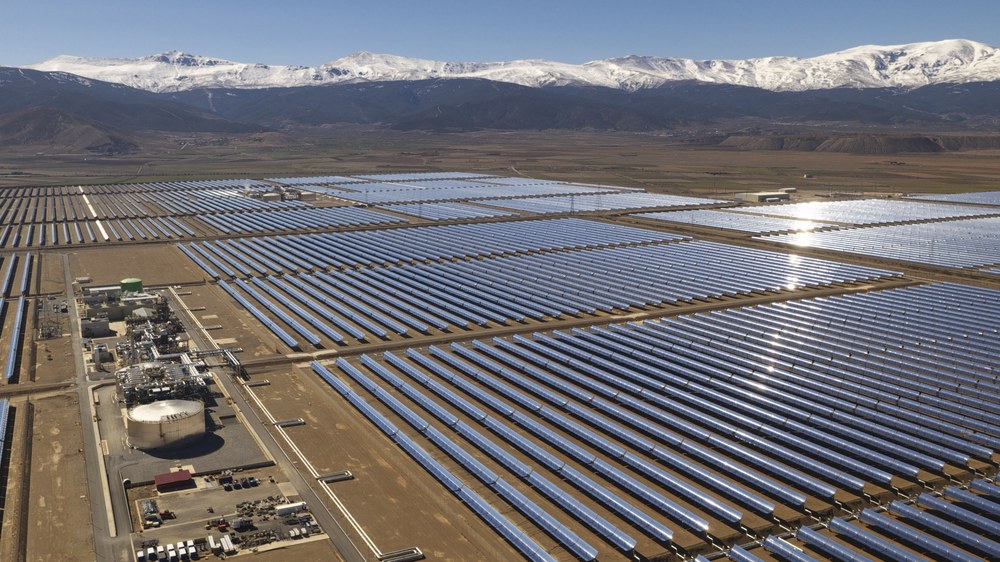
A well-known European example is Andasol I with an electrical output of 50 megawatts. The solar field heats a synthetic thermal oil to just under 400 degrees Celsius, which is then used to drive a steam power cycle. The integrated thermal storage system with around 29,000 tons of molten salt makes it possible to generate electricity for about 7.5 hours during periods of reduced solar input or at night. The almost identical Andasol II and III power plants were built next to Andasol I. The Andasol plants are classic solar thermal power plants with a thermal-oil loop in the solar field and a separate molten-salt loop in the storage system. The DLR Institute of Solar Research is working on the next generation of solar thermal power plants, which will operate entirely with molten salt as both heat-transfer and storage medium. This will expand the range of applications, reduce investment costs and system complexity, and increase overall efficiencies.
Process heat for industry and commerce
A recent example is the Heineken brewery in Seville. To cover its heat demand, a large solar thermal plant with parabolic trough collectors has been installed. The plant provides around 30 megawatts of thermal power and occupies an area of about eight hectares. Pressurised water with temperatures of up to 210 degrees Celsius is used as the heat-transfer medium in the solar field. Several pressurised-water storage tanks provide a total volume of around 800 cubic metre and a thermal storage capacity of about 68 megawatt hour. This enables the plant to supply CO₂-neutral heat for several hours and, on average over the year, to cover around 60 percent of the heat demand of 10–20 megawatts at temperatures of up to about 140 degrees Celsius. The project illustrates the potential of parabolic trough systems for decarbonising industrial process heat and for long-term solar heat supply contracts.