The demand for short-term forecasts (nowcasts) of solar radiation is increasing, especially with the growing contribution of decentralised solar power generation. The nowcasts enable a more accurate forecast of solar power production, especially in changeable conditions.
Nowcasts enable grid operators to better estimate intermittent power generation and integrate it into grid planning. This allows for more efficient operation of the plants and use of storage solutions or backup systems.
Radiation measurements, numerical weather models and sky and ground images serve as the basis for the nowcasts. For image-based methods, satellite images and/or ground-based cameras are used, which are directed either towards the sky or the ground. At the Institute of Solar Research, we develop, evaluate and combine forecasting methods and their results.
Optimised nowcasts for high resolution
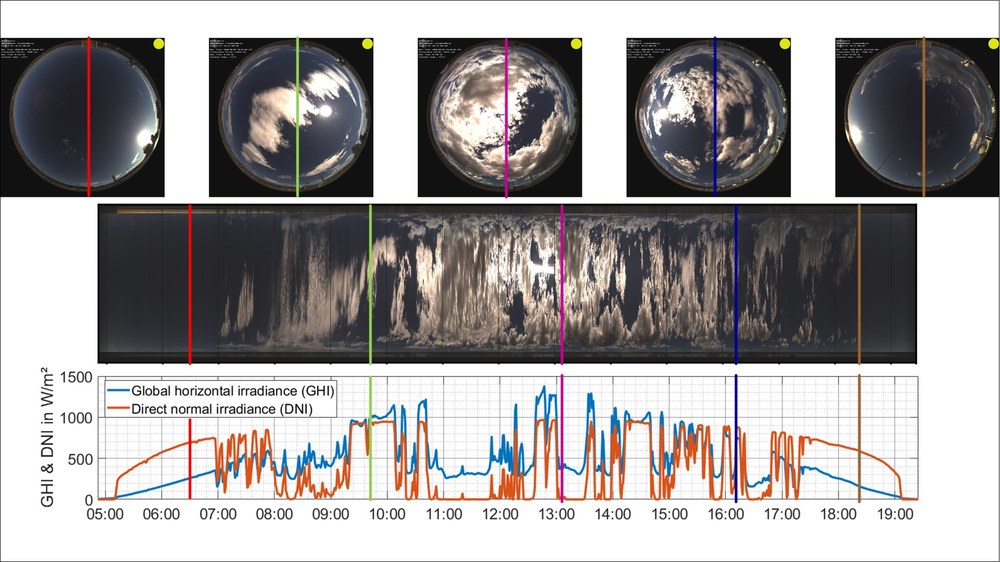
All-sky imager systems (ASI) generate and analyse hemispheric images of the sky and monitor the entire sky. They facilitate the detection of sudden changes in irradiance (ramps) and thus play a decisive role in the provision of nowcasts with high temporal and spatial resolution. Cloud fields are resolved in great detail, enabling forecasts to be made even for partial cloud cover. Typically, the forecast horizon for individual ASI systems is up to twenty minutes. The use of spatially extensive camera networks can extend this horizon to over an hour, and by combining them with satellite or weather model data, several hours or days can be achieved.
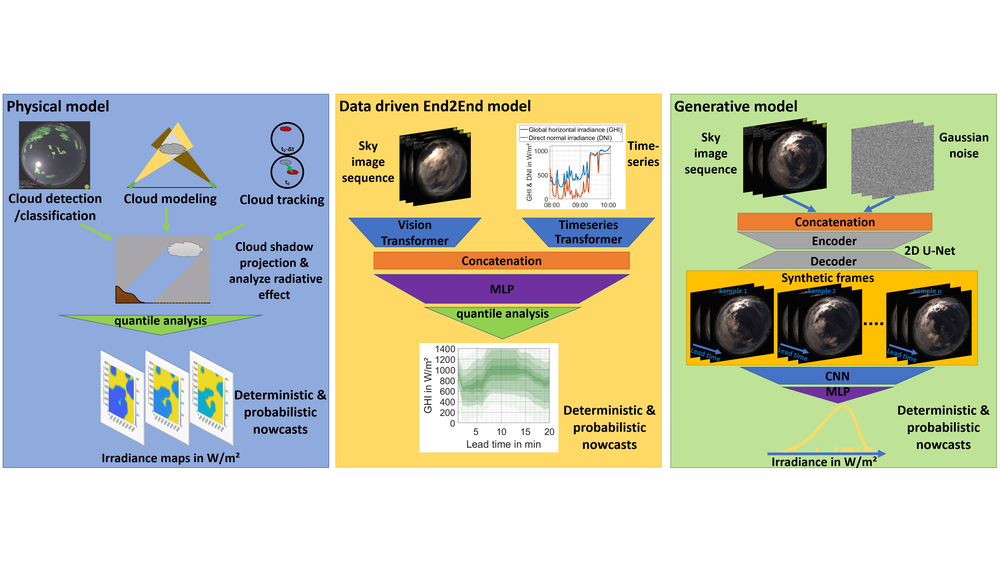
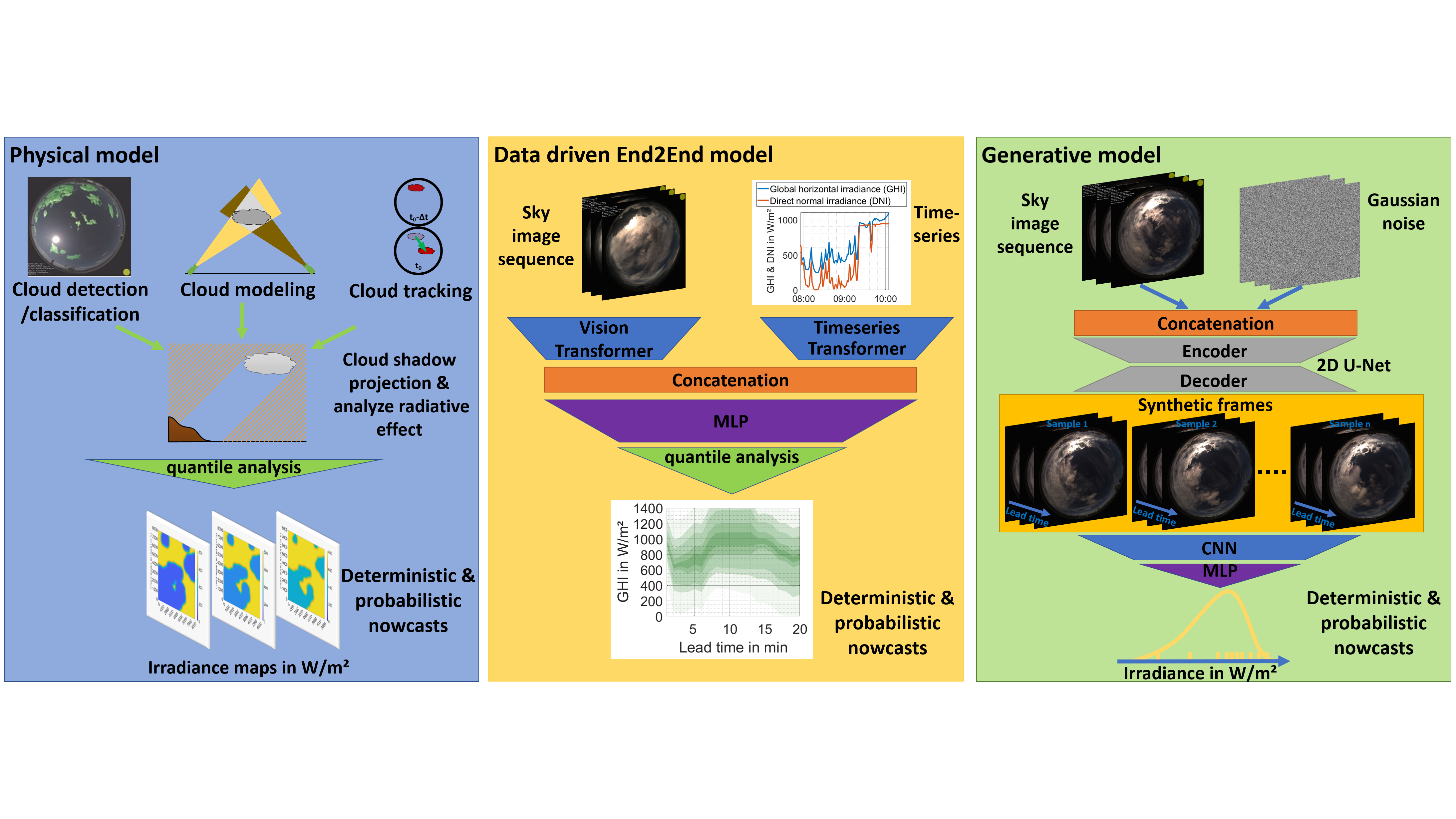
Illustration of the three basic approaches for ASI-based nowcasts
On the left, the indirect (physical) all-sky imager model, in the middle, the direct (data-driven) all-sky imager model on the right, the generative all-sky imager model.
There are three basic approaches for ASI-based nowcasts:
Indirect methods, which rely on a sequence of physically based processing steps
Direct methods that use trained deep learning models to derive predictions directly from sky images
Generative methods that predict several possible continuations of previous observations, from which conclusions about solar irradiance can be drawn
Studies show a clear trend towards direct approaches, as these are able to predict energy quantities with high accuracy. However, these methods are not yet able to capture ramps accurately due to the strong smoothing. In contrast, indirect methods have lower accuracy but avoid the problem of smoothing. In addition, these methods allow for geolocalization of clouds and thus spatial nowcasts when at least two cameras are used.
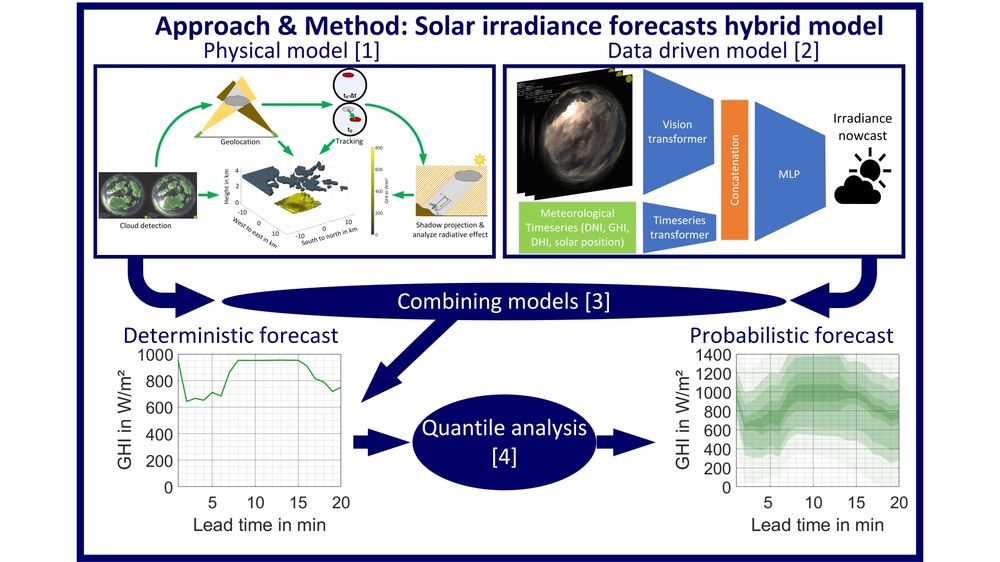
At our institute, hybrid methods have been developed that combine both indirect physical and direct data-driven approaches. These methods maintain the high accuracy of the direct approaches while improving the detection of ramps.
Illustration of processing pipeline of hybrid nowcasting model for deterministic and probabilistic nowcasts
The hybrid model combines a direct (data-driven) and an indirect (physical) all-sky imager model.
Recent studies underscore the potential of generative models, which have demonstrated the ability to outperform both indirect and direct forecasting methods. Notably, these models are the first to accurately predict changes in cloud shape, as well as cloud formation and dissipation. An additional advantage of generative models is their capability to directly generate probabilistic ensembles of potential future conditions, enabling real-time uncertainty estimation for predictions. Consequently, ongoing research at our institute is centered on advancing these generative models. While current methods are limited to point forecasts based on data from a single camera, future developments aim to integrate camera networks with satellite data, enabling spatial forecasts with lead times of at least one hour.
Nowcasting systems are an important tool for operating solar power plants and power grids more flexibly, efficiently and reliably.