
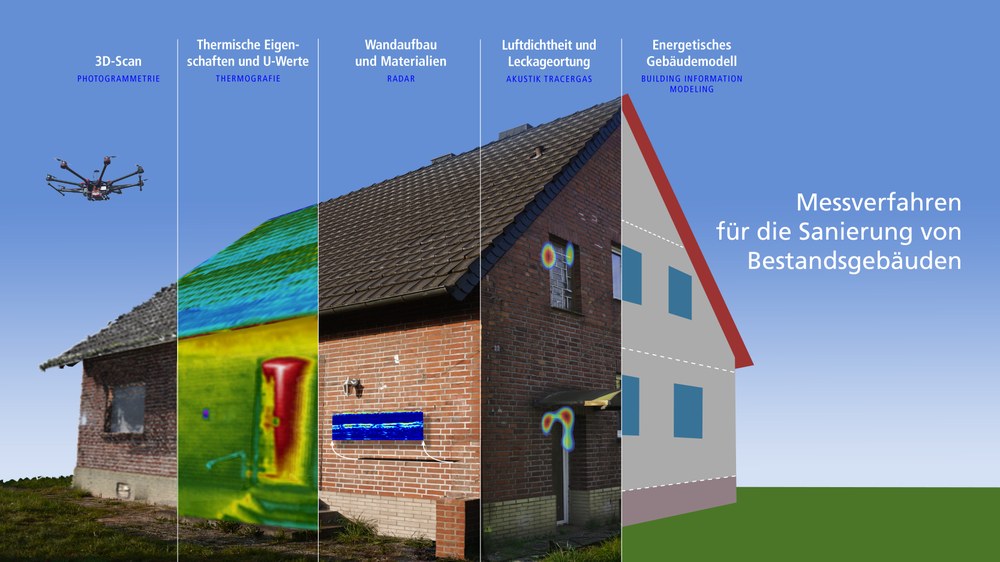
In particular, existing buildings must be modernised for this purpose, as they are rarely replaced by new buildings in Germany and Europe. We face a number of challenges in this respect. Which measures and technologies make the most sense for which buildings or neighbourhoods? Where is it best to use heat pumps, and where is it best to connect to district heating? Can energy consumption be reduced more efficiently by modernising building technology, by individual measures such as replacing windows, or by comprehensive renovation including façade insulation?
These questions need to be answered individually for each region, municipality, neighbourhood and building. At the same time, there is a lack of specialists to carry out the necessary analyses across the board in the required time.
Energy characterisation of buildings
This is where our research comes in. We develop methods to quickly characterise buildings in terms of energy with the required accuracy. In doing so, we focus on the scale from the individual building to the local authority. We develop measurement methods for individual buildings in order to determine how much heat is lost in which way without severely impairing the operation of the building.
One focus is on the area of airtightness. Conventional methods such as the blower door test quickly provide an integral value for small buildings that describes the heat losses through air exchange with the environment. However, finding individual leaks in order to rectify them in a targeted manner is a very time-consuming process.
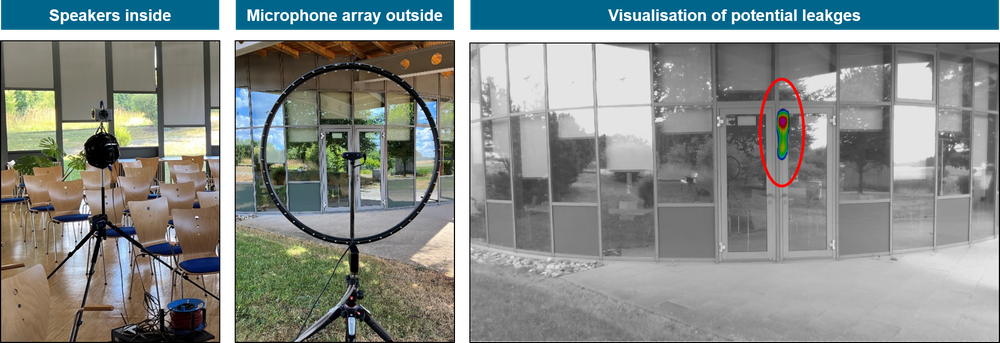
In several projects, we are developing acoustic and thermographic methods to speed up this process: Using microphone arrays that utilise advanced beam-forming technology, we can identify where sound is penetrating the building envelope, which is a promising indicator of a non-airtight area. By analysing a series of infrared images for the frequency and amplitude of temperature changes while periodically changing the pressure in the building, we can distinguish leaks from thermal bridges and reflections from the surroundings. We are currently developing these methods further towards market maturity, both on our own test benches in the laboratory and on real buildings.

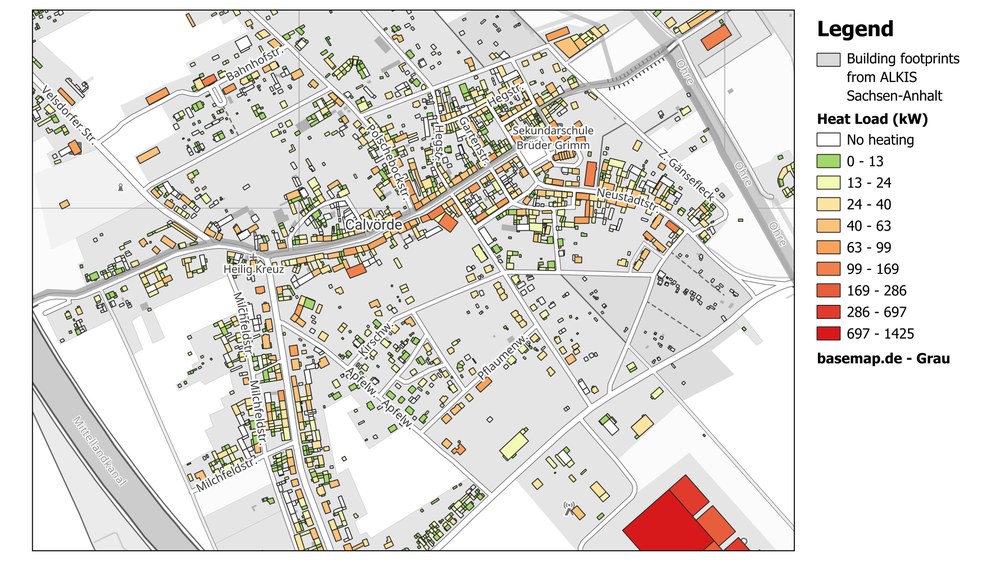
Fewer details are required for neighbourhood concepts, heating network planning and municipal heating plans. However, the data must be available for a large number of buildings at the same time. In order to plan the use of renewable energy sources, energy consumption must also be predicted with a high temporal resolution of hourly values.
To achieve this, we collate data from various open sources such as official cadastres, OpenStreetMap and earth observation. These are analysed using statistical methods. We develop methods based on artificial intelligence, for example, to supplement missing information and prepare the large data sets for use by experts. Ultimately, models of the building stock are generated from this data, which enable a standardised heat demand and heat load calculation as well as a dynamic simulation of each individual building.
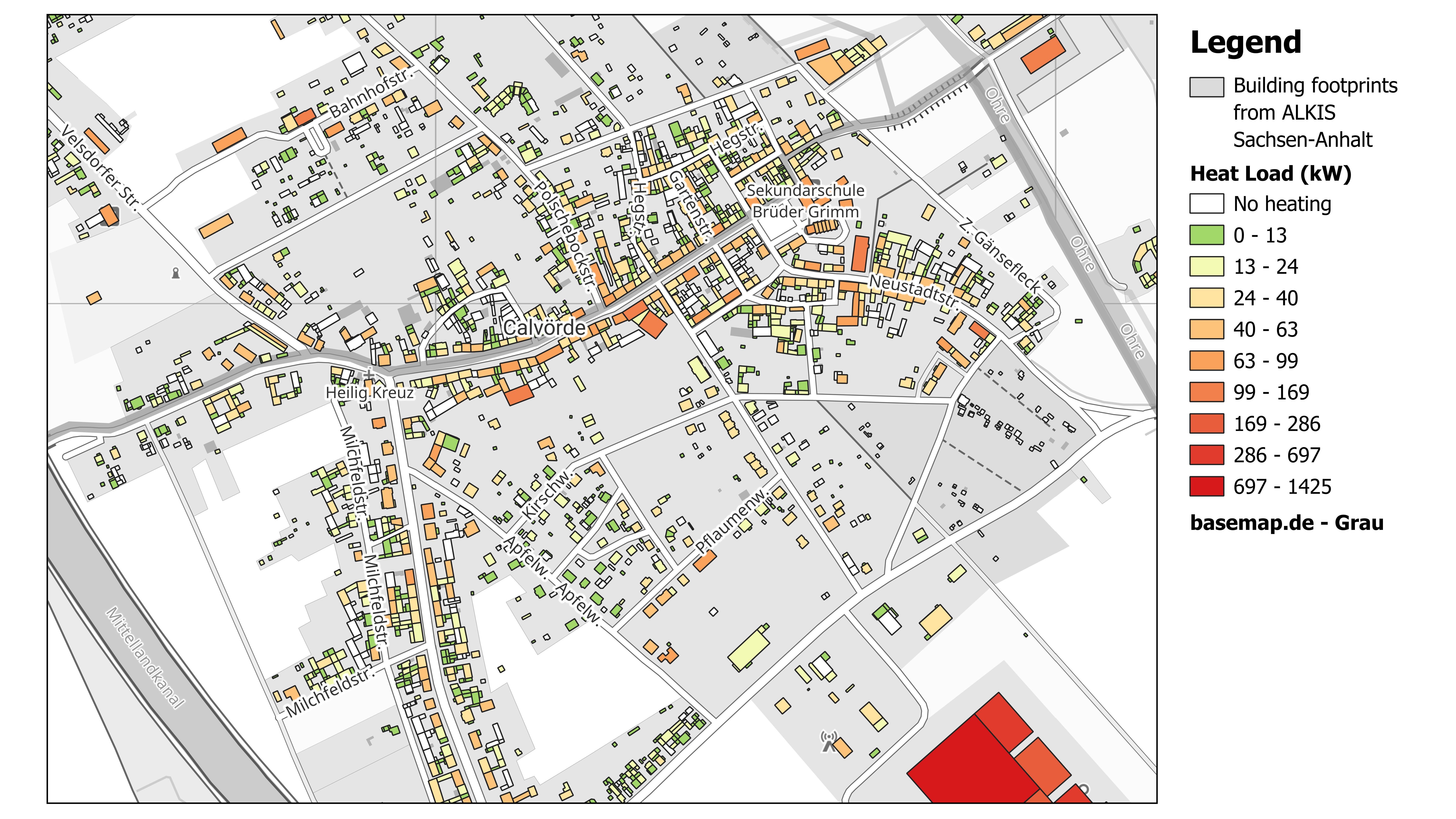
We work closely with the Institute of Networked Energy Systems on research into the energy performance of buildings. In jointly supervised doctoral theses and projects, we are working on the evaluation of innovative technologies such as infrared heating and on methods for the automated optimisation of energy systems. These represent a further step towards accelerating the selection and design of measures and increasing the objectivity of complex decision-making processes.
Focus on research collaboration with companies
Our methods provide the data basis on which decisions can be made and planning carried out. In our projects, we work together with companies in the field of measurement technology as well as with planning offices, housing associations and local authorities.
Our developments are also implemented directly by founding our own companies: In 2019, employees of the institute founded the company Lumoview which quickly creates models of existing buildings for a variety of planning tasks. At the beginning of 2024, the company heatbrAIn was founded, which evaluates and supplements publicly available data on the building stock and uses this to generate building data for municipal and neighbourhood-specific heat planning.