
Hybrid Solar Thermal Energy in District Heating



A practical example from Taars, where a hybrid solar thermal system was successfully integrated into a district heating network, shows that combining different types of solar thermal collectors offers major advantages.
In Taars/Denmark, a hybrid solar thermal system combining flat-plate and parabolic trough collectors was commissioned in August 2015. The system comprises a flat-plate collector field covering 5,960 square metre and a parabolic trough collector field covering 4,039 square metre. The return water from the district heating network is first preheated to around 70-75 degrees Celsius in the flat-plate collector field via a heat exchanger. The preheated water then passes through the parabolic trough field, which raises the temperature to 75-95 degrees Celsius.
The parabolic trough collectors were manufactured by Aalborg CSP A/S. The combination of flat-plate and parabolic trough collectors offers several advantages:
- Temperature-dependent efficiency: Flat-plate collectors work efficiently at lower temperatures, while parabolic trough collectors with evacuated absorbers achieve high efficiency even at higher temperatures.
- Overheating protection: The parabolic troughs can be defocused to prevent stagnation (when heat demand is low), enabling higher solar coverage of up to 30 percent to be achieved without additional storage requirements.
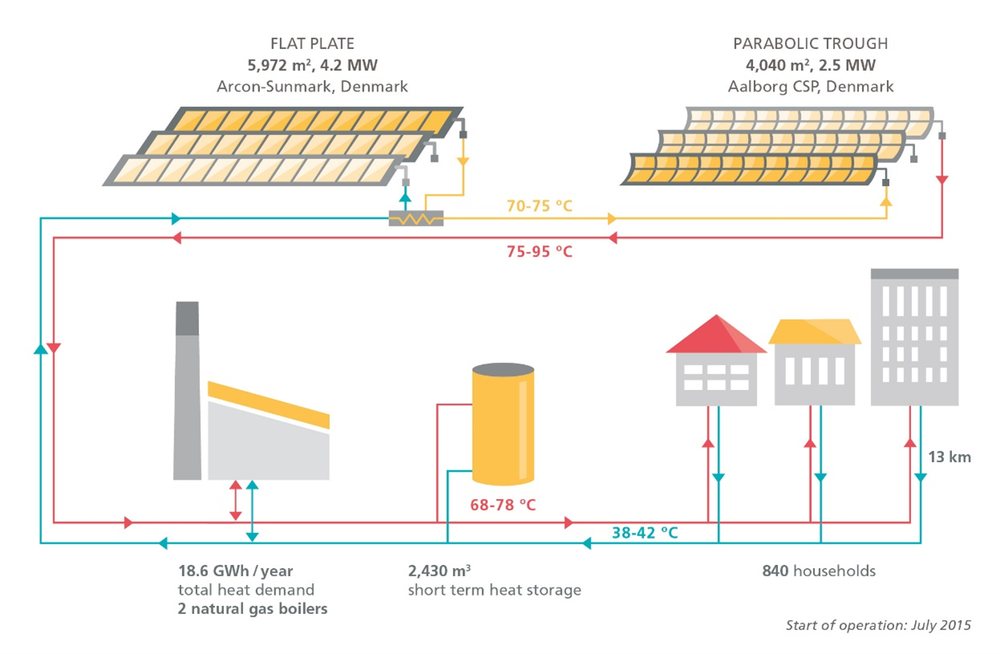
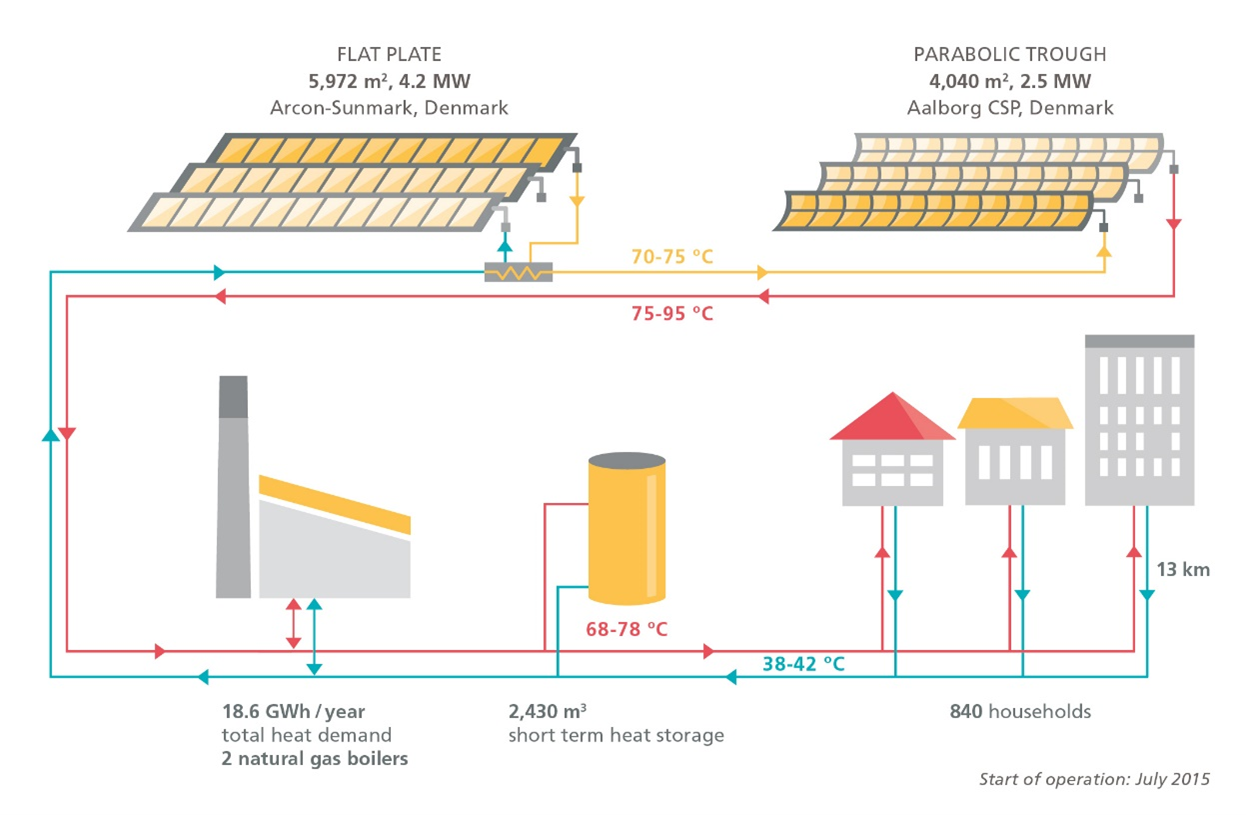
If insufficient heat is supplied, two natural gas boilers with a total output of 9.1 megawatt serve as a secondary heat source. In addition, two heat storage tanks with a total volume of 2,430 cubic metre are available, which can be used as short-term storage for several days during summer.
The plant was measured and simulated from September 2015 to August 2016. For Northern Jutland, the potential annual output of the plant is estimated at 5,180 megawatt-hours (518 kilowatt-hours per square metre). The results from Taars show that the hybrid combination of different collector types is an optimised solution for district heating networks and is effective in temperate climates.