
Potential and market for solar process heat
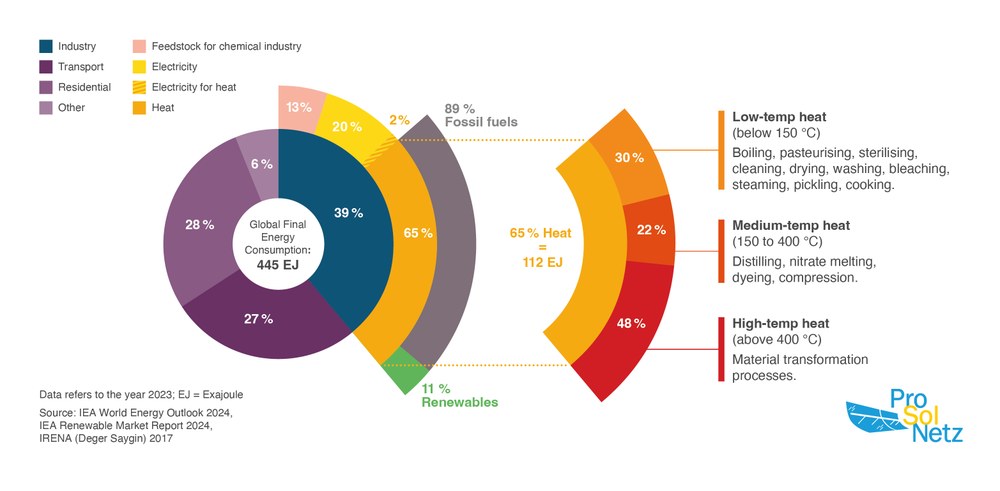

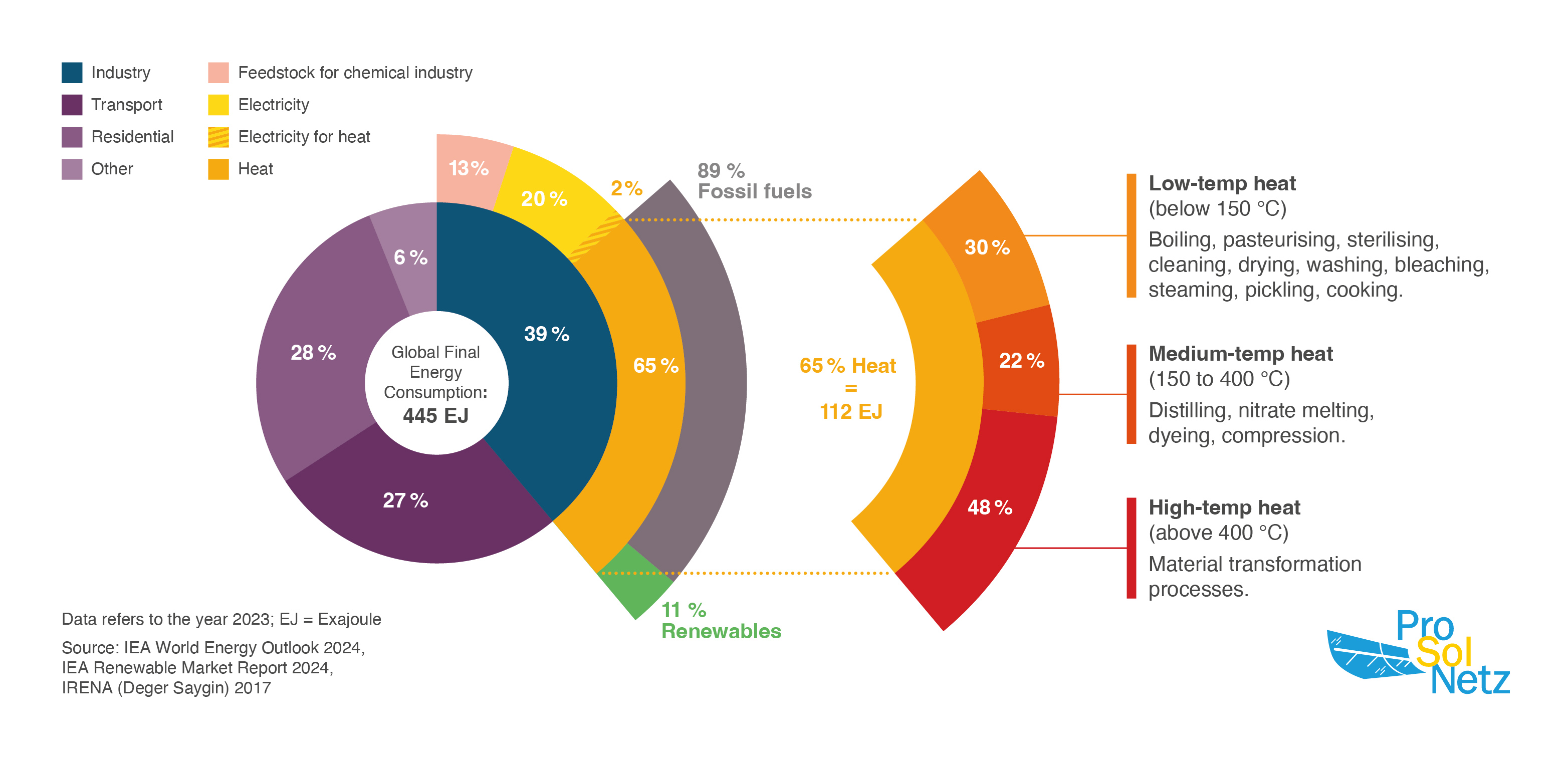
Global demand for process heat is enormous, amounting to 112 exajoules and accounting for a quarter of final energy demand in 2023. Nevertheless, significantly more attention is being paid to decarbonising the electricity sector than to CO₂ reduction in the process heat sector.
Global process heat still predominantly covered by fossil fuels
The share of renewable energies in global process heat demand remains very low at only 11 percent. Over the past ten years, this share has risen by only two percentage points. The main reason for this is the continuously growing heat demand of industry: while 85 exajoules of process heat were consumed worldwide in 2014, this figure had already risen to 112 exajoules (EJ) in 2023 – an increase of 32 percent.
Renewable process heat is currently generated almost exclusively from biomass, which accounts for 10.6 percent. Renewable heat networks contributed only 0.2 percent to global process heat demand in 2023. The contribution of solar energy to industrial heat demand worldwide has been negligible so far, at only 0.002 percent.
This figure is based on the globally installed collector area for solar process heat of 1.359 million square metres at the end of 2023. With an average annual yield of 450 kilowatt-hours per square metre, this corresponds to solar heat generation of around 612 gigawatt-hours or 0.002 exajoules.
Around half of global industrial heat demand is accounted for by processes with temperatures of up to 400 degrees Celsius. These can be easily supplied using proven and marketable solar thermal collector technologies. These include processes such as cooking, pasteurisation, sterilisation, dyeing, drying, cleaning and distillation.
SHIP market has tripled in just a few years
The global market for solar process heat (SHIP) is growing dynamically. At the end of 2024, plants with a capacity of 1.1 gigawatts were in operation worldwide. This represents a tripling of capacity compared to 2016, when regular industry surveys began. Since 2017, the companies listed on the SHIP project developer world map (https://www.solar-payback.com/suppliers/) have been surveyed annually using a questionnaire on newly installed plants in order to determine the respective market volume of the previous year.
To date, systems that supply process heat up to 100 degrees Celsius have dominated in Germany and globally. The first systems with concentrating collectors in Belgium and Denmark show that this technology can also be used technically and economically in German latitudes.
Further interesting information can be found at IEA SHC || Solar Heat Worldwide.