March 20, 2024 | DLR supports Swiss Federal Railways in the FAST project
Shunting from a distance
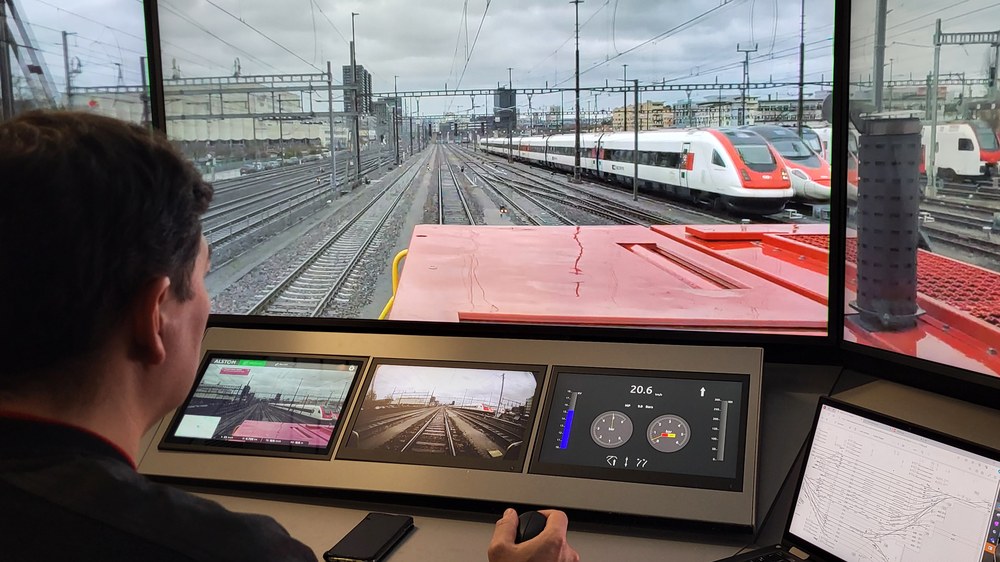
The prototype of the remote shunting workstation tested in the project
Brake test and driving off on signal - at the remote shunting workstation, many things are the same for the train drivers, but there are also differences. While they also physically perceive the acceleration when travelling on the locomotive, for example, the video stream and the speed display are the main sources of information here. Using a set of typical shunting tasks, DLR has been commissioned by SBB to investigate how well the workplace is already suited to remote control and how it can be further optimised.
Credit:
SBB AG
DLR, SBB and ALSTOM are trialling remote train shunting.
Manoeuvring is a complex application. The investigations focus on the requirements for human-technology interaction.
In particular, DLR is contributing its expertise in the user-friendly design of a workstation for remote control.
Focal points: Transport, railway research, automated and connected driving
What is needed to remotely control a locomotive in shunting mode? How must a workstation for remote shunting be designed and function? The German Aerospace Centre (DLR) is investigating these questions on behalf of Swiss Federal Railways (SBB). On 21 March 2024, DLR, SBB and ALSTOM will present the initial results during a driving demonstration. The project is a proof-of-concept in the SBB project FAST (Full Automation Specification Testing) and contributes to the specification of requirements for automation in railway operations at European level.
No automation without human operators
For some years now, there have been ideas about what automation in the railway sector could look like. Even in a scenario in which trains run autonomously, it must be possible to monitor the correct functioning of the systems and, if necessary, diagnose and intervene. "Even with a high level of automation, human operators will remain an indispensable part of the railway system," explains Dr Annika Dreßler from the DLR Institute of Transportation Systems. "In order to ensure safe and efficient operations, we must design future workplaces in such a way that they meet the performance requirements, skills and needs of the operators," Dreßler continues.
The use case of shunting offers the researchers an ideal test field for investigating the requirements of remote control for people, technology and organisation (MTO). In particular, the focus is on which requirements need to be met for optimal human-technology interaction. For example, the DLR scientists addressed the questions of which sensory information and feedback is required and in what quality, and which functions should be available to the remote operators.
Reliably controlling 90 tonnes from a distance
SBB had the prototype of the remote shunting workstation built by ALSTOM. For the trials, DLR and SBB jointly selected a set of tasks from shunting operations that represent good test cases for the sensors, information transmission and functions of the workstation. "Our test scenarios include driving according to signals in various constellations, approaching another rail vehicle for coupling and recognising various obstacles in the track," explains Dreßler. In February and March 2024, 24 SBB train drivers from passenger and freight transport as well as infrastructure and shunting operations tested the system. The controlled Aem 940 locomotive was located in the Zurich-Mülligen marshalling yard. The control centre, on the other hand, was located in the ALSTOM building in Oerlikon, five kilometres away.
"Now that the tests have been completed, the exciting phase of data evaluation begins for us," says Dreßler. "It will show us how well the prototype system was able to perform the manoeuvring tasks during the day and at night under different weather conditions and what we can still improve."