GreenH2Atlantic • Flexible electrolysis for green hydrogen on a 100-megawatt scale
Green hydrogen from wind and solar energy for a range of end users
GreenH2Atlantic • Flexible electrolysis for green hydrogen on a 100-megawatt scale
GreenH2Atlantic will support Europe in achieving environmentally friendly and cost-effective electrolysis on a gigawatt scale in the future by developing and demonstrating a one-of-a-kind 100-megawatt alkalior PEM electrolyser – the only one of its kind – at TRL 8, utilising scaling, standardisation and manufacturing automation.
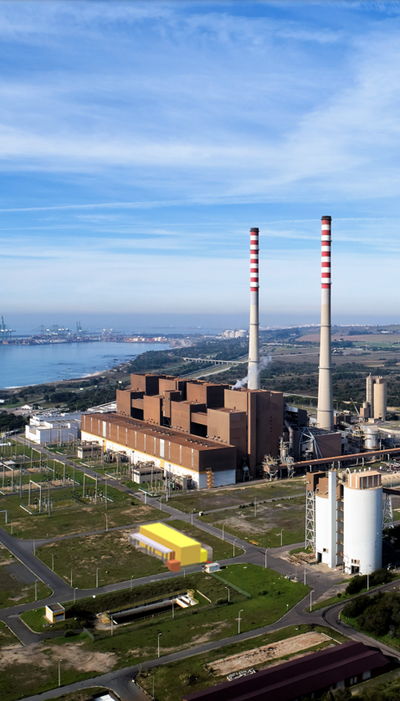
Location of the planned electrolyser (shown as a model in yellow) on the site of the coal-fired power station at the port of Sines, Portugal
Transition from black to green. The electrolysis plant is being set up on the site of a coal-fired power station that has since been decommissioned and will produce green hydrogen in future. Parts of the existing infrastructure can continue to be used.
Image: 1/2, Credit:
EDP
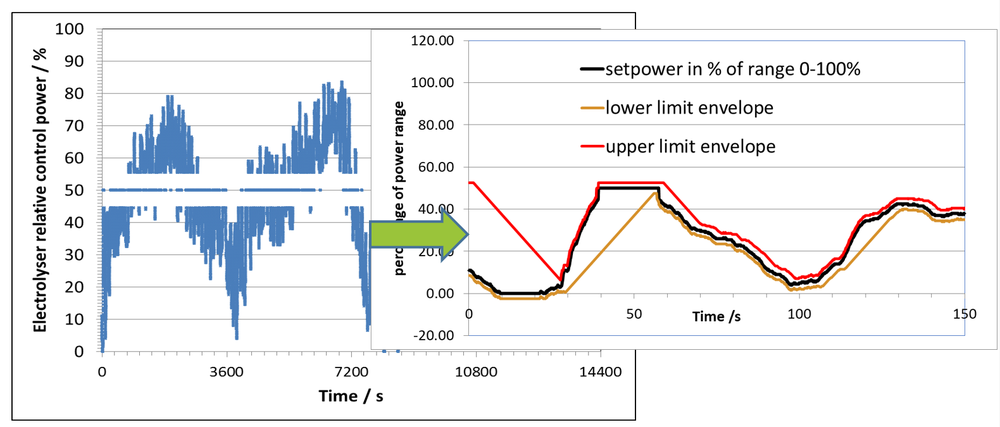
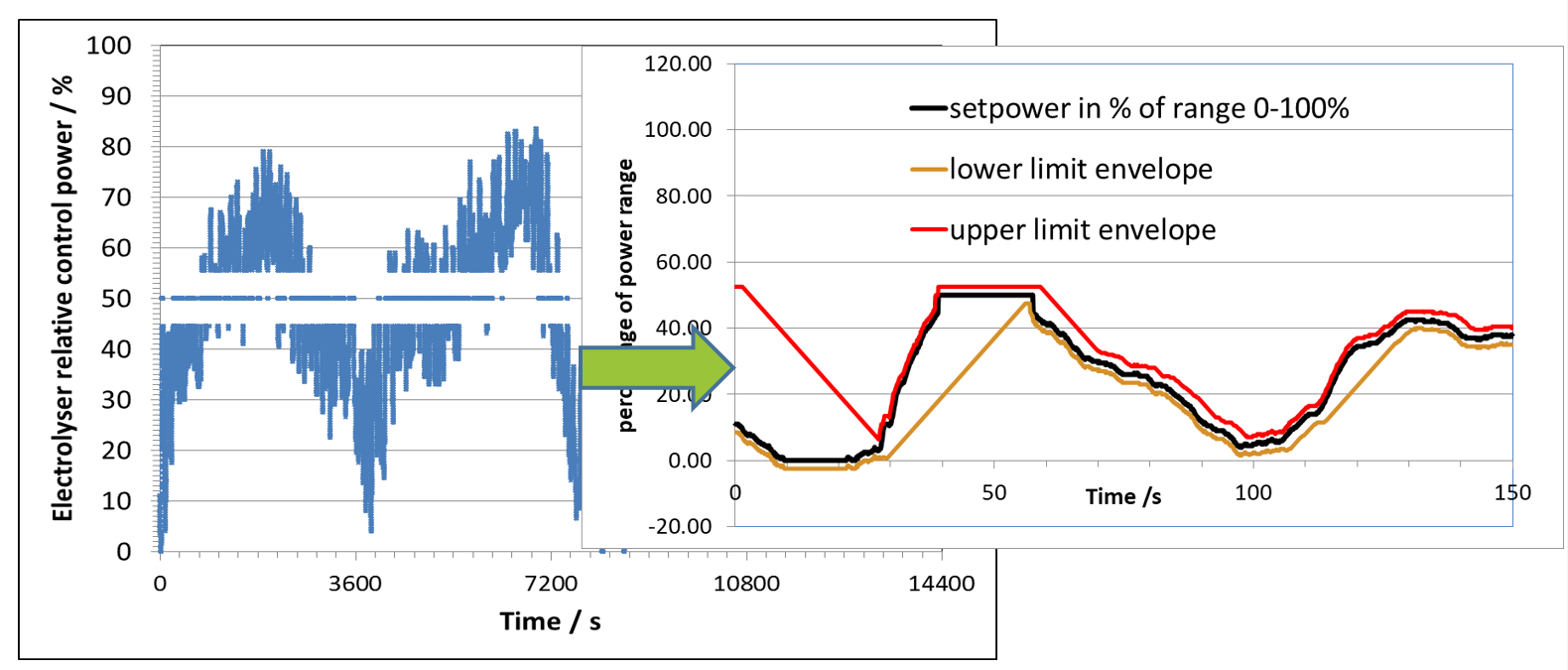
Test report for an electrolyser for regulating power
When designing the electrolysis plant, it is important to ensure that the electrolyser is capable of providing regulating power to the electricity grids. The figure shows a regulating power profile that is realistic for primary regulating power and which can be used as a test profile.
This 100-MW electrolyser will consist of innovative, scalable and rapidly adjustable multi-megawatt modules that will address development needs in terms of capital expenditure (CAPEX), efficiency, size, service life, current density and flexibility.
GreenH2Atlantic will supply several local customers and help to reduce the LCOH for green hydrogen to 2.87 EUR/kg. An innovative interface system, comprising advanced power electronics, enables the electrolyser to be directly connected to local, dedicated renewable energy from solar and wind power. Furthermore, an innovative hydrogen energy management system will enable the optimisation of operating costs (OPEX), capacity utilisation, real-time management of H₂ production, and analysis of system behaviour, amongst other things.
Our contribution to research
The German Aerospace Centre (DLR) is contributing its expertise on the construction and operation of electrolysers, degradation mechanisms and test protocols to the project. Building on previous work, test protocols are being implemented in collaboration with the electrolyser manufacturer and operator; these are designed to determine the electrolyser’s characteristics (KPIs = key performance indicators), which are particularly relevant for integration with renewable energy sources and the control capacity of the electrolysis system. Furthermore, DLR’s expertise can help to avoid operating conditions that promote degradation, thereby extending the service life of the plant.
Aim of the project
The GreenH2Atlantic project aims to develop and demonstrate an electrolysis plant for a flexible production process for green hydrogen for multiple end-users on a scale of 100 megawatts (MW).
GreenH2Atlantic at a glance
Project
GreenH2Atlantic
Duration
1.12.2021 - 30.6.2032
Project participants
DLR-Institute of Engineering Thermodynamics, Germany
EDP RENOVAVEIS SA, Spanien
PETROGAL SA, Portugal
MARTIFER-CONSTRUCOES METALOMECANICAS SA, Portugal
VESTAS WIND SYSTEMS A/S, Dänemark
BONDALTI CHEMICALS SA, Portugal
INSTITUTO DE SOLDADURA E QUALIDADE, Portugal
INESC TEC - INSTITUTO DE ENGENHARIADE SISTEMAS E COMPUTADORES, TECNOLOGIA E CIENCIA, Portugal
COMMISSARIAT A L ENERGIE ATOMIQUE ET AUX ENERGIES ALTERNATIVES, Frankreich
AXELERA – ASSOCIATION CHIMIE-ENVIRONNEMENT LYON ET RHONE-ALPES, Frankreich
HYTLANTIC SA, Portugal
SIEMENS AKTIENGESELLSCHAFT, Deutschland
HYLAB - GREEN HYDROGEN COLABORATIVE LABORATORY, Portugal
Funding
European Union’s Horizon 2020 research and innovation programme
Credit:
eu
Contact
Prof. Dr. rer.nat. K. Andreas Friedrich
Head of Department Electrochemical Energy Technology