As part of the EU-funded SWEETHY project, an electrolysis stack is being developed to produce hydrogen directly from seawater
SWEETHY • Hydrogen directly from seawater
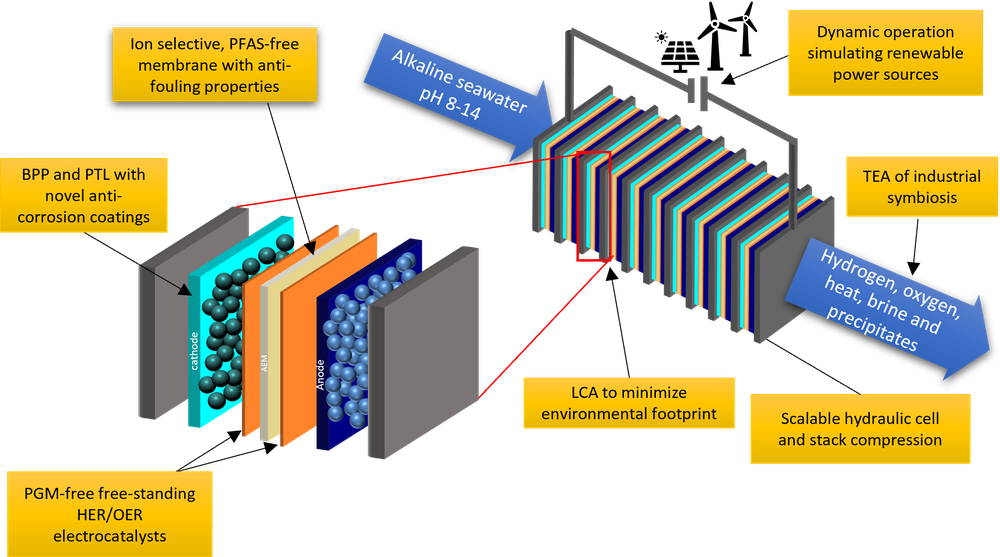
Overview of the technology that will be developed within the SWEETHY project
Credit:
Live Mølmen/RISE
The SWEETHY project addresses the challenge of treating contaminated water by utilising the innovative AEMWE technology (anion-exchange membrane water electrolyser) and by developing new, more durable and cost-effective materials capable of withstanding highly corrosive saline conditions. The electrolysis stack developed ultimately guarantees an operational lifespan of more than 2,000 hours, with a degradation rate of 1 per cent per 100 hours.
Sustainability and the circular economy through industrial symbiosis
The overall sustainability and circular economy of the electrolyser platform are ensured through the development of symbiotic solutions in collaboration with external industry partners, which enable the efficient reuse of electrolyser by-products (brine and other sea salts, as well as heat).
Ultimately, SWEETHY’s work paves the way for decentralised and distributed hydrogen production using seawater and local renewable energy sources.
Nine organisations (two research centres, four research and technology centres, and three small and medium-sized enterprises) from seven European countries (Sweden, Italy, Spain, Germany, France, Norway and the Netherlands) are involved in this ambitious project.
Project objective: To improve corrosion resistance
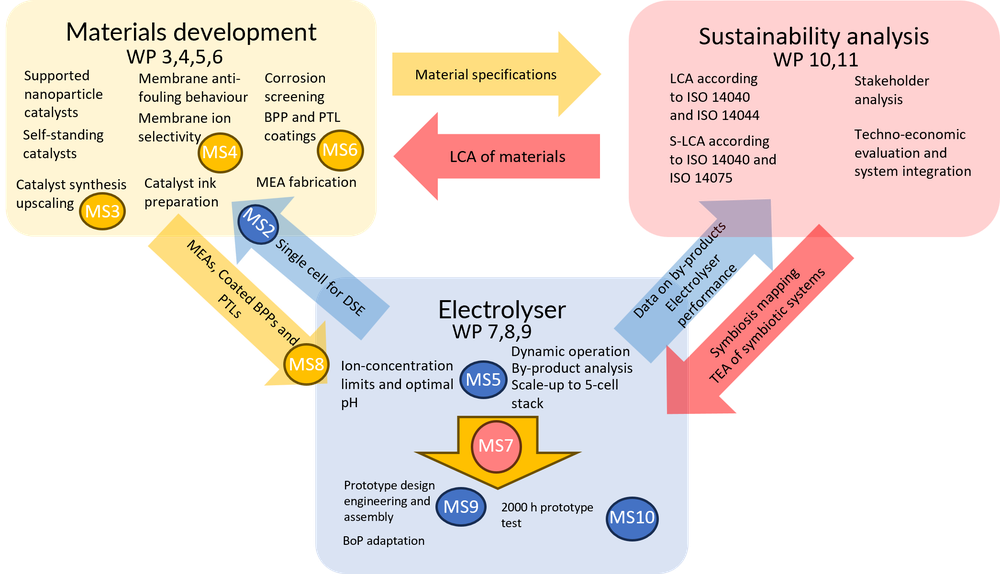
The project addresses the challenges of seawater electrolysis from three perspectives: materials development, sustainability analysis and electrolyser configuration.
The materials used for the individual components of the electrolyser are being investigated with the aim of improving their corrosion resistance in saline conditions.
Sustainability and cost-effectiveness considerations are factored into the assessment and serve as guidelines for identifying the key trade-offs between cost, efficiency and durability.
Finally, our materials are integrated into a modular and scalable electrolyser configuration that is fed with seawater and operates under dynamic conditions typical of renewable energy sources.
Our role in the SWEETHY project
As project partners in SWEETHY, we contribute our extensive expertise in the development of membrane electrode assemblies (MEAs). Furthermore, we support the consortium in optimising individual cell performance through the use of advanced surface science techniques and electrochemical diagnostics.
We also play a key role in the development of anti-corrosion coatings for bipolar plates (BBPs) and porous transport layers (PTLs), drawing on our many years of expertise in the field of plasma spraying technologies.
An overview of the work plan and interactions within the SWEETHY projects with the milestones and work packages indicated
Credit:
Live Mølmen/RISE
SWEETHY at a glance
Project
SWEETHY (Direct Seawater Electrolysis Technology for Distributed Hydrogen Production)
Duration
1.3.2025 - 28.2.2029
Project participants
DLR-Institute of Engineering Thermodynamics
CIDETEC Surface Engineering
CENmat
SINTEF Industry
National Research Council of Italy (CNR-ITAE)
ProPuls
Research Institutes of Sweden (RISE)
Funding
The project is supported by the Clean Hydrogen Partnership and its members. Co-funded by the European Union under Grant Agreement N° 101192342.
Credit:
Clean Hydrogen Partnership
Credit:
EU
Contact
Prof. Dr. rer.nat. K. Andreas Friedrich
Head of Department Electrochemical Energy Technology