
3D Components Analysis
Targeted research into and optimisation of modern materials – ranging from universal material structures in general materials research to application-specific components in future-oriented energy converters and storage systems such as batteries, fuel cells or electrolysis systems – requires precise analysis of physical and chemical processes at the micrometre and nanometre scales. As part of the ‘3D Component Analysis’ large-scale facility, two independent, complementary systems are available for this purpose: a nano-computed tomograph (n-CT) for non-destructive, AI-assisted structural analysis, and a high-resolution mass spectrometer (ICP-MS) with integrated laser ablation (LA) and LIBS for precise elemental analysis. Both instruments can be operated independently; however, when used in combination, they provide comprehensive insight into the geometry and chemistry of complex materials and system components.
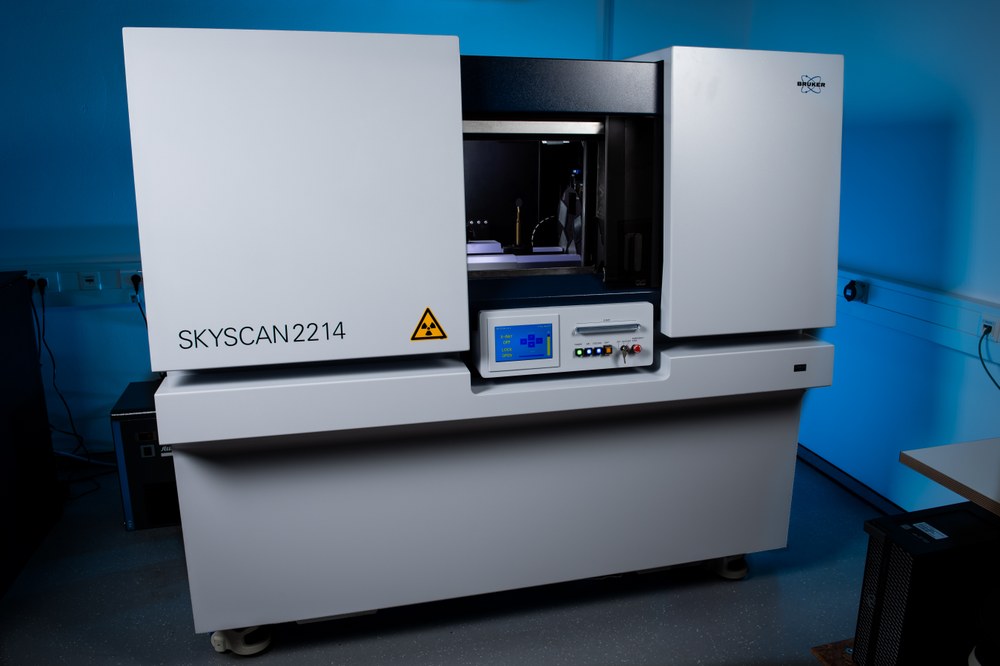


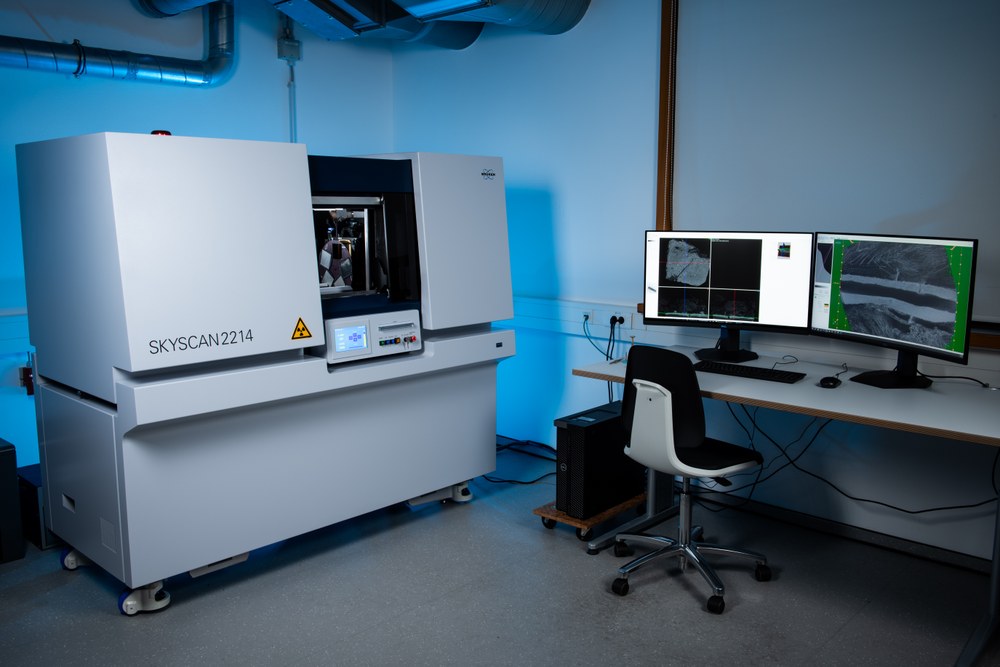


The SKYSCAN 2214 nano-computed tomography scanner is used for three-dimensional non-destructive characterisation. The system functions as a high-resolution X-ray microscope, which analyses solid samples from all angles as they rotate and generates an accurate, three-dimensional volume model of the object’s interior using digital reconstruction. With a minimum pixel size of up to 100 nanometres, microstructures, interfaces and even material defects in the sub-micrometre range can be quantified. The configuration comprising four flexible X-ray detectors enables the precise imaging of a wide variety of geometries and textures up to a diameter of 140 millimetres. The system is complemented by a compression unit for mechanical material testing under controllable compressive or tensile loads directly in the beam path. A primary focus of application in energy research lies in time-resolved operando investigations (4D-CT). Optimised reconstruction algorithms enable transient thermodynamic and electrochemical processes – such as the nucleation of microcracks in battery electrodes, dynamic shifts in pore size distribution or multiphase mass transport in gas diffusion layers of fuel cells – can be analysed visually and quantitatively directly whilst the system is in operation.
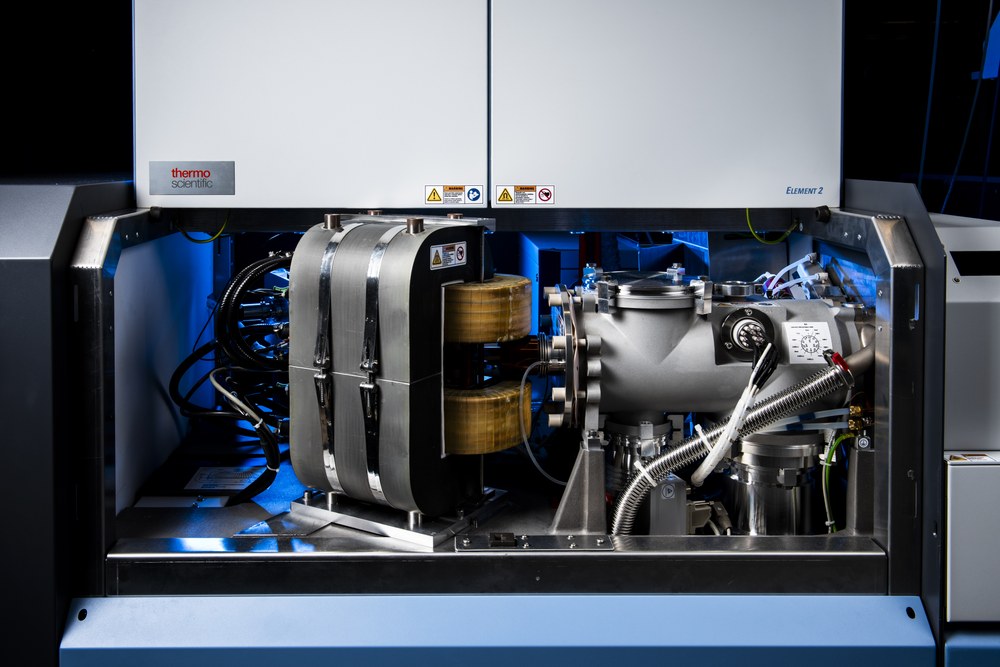
Chemical element and isotope analysis is carried out separately using the high-resolution sector-field ICP-MS. For the direct analysis of solids, the mass spectrometer is coupled with a laser ablation unit, which uses a high-energy laser beam to ablate sample material in the micrometre range in a minimally invasive manner. This material is then transported into a plasma. The subsequent mass separation in the high-precision magnetic sector field physically eliminates spectral interference, thereby enabling error-free element quantification in the ultra-trace range, such as in platinum or iridium catalysts. Simultaneously, the integrated LIBS technology captures the signal from the laser-induced plasma, enabling sensitive real-time detection of light elements such as lithium or fluorine. Complementing the focus on solids, ICP-MS enables trace analysis of aqueous media such as process waters for the investigation of a wide variety of degradation and leaching processes, as well as the fully quantitative determination of solid content following, for example, chemical acid digestion.
The key advantage of the large-scale facility lies in the synergy effect: whilst n-CT maps the physical geometry, ICP-MS provides the chemical composition. It is only this combination that delivers a comprehensive, complete picture of, for example, complex system components.
The range of applications for both large-scale instruments extends beyond energy technology and forms a versatile platform for interdisciplinary scientific and industrial collaboration. In geology and palaeoclimate research, tomography is used to characterise the growth structures of marine organisms, whilst ICP-MS determines their elemental and isotopic ratios for climate reconstruction. In materials science, CT enables the detection of microstructural defects in additively manufactured components, whilst ICP-MS verifies the homogeneity of the alloy constituents. Furthermore, both systems provide critical structural and material data in the semiconductor industry for the detection of surface contaminants on wafers, as well as in biomedical implant research for the analysis of bone-implant interfaces.