
DEMON - Fuel Cell Test Rig for Multi-Stack Energy Systems
The DEMON test rig at the DLR Institute of Engineering Thermodynamics in Hamburg is used to investigate the transient operation of fuel cell systems for energy supply, with a focus on aviation applications. Mechanisms for power scaling are investigated by integrating several stacks with a shared media supply. Their dynamic characteristics are determined in experiments and further improved through automation.
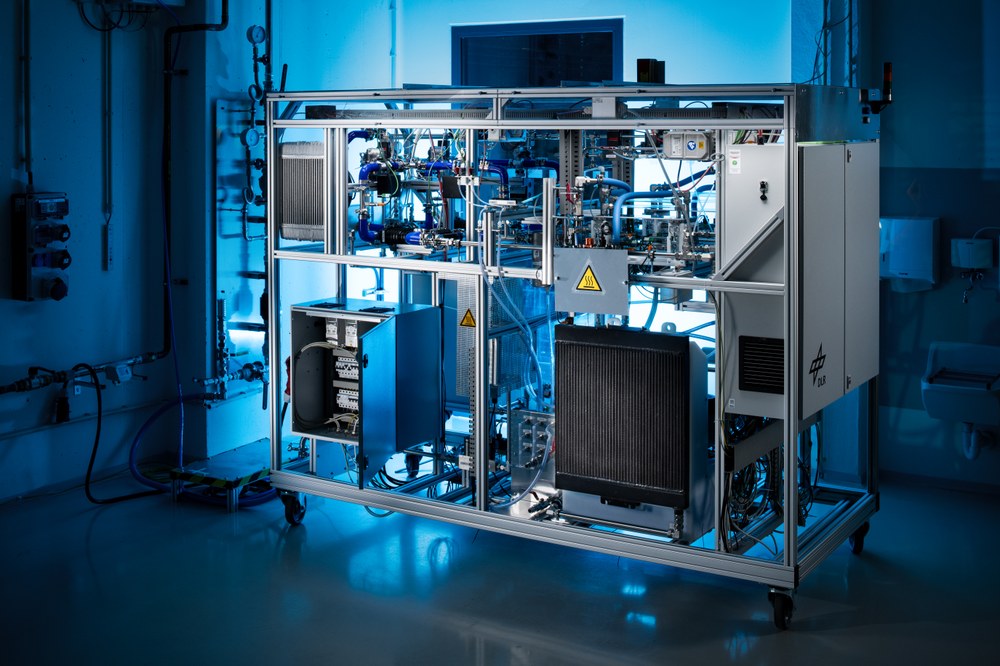


Research tasks: operation and control of fuel cell systems
Decarbonisation in the heavy-duty segment of the transport sector, particularly in aviation, requires the development of innovative energy concepts and the adaptation of their operating modes. One approach involves connecting several fuel cell stacks into a so-called multi-stack fuel cell system (MFCS) for energy provision in the most energy-efficient and weight-saving manner possible. However, it is not only the design of these systems that presents a challenge. Control engineering also requires intelligent solutions, as it must ensure the electric power supply of the highly integrated system architecture across all operating scenarios. The investigations at the DEMON test rig therefore focus on research questions in the following areas:
- Characterisation of the transient behaviour of the electric power supply by highly integrated MFCS
- Model-based development of controllers for balance-of-plant (BoP) components
- Testing of different automation approaches and operating concepts for fuel cell systems
- Validation of operating strategies
Operating modes and investigation options
The following operating modes are possible:
- Inhomogeneous operation of both stacks.
- Individual operation of specific subsystems.
- Use of dummy stacks to bridge the media supply.
- Switching between internal radiator cooling and external cooling.
These allow a wide range of investigations to be carried out, e.g.:
- Dynamic operating scenarios in the heavy-duty segment, such as rapid load changes.
- Critical system conditions, such as reduced cooling capacity.
- Running scaled aircraft mission profiles as electric power supply for energy provision with high-resolution data acquisition.
- The influence of individual components on overall system behaviour, e.g. the influence of parasitic auxiliary power from the 24 VDC and 230/400 VAC supply.

Daniel Reinhardt
Media supply and disposal
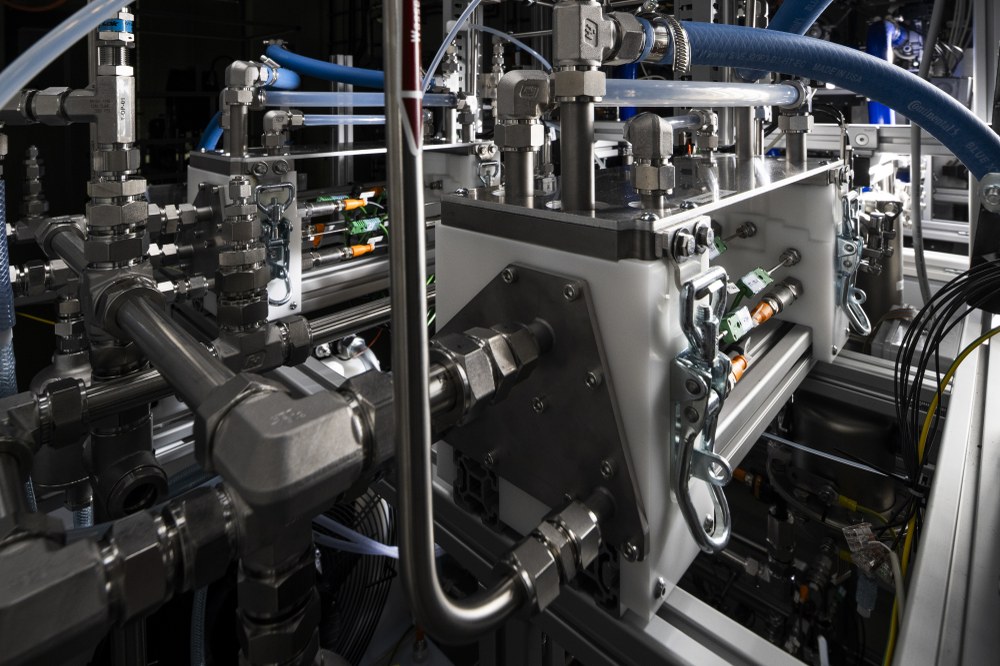
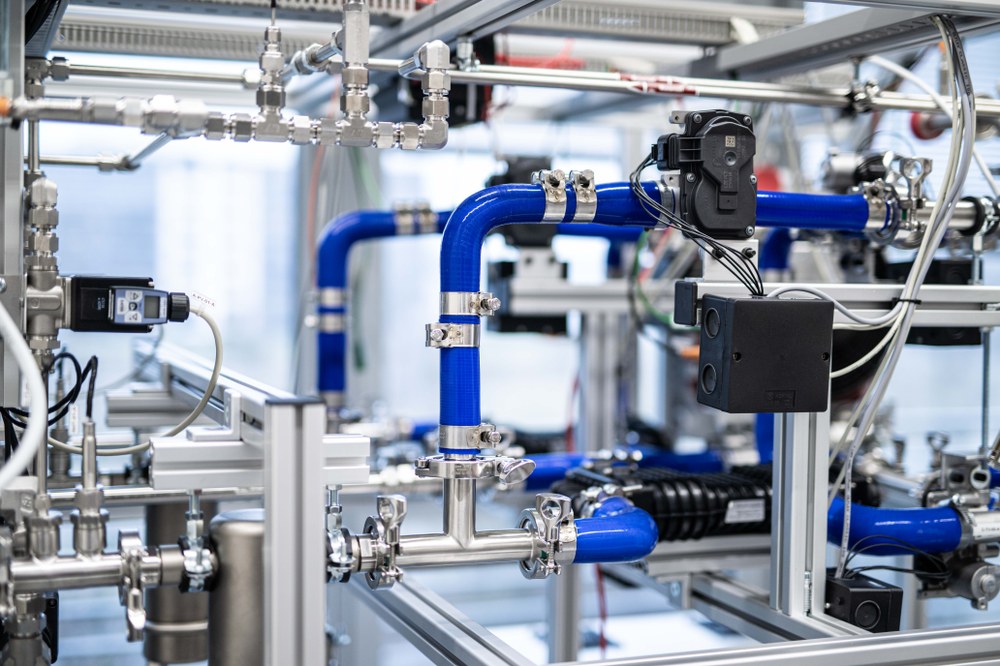
The media supply of the laboratories at the Zentrum für Angewandte Luftfahrtforschung (ZAL) provides gaseous hydrogen and process air of the required purity for operating the test rig. In addition, the nitrogen supply enables flushing and inerting of the hydrogen-carrying parts of the plant. The hydrogen gas is expanded to the operating pressure of the stack and mixed with recirculated anode exhaust gas. The supply of process air is controlled on the cathode side via a mass flow controller and humidified before entering the stack. Both systems are designed to supply fuel cell stacks with a nominal electrical output of up to 12 kW and a relative operating pressure of up to 2 bar. The humid exhaust gases of the test rig are condensed and discharged via the building’s chimney.
Extended investigation options
- Electrical load management and scenarios for reconditioning the fuel cell stacks.
- Alternative removal of waste heat via an externally connected cooling unit.
- Effects of alternative balance-of-plant components on the overall system.
- Operation in boundary ranges, for example start-up and shutdown processes.
- Investigation of ageing effects using accelerated stress tests (AST).
- Degradation analysis using gas analysis and impedance spectroscopy.