
Test field High Temperature Cells and Stacks
The decarbonization of energy supply and mobility requires highly efficient energy conversion technologies. High temperature Fuel cells and electrolyzers offer great potential as key technologies in this regard. To unlock the full performance of these systems, the availability of precise test environments is essential. Our high-temperature cell and stack test field provides a comprehensive infrastructure for the characterization and optimization of solid oxide (SOC) and proton-conducting cell (PCC) technology under near-real-world conditions.
Rapid screening at the button-cell level (~ 1 cm²)
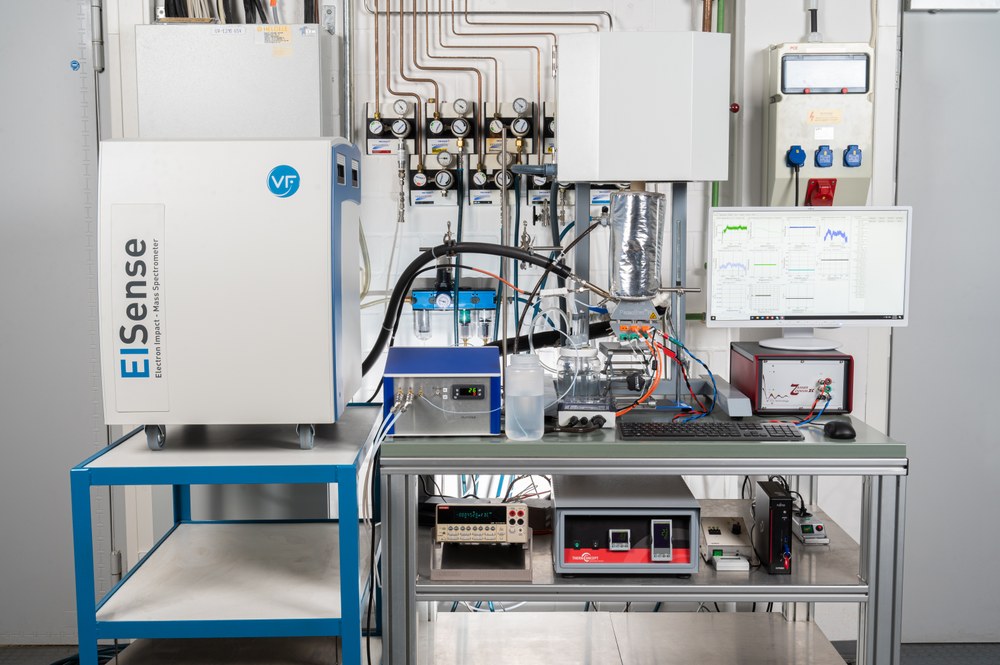
A separate area dedicated to button cell characterization is available for the rapid validation of new material combinations and the early-stage verification of cell designs for solid oxide and proton-conducting cells. With two dedicated test stations, small-format cells—approximately 1 cm² in size—can be tested efficiently.


Comprehensive characterization capabilities under real-world conditions
A key feature of our laboratory is its flexibility regarding cell geometry and operating conditions. We offer two solid oxide cell test stations for single cells in the 5×5 cm² format, at which we can characterize up to four cells simultaneously. This enables efficient operation and significant time savings in material development.
Our test stands support both fuel cell and electrolysis modes and are designed for use with a wide variety of gases, such as hydrogen (H2), nitrogen (N2), methane (CH4), carbon monoxide (CO), carbon dioxide (CO2), and air. A distinctive feature of our systems is the precise pre-programming of gas changes and temperature profiles at defined time points, enabling the exact replication of real-world, fluctuating operating conditions.
Stack test field
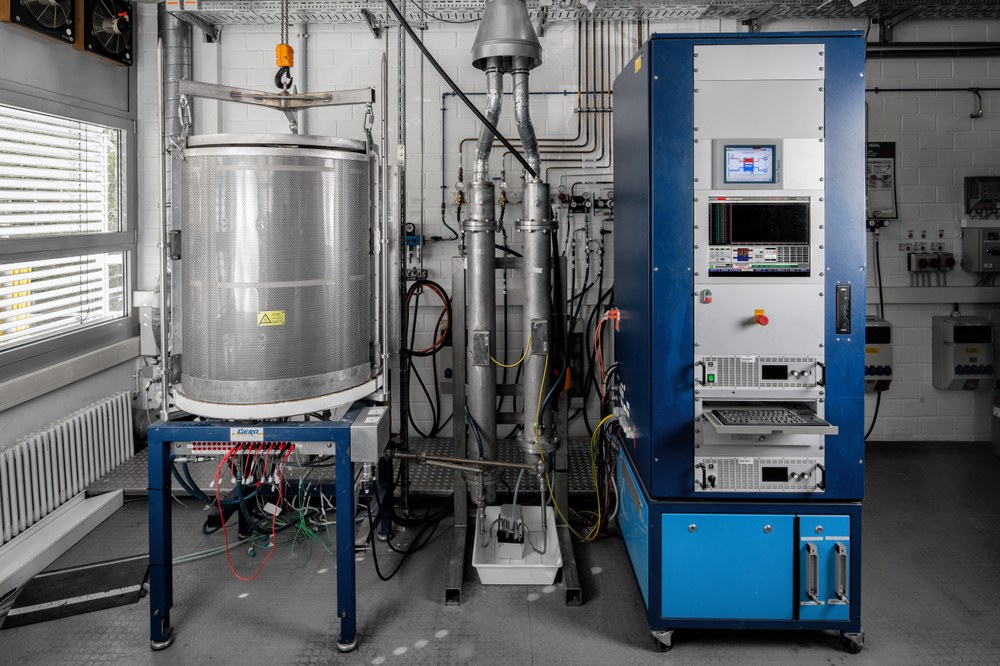
With our 4 test stations dedicated to stack investigations, we can investigate the electrochemical behaviour of SOC (3 test stations) and PCC (1 test station) stacks.
More specifically, SOC stacks comprising up to 60 layers, with an active cell area of 400 cm² and reaching a power output of up to 5 kW, can be tested. Control via a PLC ensures reliable, automated operation - covering stationary, dynamic, intermittent, and reversible modes - for durations exceeding 10,000 hours. The stacks can be operated within a temperature range of 600 °C to 1000 °C, offering a wide range of variability for fuel and oxidant gases. Thus, in fuel cell mode, it is possible to utilize not only hydrogen but also reformate gas mixtures consisting of methane, carbon monoxide, and carbon dioxide. In electrolysis mode, in addition to standard steam electrolysis, co-electrolysis of steam and carbon dioxide to produce syngas (hydrogen and carbon monoxide) is also possible.

High Data Quality and Precise Gas Analysis
To provide reliable data for assessing electrochemical performance, our laboratory is equipped with a state-of-the-art gas analysis infrastructure. We utilize a quadrupole mass spectrometer with electron ionization (EI-MS) for the precise multi-component analysis of the cell’s outlet gas. This detailed analysis of the gas composition enables us not only to determine the gas-phase throughput but also to perform exact calculations of the Faradaic efficiency and selectivity—a capability of particular importance for research into new membranes and catalysts.
Particularly at the stack level, the following analytical procedures can be performed:
- DC measurements with variable direct current (so-called current-voltage characteristics)
- Gas analysis of reactant and product gases to determine gas conversion
- Analysis of the leak-tightness of the stack and its individual layers
- Determination of homogeneity across the height of the stack
- Electrochemical Impedance Spectroscopy (EIS) on the entire stack and on its individual layers
- Analysis of individual electrochemical processes by determining relaxation times (DRT: Distribution of Relaxation Times)
- Determination of the respective resistances of cell components using equivalent circuit models
- Reliable quantitative determination of degradation rates over periods exceeding 10,000 hours
- Qualitative analysis of various degradation mechanisms
Research goals
Cell and stack investigations are crucial to enhancing the performance of SOC and PCC technologies across a wide range of applications. Based on these results, actionable recommendations regarding materials selection and the design of individual stack components can be effectively drawn. Through reliable long-term operation—combined with detailed electrochemical characterization—strategies and concepts can be developed to ensure the safe and low-degradation operation of these electrochemical reactors. Analogous to performance enhancement, we can draw key recommendation to developers for improving their technology
Projects
- H2Giga-HTELstacks
- SUSTAINCELL
- HADES
- PEPPER
- International Joint Research Centre KIMM + DLR