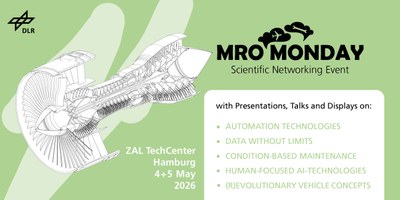
4.–5. Mai 2026
Scientific Networking

MRO Monday 2026

Eine Anmeldung für den MRO Monday ist ab dem 16.2.2026 möglich.

Agenda - Montag 04.05.2026

14 Uhr
Ankunft und Auftakt
Eröffnung der Veranstaltung durch den Institutsdirektor Gerko Wende

14:15 Uhr
Auftakt-Keynote
Speaker tba.

15:00 Uhr
Focus: MRO x Industry
Session zu erfolgreichen Kooperationsprojekten zwischen Industriepartnern und dem DLR Institut für Instandhaltung und Modifikation.

16:00 Uhr
Focus: EXPO
Robotiker Florian Heilemann (DLR) stellt die Automations-Projekte der Ausstellung vor und leitet in die Eröffnung dieser über.

16:30 – 18:00 Uhr
EXPO Opening
Social Event zum Networken und für erste Eindrücke der Ausstellung.

an beiden Tagen geöffnet
EXPO
Aussteller tba.

Agenda - Dienstag 05.05.2026

9:00 Uhr
Begrüßung
Institutsdirektor Gerko Wende mit eröffnenden Worten für den Tag

9:15 Uhr
Kick.Off: Keynote tba.
Speaker tba.

Session A.1 : Sustainable Competitiveness
5.5.2026, 10:30 Uhr

The aviation industry is at a crossroads. With increasing regulatory pressure, geopolitical dependencies, and the need to drastically reduce environmental impact, competitiveness can no longer be separated from sustainability. MRO is right at the center of this transformation, connecting design, operation, and end-of-life in a way that defines modern aviation's efficiency and reliability.

To address sustainable competitiveness, an integrated approach combining circularity, advanced technologies for maintenance strategies, digitalization, and process inovation is needed. Circular economy principles point the way towards closing material loops and keeping valuable components in use. Digital methods, from predictive health monitoring to data-driven logistics, promise new levels of efficiency and reliability. But they only unfold their potential if the underlying processes evolve as well: through better modelling, transparency, and continuous optimisation, especially in the early phases of product development. This session provides insights an these factors and discusses associated barriers and opportunities. Bringing all these perspectives together, it explores how MRO can move from being a cost factor to becoming a driver of sustainable competitiveness.

Session B.1 : Human-Focused KI-Technologies 
5.5.2026, 10:30 Uhr

Maintenance in aviation usually involves a large amount of manual labour. Due to the high individuality of damages, many of these tasks cannot be automated efficiently. On the other hand, a shortage in workforce exists and there is a trend towards a more digitalized maintenance, making it important to acquire machine-readable data from manual processes. This session exploreres how technologies can assist the human in maintenance, e.g. by supplying needed information in a usable way or by assisting in non-value adding tasks and automated data acquisition. It also provides insights into how new MRO technologies should be developed in order to achieve a high usability, user acceptance and trust into new technologies. 

Session A.2 : Maintenance Aspects for (R)evolutionary Vehicle Concepts
5.5.2026, 12:30 Uhr

With the expectation of rising kerosene prices and societies demanding pathways towards carbon neutrality, the aviation industry is under pressure in its pursuit to reduce their fossil fuel need and the associated climate impact. Consequently, new revolutionary aircraft design concepts – for the use of alternative energy carriers such as hydrogen – are required to decouple emissions from growing air traffic volumes. However, in addition to maturity challenges of the respective technology (e.g., weight-reduced fuel cells with sufficient power outputs), there are substantial uncertainties associated with the overall operational implications for these concepts and their economic viability. Since aircraft maintenance contributes up to 25% of to the direct operating cost of an aircraft, it represents a major leverage to address these issues. Therefore, this session aims to

  1. Present approaches for the identification of maintenance requirements in early design stages,
  2. Examine how the maintenance execution changes for new aircraft system design philosophies,
  3. Define possibilities to mitigate additional manual maintenance labor, and
  4. Perform comparisons beyond the aviation industry to identify synergies among different applications in the transport sector. 

Session B.2 : Data without Limits 
5.5.2026, 12:30 Uhr

Modern engineering thrives on data—but what happens when data are scarce, incomplete, or too costly to collect? Data Without Limits explores how physics, AI, and creativity combine to overcome these boundaries. In non-destructive testing, Physics-Informed Machine Learning leverages the laws of physics to cut data needs while improving defect detection accuracy. Where measurements are limited, synthetic training data bridges the gap—enabling reliable aircraft dent detection without exhaustive real-world samples. Conversely, in data-rich domains such as fuel burn prediction, Big Data analytics and advanced neural networks uncover subtle efficiency patterns that were previously hidden. Together, these approaches redefine what’s possible when intelligence meets physics: a future where data scarcity is no longer a limitation, but an invitation to innovate.

Session A.3 : Automationtechnologies
5.5.2026, 14:30 Uhr

A key element of competitiveness is increased work efficiency. Automation is one of the most decisive factors in achieving this. While many production processes have been heavily automated since industrialisation, the MRO sector has thus far lagged behind. This is due to obstacles such as small batch sizes, frequently changing tasks, difficult accessibility and high safety requirements, which could not be overcome by traditional automation techniques. However, modern methods from robotics and data processing now offer new opportunities to increase not only the degree of automation but also the quality and quantity of data.

This session will begin with an overview of the current state of the art in industry and research. It will then present how a robot-based contactless ultrasound method can be used to find damage in CFRP parts that are difficult to access. In addition, a robot-based inspection system for automatic 3D damage assessment of engine components will be presented.

Session B.3 : Condition-Based Maintenance
5.5.2026, 14:30 Uhr

Currently the scheduling of maintenance for a component is based on design parameters (e.g. flight cycles) and empirical models (e.g. for degradation). Where long-term models are not available or applicable maintenance activities may be triggered when a defined threshold is reached during inspection. While these approaches assure a safe operation, they go along with an inherent lack of efficiency, may require ad-hoc actions and provide only little insight into the actual condition of a component. In order to exploit the whole potential engineered into a component it is desireable to closely monitor and predict its condition and plan activities at a point in time when this potential is almost fully used while still remaining save. This session shines a light at different approaches of condition monitoring, implications readarding safety and security of data systems as well as the modelling of maintenance.

16.00 Uhr
Abschluss-Keynote
Speaker tba.

16.20 - 16:30 Uhr
Abschluss
Institutsdirektor Gerko Wende mit Danksagung und abschließenden Worten