Aeroelasticity in Strut-Braced-Wing Configurations: A Contribution to Conceptual Design
November 9, 2026
Aeroelasticity in Strut-Braced-Wing Configurations: A Contribution to Conceptual Design
Aviation contributes about 1–2% to global CO₂ emissions, doubling every two decades under a 3–4% annual traffic growth. Decarbonization requires efficient technologies and aircraft concepts. One approach are high-aspect-ratio wings, which reduce induced drag and increase flexibility through thinner airfoils and reduced overall area. The strut-braced wing (SBW) concept, where a strut provides structural support, enables the implementation of such high-aspect-ratio wings. Within the European Clean Aviation research program, the AWATAR project (Advanced Wing MATuration And integRation) [1, 2, 3] investigates the conceptual design of short- and medium-range aircraft with an aspect ratio of ~25. Parametric studies focus on wing-strut weight optimization, while analyzing the effects of geometric nonlinearities and aeroelastic stability.
Physical challenges in SBW Configurations: Overdeterminded Structures and Geometric Nonlinearity
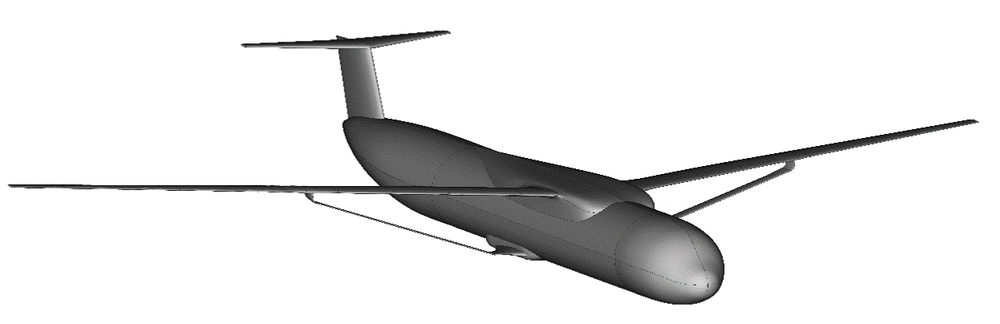
Figure 1 shows the AWATAR configuration. SBW configurations are characterized by statically overdetermined connections between wing, strut, and fuselage. This leads to complex load distributions and additional axial forces from strut reaction loads. Large deformations occur, inducing geometric nonlinearities that significantly affect stiffness, load paths, and eigenmodes.
Linear structural mechanics is based on linearized kinematic relations and equilibrium conditions. However, in high-aspect-ratio, strut-braced-wings, large deformations and rotations as well as load-dependent stress states can give rise to geometrically nonlinear effects. These effects can significantly influence the effective structural stiffness and, consequently the natural frequencies, mode shapes, and flutter stability. Linear analyses that do not account for these effects may therefore yield inaccurate or non-conservative results. For a reliable assessment of the structural-dynamic and aeroelastic behavior of high-aspect-ratio, strut-braced wings, the consideration of geometric nonlinearities is therefore of particular importance.
Conceptual Optimization and Nonlinear Load Analysis: Aileron Effectiveness and Loading
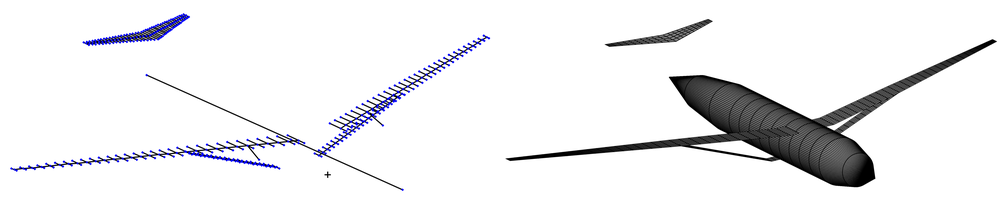
Figure 2: Finite element beam and aerodynamic panel models
Parametric studies were carried out using the DLR-developed CLA (Conceptual Loads Analysis) tool [4, 5], a semi-empirical method for estimating wing and strut mass. It accounts for structural and aeroelastic boundary conditions and considering maneuver, gust, and landing loads. Design variables included strut attachment position along span and chord, strut angle, engine position, and Prandtl’s lift distribution. Results show that including aileron effectiveness in structural optimization significantly influences the optimal strut position for minimum system weight. Attaching the strut to the rear spar improves aileron effectiveness and reduces total weight [5, 6].
From the most promising configurations, finite element (FE) beam models were exported (see Figure 2) and used in MSC Nastran for linear and nonlinear analyses. Geometrically nonlinear analyses reveal load-dependent redistribution of internal forces: push-down maneuvers increase stiffness via strut tension forces and reduce bending moments, while pull-up maneuvers reduce stiffness due to strut compression forces and increase bending moments. Thus, linear analyses are conservative under compression but non-conservative under tension.
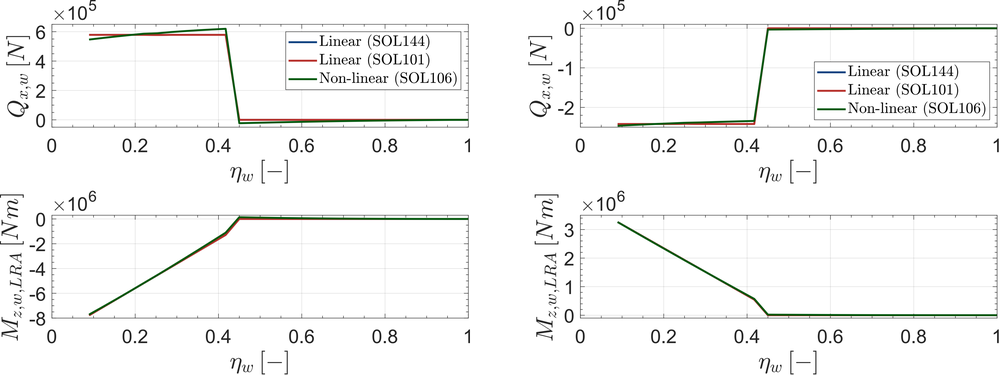
Figure 3: In-plane shear and bending moment on the wing for pull-up (left) and push-down (right) load cases; configuration with aileron effectiveness constraint
Another important aspect of SBW configurations are so-called in-plane loads, i.e., loads acting in the plane of the wing. In particular, in the inboard wing region between the strut attachment and the fuselage, significant in-plane shear forces and bending moments arise due to the geometric arrangement and the load transfer between wing and strut. Figure 3 shows the distribution along the normalized spanwise coordinate η_w, where η_w = 0 corresponds to the wing root and η_w = 1 to the wingtip. Shown are the in-plane shear force Q_x,w (top) and the in-plane bending moment M_z,w (bottom) for the pull-up (left) and push-down (right) load cases. These can exceed out-of-plane bending moments by up to fourfold and significantly affect maximum root section stresses. In conventional designs, such in-plane loads are negligible, but represent a major load case in SBW configurations. Since the CLA tool does not take these loads into account in the structural sizing, there is a real risk of the structure to being undersized [6].
Aeroelastic Stability: Flutter Instability and the Role of Nonlinear Preloading
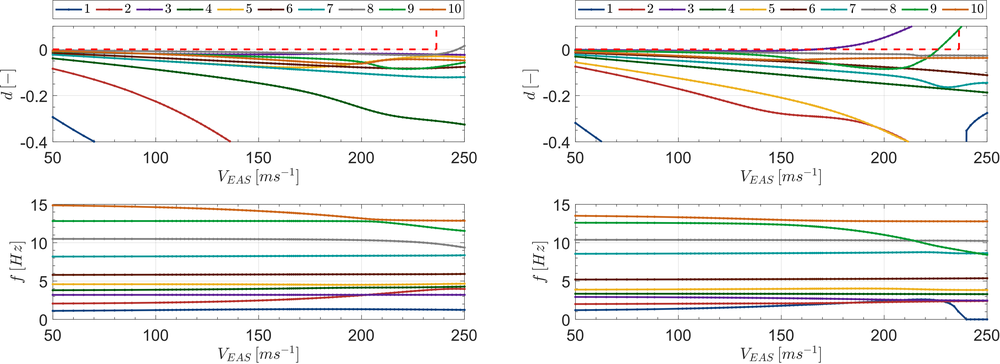
Flutter analysis of the SBW configurations investigated revealed instabilities within the flight envelope. These instabilities can be attributed to the missing consideration of aeroelastic boundary conditions in the conceptual design. To compare linear and nonlinear solutions, a nonlinear preloading is introduced via the tangent stiffness matrix from a static nonlinear analysis. The tangent stiffness matrix is derived from a deformation state under a defined load case and provides a linear approximation of the nonlinear force-displacement relationship. Critical flutter speed varies considerably with this approach, while flutter mechanisms remain unchanged. Compressive loads (push-down maneuvers) tend to destabilize the wing, whereas tensile loads stabilize it (see Figure 4). Results confirm that linear approaches are inadequate for high-aspect-ratio configurations. Aeroelastic constraints - such as aileron effectiveness and flutter margins - must be integrated early in the design process.
Figure 4: Flutter results (Vd und Vf diagrams) of clamped configurations with aileron effectiveness constraint considering geometric nonlinear prestress and the load cases pull-up (left) and push-down (right)
This study demonstrates that geometric nonlinearities and aeroelastic stability are central to SBW aircraft design. Linear analyses are inadequate, particularly in the context of compressive loading, where non-conservative results are obtained. A comprehensive and precise assessment of structural stiffness and flutter stability necessitates the incorporation of preloading effects and geometric deformations. Aileron effectiveness strongly influences structural sizing, while in-plane bending moments in the inboard wing region must be explicitly considered.
Future work will focus on detailed shell models of the wing-strut configuration to investigate loads and flutter characteristics under parameter and modeling variations. These results will accelerate the development of efficient, environmentally sustainable aircraft.