
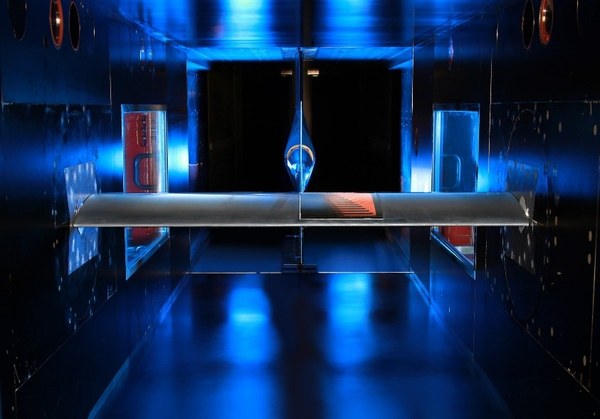
Abteilung Aeroelastische Experimente
Die Abteilung Aeroelastische Experimente widmet sich der Planung, Durchführung und Analyse von Windkanal-Experimenten.
Modern aircraft are equipped with a variety of different sensors to ensure functionality and operational safety. This sensor information needs to be processed in real time using intelligent algorithms for data fusion and machine learning. It allows flight conditions to be continuously monitored and intelligent control methods to be used in order to optimize operational performance. This may also be referred to as the establishment of an "aircraft nervous system," which represents an important step toward achieving current goals in aviation: reducing environmental emissions, enhancing operational safety, and increasing automation. To unlock the use of such methods in aircraft, these technologies are being tested and evaluated in dedicated wind tunnel experiments, in this case using a small-scale aeroelastic wing model [1]. As an example of such wind tunnel investigations, the test hardware and measurement setup employed within the impulse project "Sensor and AI Fusion for Enhanced PeRformance and Reliability" (SAFER²) are described.
In order to investigate complex monitoring and control technologies, a hardware is required that includes both a wealth of sensors and control surfaces. Such hardware was developed in SAFER² in form of the aeroelastic wing demonstrator.
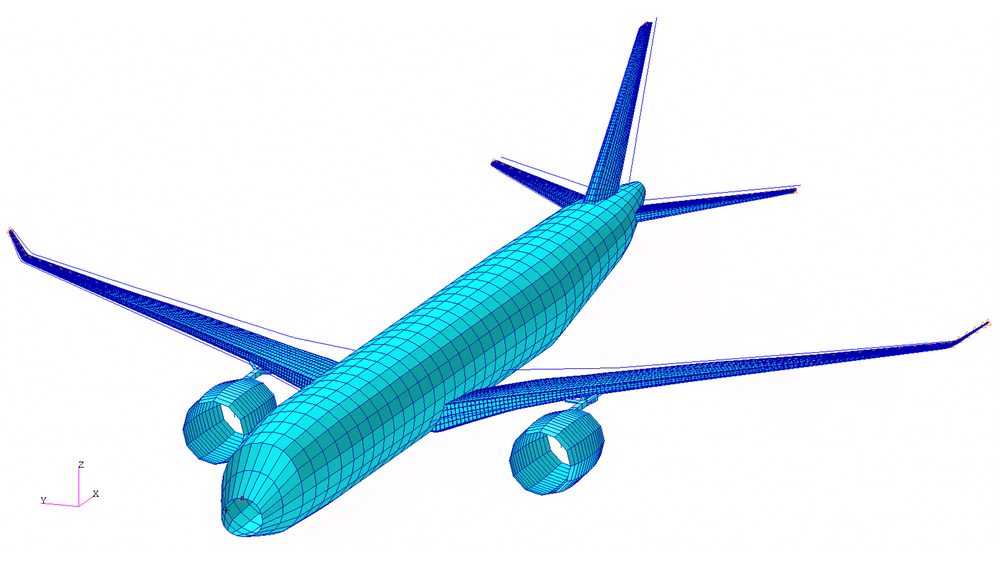
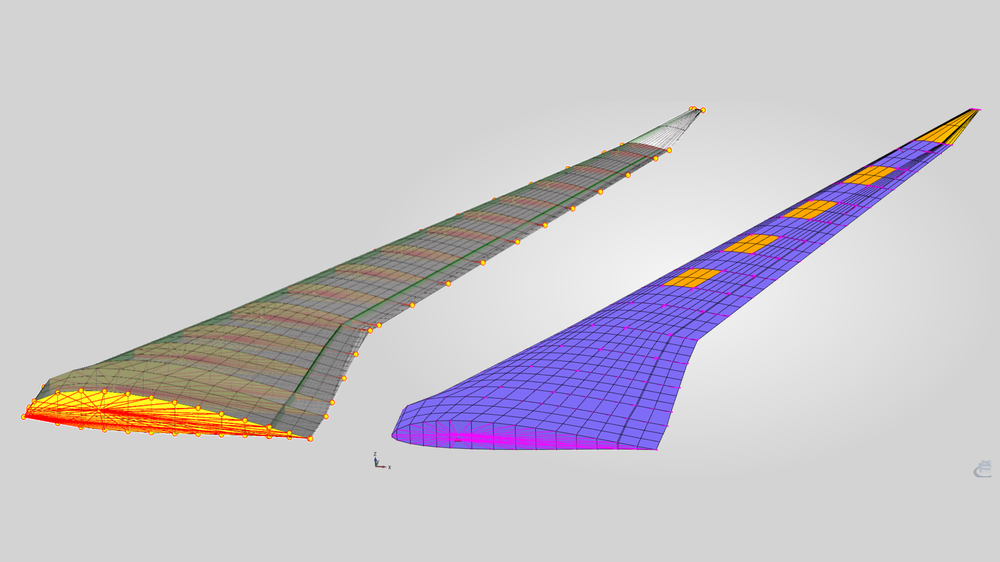
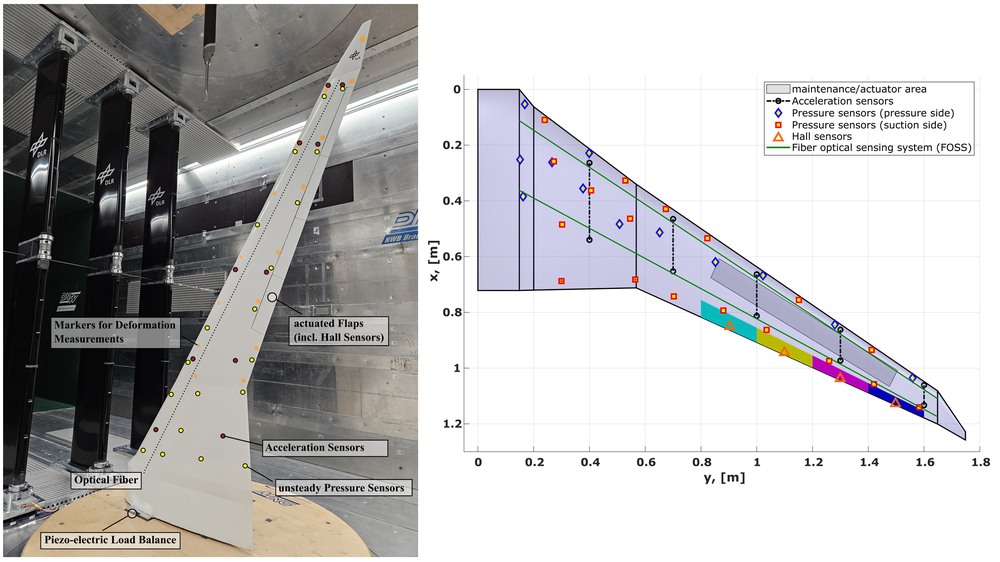
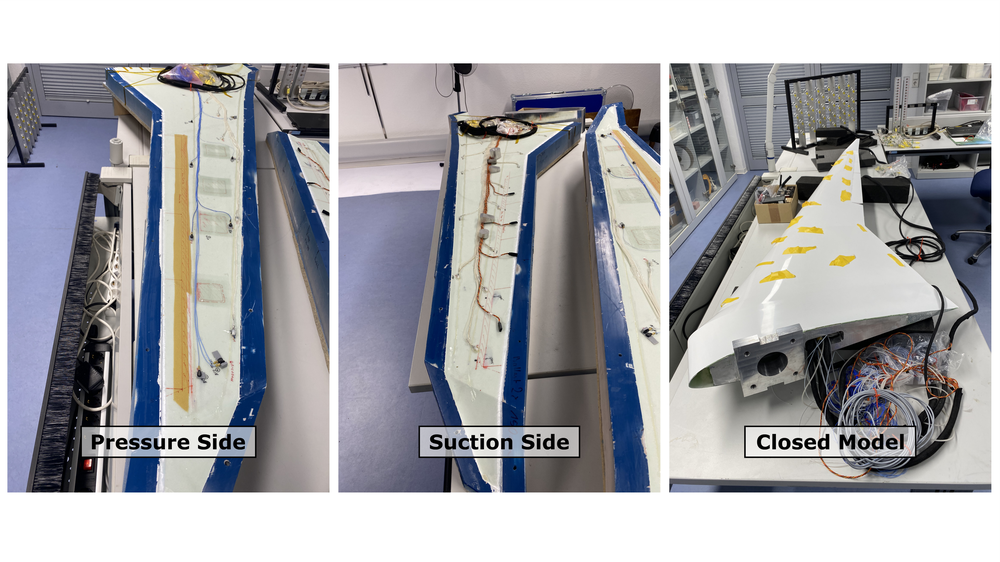
The aeroelastic demonstrator is a scaled-down model of the wing of a long-range wide-body aircraft with a high aspect ratio (see Fig. 1). Such aircraft have particularly long and slender wings, which reduce drag and thus fuel consumption. The aerodynamic design is based on the wing used in DLR's internal predecessor project oLAF ("optimal load-adaptive aircraft"), thereby allowing new insights to be directly compared to existing findings. The structural design has also been largely adopted and is based on a NASTRAN finite element model generated using the DLR-AE internal parametric modeling process ModGen (see Figs. 2 and 3) [2]. Yet, the demonstrator differs from its predecessor by being equipped with four, instead of five, controllable flaps, corresponding maintenance compartments for their actuators, as well as an increased number of sensors. The latter make it possible to examine the behavior of the wing during operation even more precisely and to test new concepts for load adaptation.

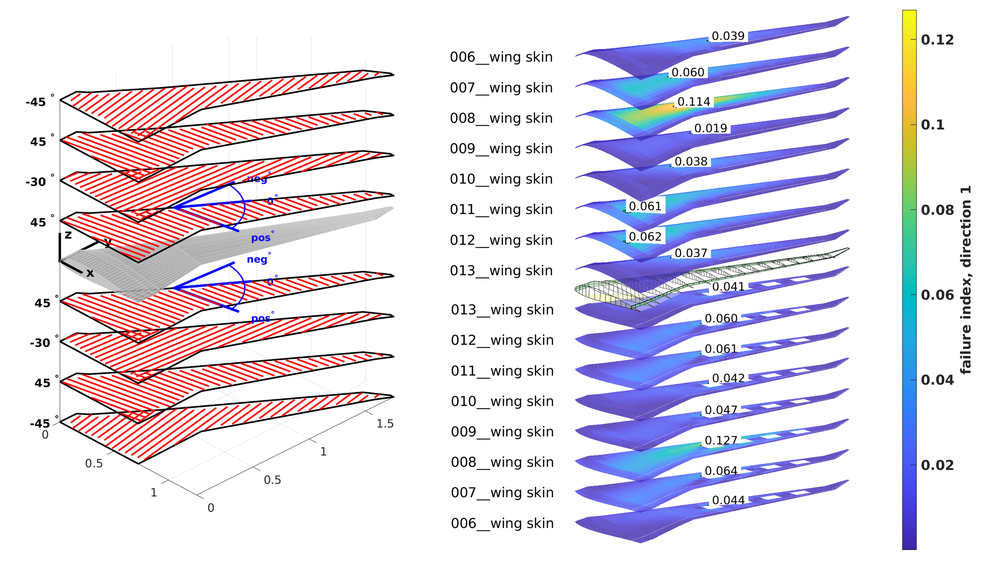
The sensors are integrated within the wing body, on the wing skin, and at the wing root (see Fig. 4). The model itself contains 30 unsteady pressure sensors that can measure dynamic pressure changes on the wing surface. In addition, the wing features 10 acceleration sensors for measuring vibrations and oscillations, which are essential for determining the wing’s structural properties and dynamic aeroelastic behavior. Dynamic deformations can also be recorded using a marker tracking method (see orange markers in Fig. 4). In steady conditions, wing deformation can also be determined using optical fibers that run along the wingspan. In order to deflect the control surfaces accurately, their positions are captured by hall sensors that are installed on the flap hinges. Besides the "local" measurement information mentioned above, the entire wing model is mounted on a special measuring device – a so-called "piezoelectric balance". This piece of equipment allows us to observe not only what is happening locally at specific points, but also how the wing behaves as a whole. This information can then be used to specifically control the wing.
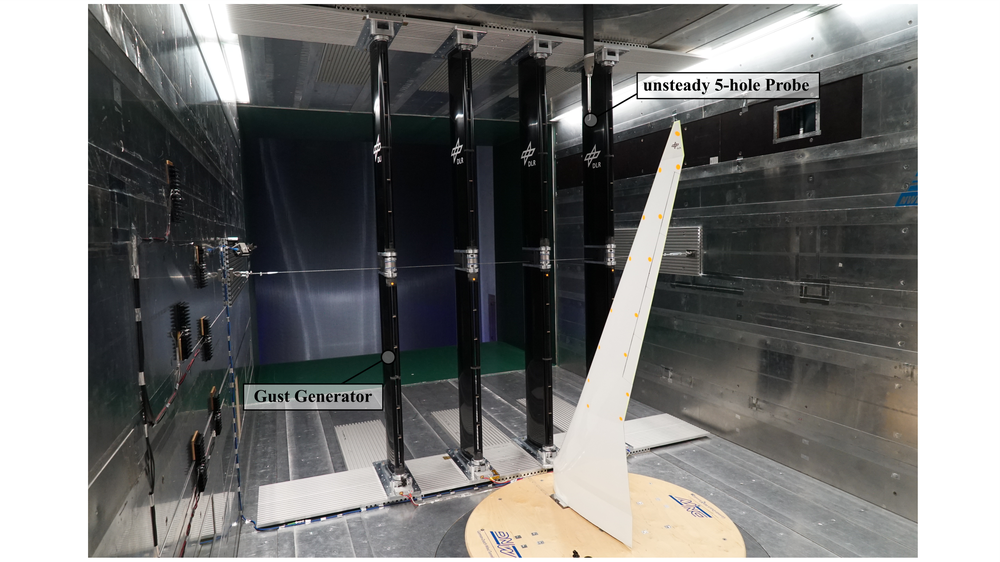
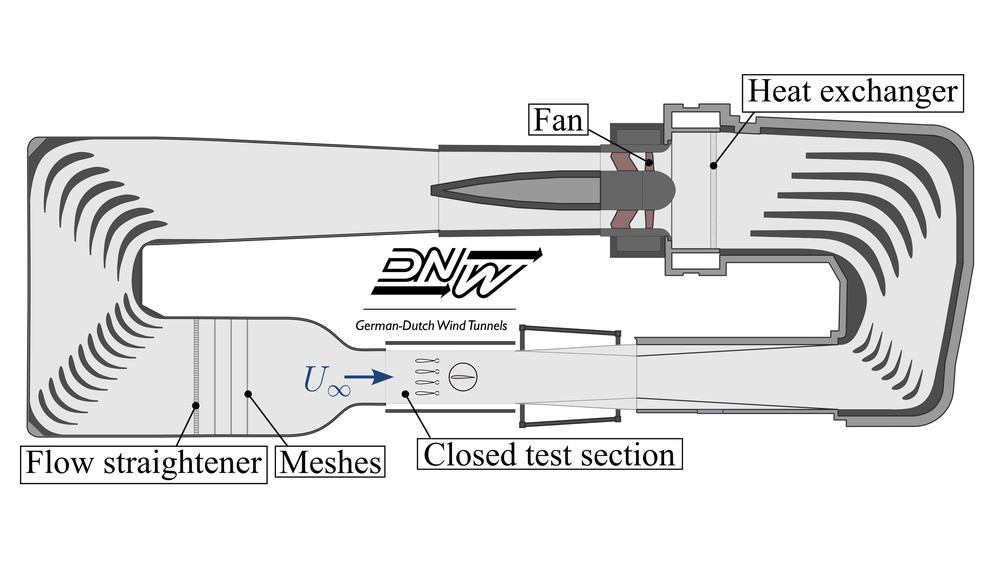
In addition to the aeroelastic wing demonstrator, additional elements are required for testing novel control and monitoring concepts. A setup was specifically developed in the wind tunnel, here the DNW-NWB low-speed wind tunnel in Braunschweig, which can modify the inflow conditions by generating gusts and/or turbulent flows using a so-called gust generator (see Fig. 6) [3]. The gust generator itself was originally designed and built as part of the DLR oLAF project and further developed within the SAFER² project to now consist of four rotating slotted cylinders. These can be controlled independently of each other using an in-house developed software, which enables generating complex flow conditions. The induced gusts are recorded and measured in real time using an unsteady 5-hole pressure probe mounted above the wing model.
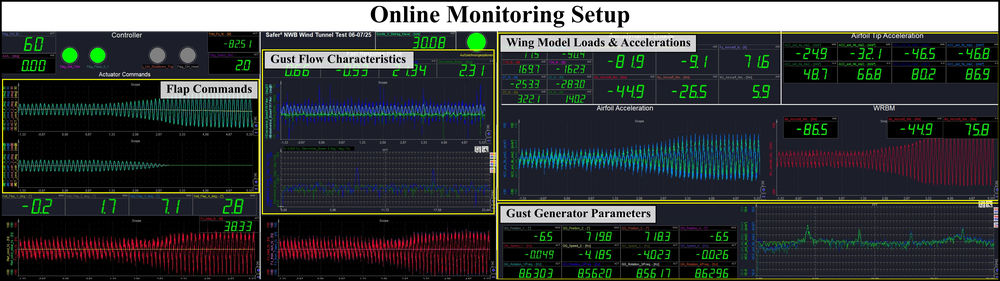
The signals from the sensors and actuators, the external measuring systems (i.e., load balance and 5-hole probe), and the gust generator are all observed in an online monitoring setup. This allows colleagues to not sit directly next to or under the wind tunnel, but instead observe the test conditions comfortably from the wind tunnel's control room. From there, the gust generator and all model sensors and actuators can be triggered using remote control. This setup not only allows measurement data as well as the flow and model behavior to be monitored in real time, but also enables safety-relevant parameters, such as aerodynamic loads acting on the model, to be controlled on demand, potentially using load-alleviation controllers. As an example, the online monitoring interface of our unsteady data measurement system is shown in Fig. 8, which depicts model forces and moments, accelerations (i.e., dynamic vibrations/oscillations), and gust characteristics, e.g., gust angle and amplitude.
Such a dedicated experimental setup is needed in order to first test and then evaluate novel, complex control, monitoring, and data reconstruction algorithms, as these methods require a wealth of reliable, real-time processable data signals from sensors to actuate the wing’s control surfaces in a targeted manner. Therefore, the SAFER² test setup allows colleagues from various institutes and departments to experimentally investigate their numerically developed models on a representative aeroelastic wing.
Several core technologies were explored and evaluated within the course of two wind tunnel test campaigns:
As part of the impulse project SAFER², a number of innovative technologies were developed, tested, and evaluated, delivering promising results for their potential application in future aircraft systems. These core technologies are being pursued further in national and international projects, including the following ongoing projects:
Dr. Thomas G. Schmidt, Abteilung Aeroelastische Experimente, DLR-Institut für Aeroelastik