Optical instruments
Depending on the application and the technological possibilities, the emphasis is on one or two of the three properties. In contrast to active lidar systems, passive lidar systems require an external light source for their measurements. This can be the Sun, the Moon or Earth's own light in the infrared spectral range.
Two main viewing directions of the camera are used to obtain different measurements: nadir and limb. In nadir viewing, the camera looks vertically downwards at the Earth. This allows, for example, imaging of Earth's surface (mapping) or determining the total amount of a trace gas in the Earth's atmosphere in the column of air between the ground and the satellite. In the case of limb viewing, the camera's line of sight brushes along the Earth's horizon. Through measurements at different altitudes above the horizon, it is possible to determine altitude profiles, such as those of trace gases in the Earth's atmosphere.
A space-based optical instrument's spatial resolution ranges from a few metres when observing Earth's surface to several hundred metres or kilometres when used for meteorological purposes. The field of view ranges from a few tens to several thousand kilometres. In remote sensing, the field of view refers to the width of the section of the Earth's surface that the camera records. For technological reasons, this is linked to the spatial resolution. As a rule, the higher the spatial resolution, the smaller the spatial field of view.
There is no universally valid definition for the designation of the optical spectral ranges. The following abbreviations are frequently used:
Designation | | Wavelength |
|---|
UV | Ultraviolet | up to 400 nm |
VIS | Visible | 400 – 700 nm |
NIR | Near infrared | 700 nm – 1.4 µm |
SWIR | Short-wave infrared | 1.4 µm – 3 µm |
MWIR | Mittleres Infrarot | 3 µm – 8 µm |
TIR | Thermal infrared | 8 µm – 15 µm |
Die spektrale Auflösung eines weltraumgestützten optischen Instrumentes richtet sich nach der jeweiligen Anwendung. Die Definition ist nicht einheitlich. Multispektralgeräte lösen 100 und mehr verschiedene breite Spektralfenster (Kanäle) auf. Diese Instrumente werden etwa für Messungen des Vegetationszustands und in der Meteorologie verwen det. Ein Beispiel ist das seit dem Jahr 2022 im Orbit befindliche METimage-Instrument (etwa 200 Kanäle von VIS bis SWIR, spektrale Auflösung 10 nm).The spectral resolution of a space-based optical instrument depends on its respective application. There is no standard definition. Multispectral instruments resolve 100 or more different broad spectral channels. These instruments are used, for example, for measuring the state of vegetation and for meteorological applications. One example is the METimage instrument, which has been in orbit since 2022 (about 200 channels from VIS to SWIR, spectral resolution 10 nanometres).
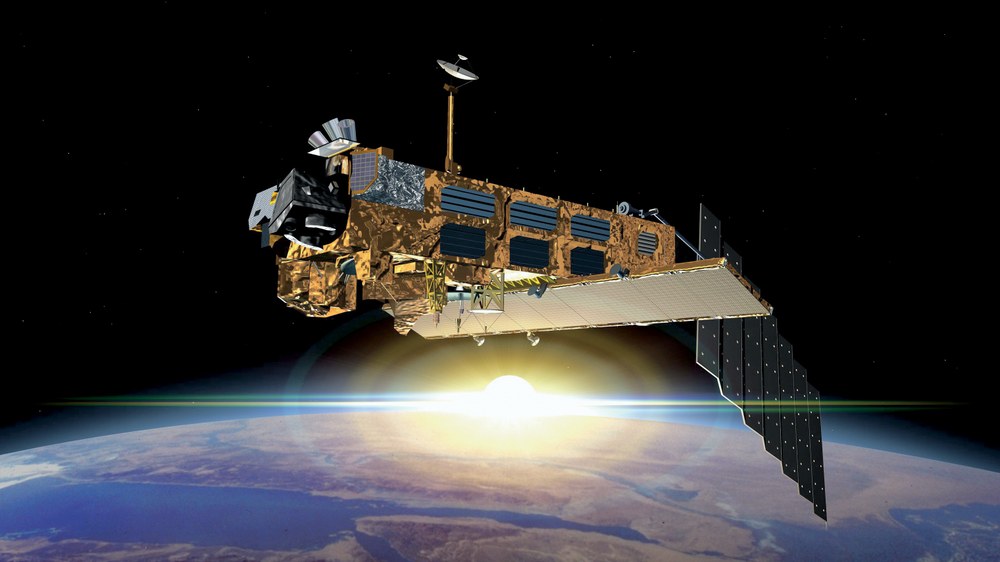
Optical instruments with a spectral resolution better than one nanometre are often referred to as spectrometers. In general, the resolution and spectral range are used to characterise the instruments, rather than the number of spectral channels. Spectrometers are used primarily for measuring trace gases in Earth's atmosphere. Examples are the instruments MIPAS (MWIR-TIR, spectral resolution 0.06-0.75 nm) and SCIAMACHY (UV-SWIR, spectral resolution 0.24-1.48 nm) on the Envisat satellite.