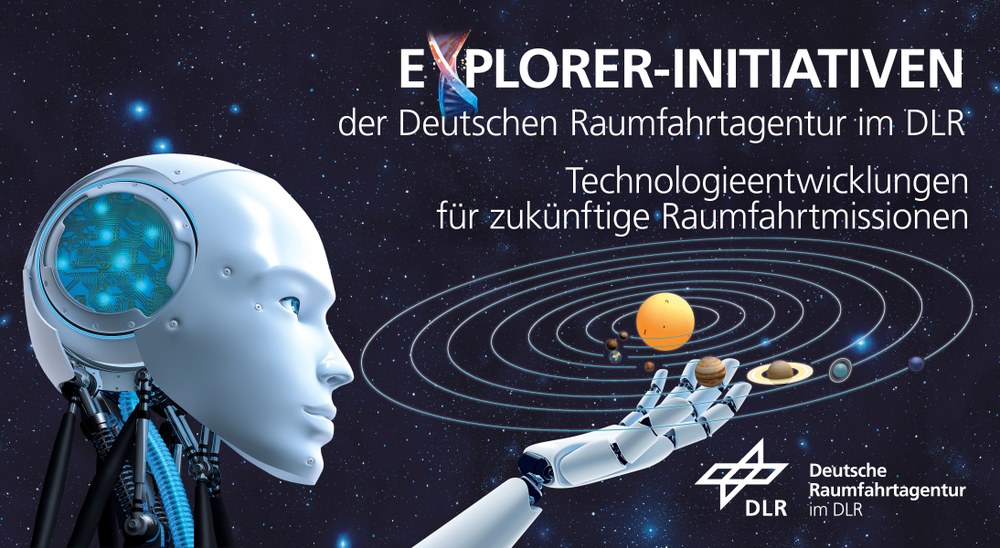
To boldly go where no robot has gone before!DLR Explorer Initiatives

The DLR Explorer Initiatives were established in 2015 with the aim of advancing key technologies for developing, shaping and, in the long term, carrying out the space missions of the future. Autonomous drones are required for the search for extraterrestrial life on Mars, Saturn’s moon Enceladus, and Jupiter’s moon Europa. On Mars, they could move around by driving, crawling and flying. On the icy moons Europa and Enceladus, they will melt their way through the surface ice crust to dive into the underlying ocean. There, they will be able to autonomously acquire samples, which will be analysed for signs of life directly on site. The DLR Explorer Initiatives are helping to develop the highly advanced artificial intelligence tools that are required for these drones to navigate autonomously. Other focus areas include fully autonomous swarms of space telescopes designed to study Earth-like exoplanets and the formation of planets. Research is also being conducted into the possibility of automated asteroid mining using swarms of satellites.
But these concept missions cannot yet be realised using present technologies. For this reason, the German Space Agency at DLR is supporting the development of the necessary key technologies with funding from the German Federal Ministry for Economic Affairs and Energy (BMWE). Particular emphasis is placed on generating spin-off applications for use on Earth.
The Explorer Initiatives are supported by various specialist departments of the German Space Agency at the DLR. Great importance is attached to interdisciplinary collaboration in these projects: developers and researchers from a wide range of disciplines are represented to support each other with advice and practical assistance. Other current focus areas include:
- non-GNSS-based navigation technologies
- development of suitable new technology platforms
- sensor technology and multi-sensor fusion
- (further) development of mission-specific algorithms
- robotic collaborative drone swarms
- Life science, which is applied in the space scenarios under consideration for the search for extraterrestrial life
- in-situ decontamination processes for the technology platforms under consideration
- 3D printing for space applications
- Conducting laboratory- and field trials; the latter in analogue scenarios on Earth that closely resemble the respective mission scenario.
- Mission (pre-)planning