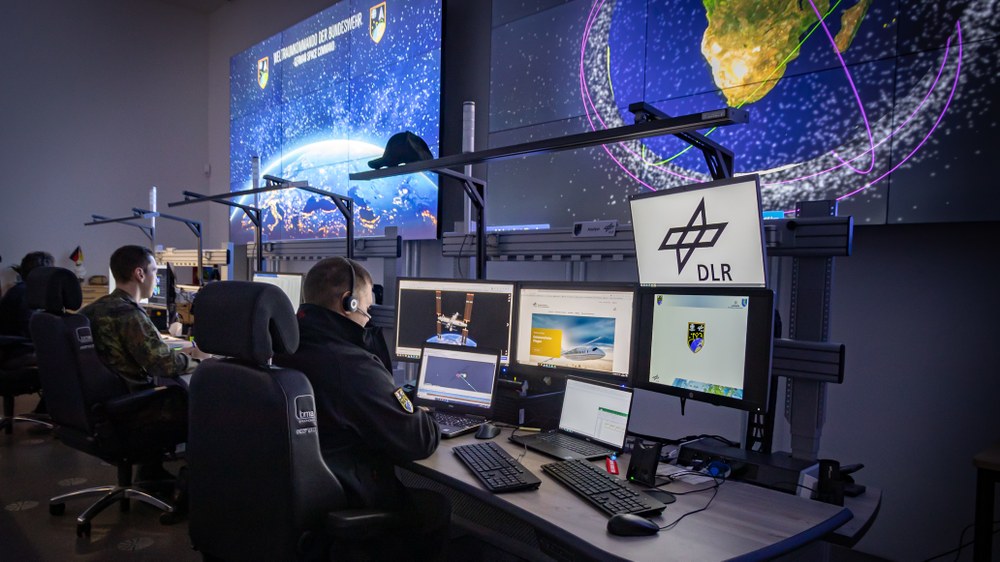
Whether it is navigation, satellite communications or the internet, satellite-based infrastructure is indispensable for today's modern information society. But other areas, such as energy supply, banking and disaster relief, also rely on satellite-based services. These are now considered critical infrastructure and as such must be protected. This protection is provided by the German Space Agency at DLR, together with the Space Command of the German Armed Forces at the Space Situational Awareness Centre in Uedem.
Together with the Space Command of the Bundeswehr, the employees of the German Space Agency at DLR contribute their expertise in the fields of orbital mechanics, sensor technology, data processing and analysis to the creation of situational overviews, in other words, the continuous monitoring of objects in low Earth orbit.
Predictions of collisions and atmospheric re-entry
The objects are not only located, but also identified and technically analysed. Among them are active satellites, but also pieces of space debris, such as burnt-out rocket stages or debris. Of the approximately 30,000 objects detected and catalogued as currently orbiting the Earth, about one third are active objects. The majority are unwanted by-products of spaceflight that pose a risk to space infrastructure and the Earth's surface. If such objects come close to active satellites, the Space Situational Awareness Centre analyses the situation for national authorities and issues collision warnings as needed. This makes it possible for satellite operators to correct their satellites' trajectories to avoid collisions with space debris.
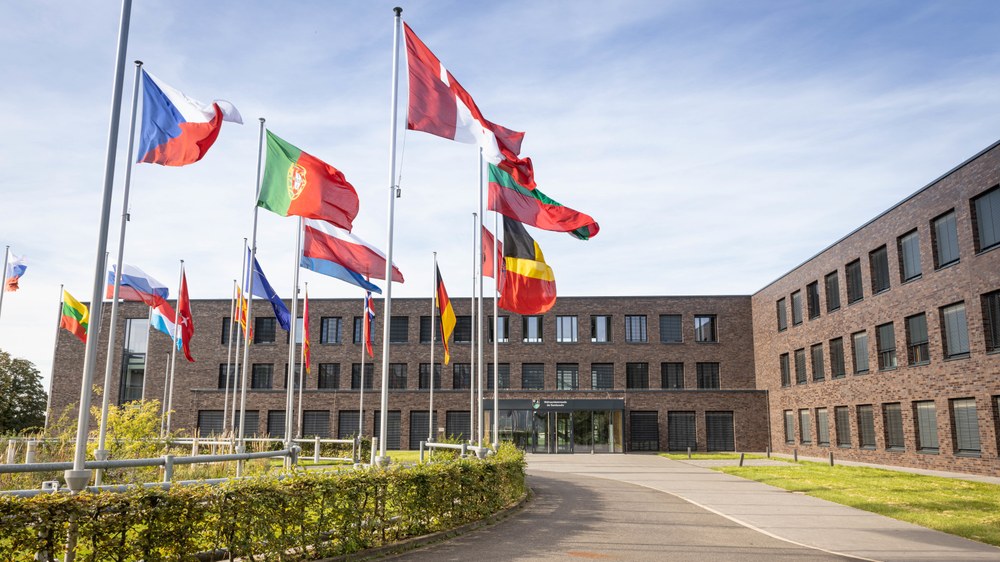
The Space Situational Awareness Centre in Uedem
The building of the Space Command of the German Armed Forces and headquarters of the joint Space Situational Awareness Centre of the German Space Agency at DLR and the German Air Force.
Credit:
Bundeswehr/Jennifer Heyn
European cooperation to ensure international security
The protection of space infrastructure and their surroundings is a global endeavour. For this reason, the German Space Agency at the DLR has been a partner in the European EU SST programme (European Space Surveillance and Tracking), which is funded by the European Commission, on behalf of the Federal Ministry for Economic Affairs and Climate Action (previously Ministry for Economic Affairs and Energy) since 2015. In this consortium of 15 EU member states and the European Union Satellite Centre, the German Space Agency at DLR contributes sensor and data processing capabilities. These are the basis for free services for the European user community of institutional and commercial satellite operators, civil protection authorities and EU bodies. Within the EU SST, the Space Situational Awareness Centre is responsible for generating and provisioning a European orbital data catalogue, which is made available to all EU SST members. In the future, security-related services, such as collision analysis, re-entry predictions and fragmentation analyses, will be provided on this basis.