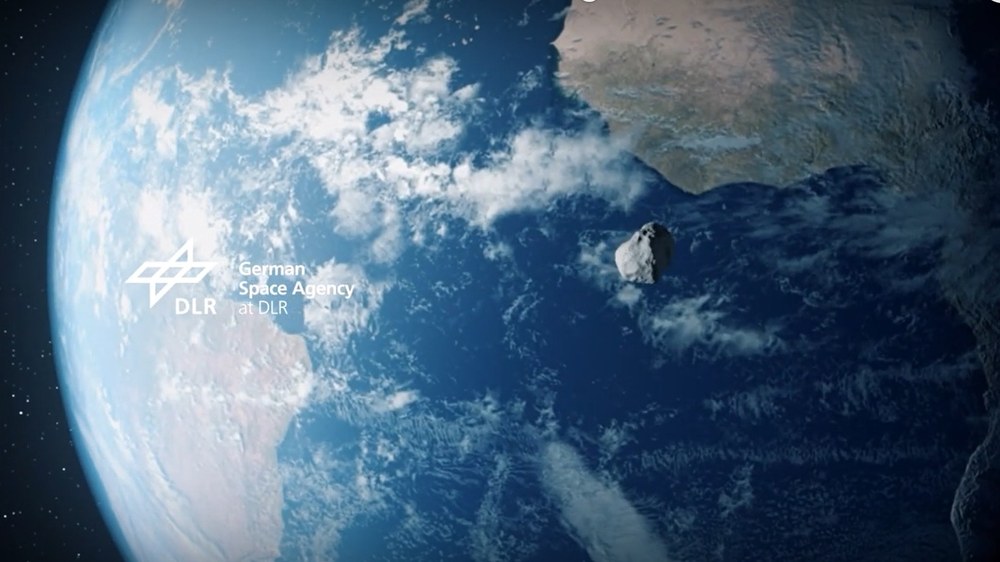
Asteroid impacts on Earth are a very rare natural disaster, but they can have serious consequences. It is therefore important to be equipped to deal with potentially dangerous asteroids. The Hera mission is investigating potential defensive measures against such celestial bodies in the future.
Although they happen very infrequently, natural disasters of this sort can have catastrophic effects. On 15 February 2013, for example, over 1000 people were injured when a small asteroid, measuring 20 metres across, entered Earth’s atmosphere near the Russian city of Chelyabinsk. Most of it vaporised on entry, triggering a pressure wave that shattered windows. This was the main cause of the injuries.
The consequences of an impact by a larger celestial body would be much greater; it could even threaten the existence of humanity as a whole. The asteroid 99942 Apophis, discovered in 2004, will come extremely close to Earth in 2029. With a diameter of around 350 metres, it would have extreme consequences in the event of an impact. Although it will not collide with Earth in the 21st century, such an event clearly shows that we must always be prepared for such impacts.
Asteroids and their origins
The first asteroid was discovered by chance by Giuseppe Piazzi (1746–1826) in 1801 whilst searching for planets. He noticed that one object had changed its position between observations. Piazzi named it Ceres, after the goddess of agriculture. Since then, our knowledge of these celestial bodies has grown considerably. Today we know of around 990,000 asteroids between the orbits of Mars and Jupiter, in what is known as the Main Asteroid Belt.
Most of them were formed when the planets formed in the Solar System. Around 4.5 billion years ago, the young Sun was surrounded by a rotating disc of gas, ice and dust. The individual elements of this disc began accreting to form ever larger objects, and eventually planets. Today's asteroids and comets originate from the ‘building blocks’ that were left over from the formation of the Solar System.
The chemical composition of asteroids varies depending on where in the Solar System they formed; they may be rich in carbon, silicate or even water. In addition, those asteroids that are fragments of larger planetesimals may also be rich in metals. Based on their composition, asteroids can be divided into three main classes: metallic, stony and carbon rich.
These rocky fragments also have different structures. Some are pockmarked with craters due to frequent collisions. Others are rubble pile asteroids. These are thought to consist of many small fragments that are only loosely bound by gravity, with dust-filled gaps in between.
In a sense, asteroids are time capsules from the formation of the Solar System. Since then, they have undergone far fewer changes than the planets. This means that they may contain information about the early Solar System, from which planets formed and life itself ultimately emerged.
Didymos, Dimorphos and Hera
Didymos and Dimorphos are a near-Earth binary asteroid system. Here, Didymos is the primary asteroid, which is orbited by the smaller moonlet Dimorphos. Didymos measures approximately 800 metres in diameter, and Dimorphos is approximately 170 metres across. Originally, the distance between them was approximately 1.1 kilometres and Dimorphos' orbital period was 11 hours 55 minutes. The controlled impact of NASA's DART spacecraft on 26 September 2022 brought the asteroid moon closer to Didymos, shortening the moonlet’s orbital period by 32 minutes to 11 hours 23 minutes. The Hera spacecraft will study the asteroid system and the effects of the impact. It is equipped with 12 measuring instruments and two CubeSats, both of which will attempt to land on Dimorphos. Hera is roughly the size of a small car and, when fully fueled, weighs around 1150 kilograms – which is rather light compared to the three-tonne comet hunter Rosetta.
Asteroid research
Alongside telescopes, space exploration missions provide the most comprehensive knowledge about asteroids. In 1991 and 1993, the Galileo spacecraft flew by the asteroids 951 Gaspra and 243 Ida on its journey to Jupiter. It discovered the moon Dactyl, which is over one kilometre in diameter, right by the 60-kilometre-long asteroid Ida. This confirmed previous ground-based observations.
Since then, other space missions have examined different asteroids. The Hayabusa spacecraft was able to collect dust samples from 25143 Itokawa and bring them to Earth in 2010. This marked the beginning of other sample return missions. Most recently, the US space agency NASA’s OSIRIS-REx mission delivered over 121 grams of material from the asteroid 101955 Bennu to Earth in 2023.
Near-Earth asteroids
The gravitational influence from planets can cause objects from the Main Asteroid Belt to become near-Earth asteroids (NEAs). This influence places them on trajectories that cross the Earth’s orbit, meaning that they could reach Earth as meteorites. While asteroids used to be discovered by chance, for some time now there have been international efforts to search specifically for such potentially dangerous asteroids, including by NASA and the European Space Agency (ESA).
Model calculations assume that a kilometre-sized NEA or comet impacts Earth once or twice every million years. The asteroid 1036 Ganymede is the largest known NEA, with a diameter of 31 kilometres. Depending on its size, the impact of such an object could have catastrophic and global effects on Earth.
Known asteroid impacts on Earth
Sixty-six million years ago, two thirds of all species living at that time – including the dinosaurs – were wiped out by a massive event. There were many hypotheses as to the cause of the mass extinction. In the early 1990s, the Chicxulub impact crater, some 200 kilometres in size, was discovered under the Yucatán Peninsula in Mexico. However, the largest part of the Chicxulub crater lies in the Gulf of Mexico and is not visible at the Earth’s surface, as the rock crashed into the shallow estuary that separated North and South America at the time. The crater is one of the largest on Earth and substantiated the theory of a huge asteroid impact. The asteroid must have been approximately 15 kilometres in diameter; its impact released the energy of millions of Hiroshima bombs and hurled away the top ten kilometres of the Earth's crust. The underlying crust was crushed by 20 kilometres, but bounced back after a few minutes.
The identification of the crater alone was not enough to clearly confirm a connection between the impact and the mass extinction. Only the extraction of drill cores from the crater provided the final proof. The samples contained asteroid dust – more precisely, high concentrations of iridium and other platinum group metals – in various layers of rock in the crater. Based on the sequence of these and other deposits, the researchers were able to determine when the asteroid impact took place, and how it and the subsequent events unfolded. An impact of this magnitude generates enormous temperatures of several tens of thousands of degrees. The pressure waves were so strong that they circled the entire Earth. Exploded and pulverised rock was hurled into the atmosphere, covering the Earth in a dense cloud of dust. In addition, droplets of sulphuric acid darkened the sky worldwide for several years. This caused the average global temperature to drop below freezing for years, triggering a mass extinction of the planet's entire plant life. This also caused the dinosaurs' food supply to disappear which led to another mass extinction. A cold phase, which probably lasted several decades, was followed by a sudden warming, as the impact had released billions of tons of carbon dioxide.
Significant craters can also be found in Europe. Between the Swabian and Franconian Alb, the Nördlinger Ries was created 15 million years ago by the impact of an asteroid with a diameter of 1000 to 1500 metres. It hit the Earth at a speed of around 70,000 kilometres per hour. The force of the impact was so violent that it penetrated four to five kilometres into the Earth, creating a crater several hundred metres deep and 24 kilometres across. The massive explosion at the point of impact displaced 150 cubic kilometres of rock. Debris masses were hurled out from a depth of several hundred metres – some as far as 400 kilometres. The impact compressed the rock layers under such enormous pressure that temperatures of around 20,000 degrees Celsius were reached, causing the asteroid and ground rock to simply evaporate. The shockwave from the impact also affected the rock at depth, where it even caused the formation of diamond. The force of the impact triggered an earthquake measuring 8.5 on the Richter scale. Within a radius of at least 100 kilometres, the shockwave and the enormous heat extinguished all life.
Planetary defence against asteroids
The previously mentioned asteroid 99942 Apophis will fly past Earth in 2029 at a distance of just 31,750 kilometres. This might sound like a vast distance, but in astronomical terms it is a narrow miss: it will pass closer than telecommunications and weather satellites in geostationary Earth orbit.
Various space agencies and the United Nations have been analysing the risk of impacts for some time. Asteroid Impact & Deflection Assessment (AIDA) is a joint international mission by NASA and the ESA to develop methods to help humanity counter such dangers effectively. It consists of NASA’s DART mission and ESA’s Hera mission.
NASA began the project with the DART (Double Asteroid Redirection Test) space probe. The asteroids Didymos and Dimorphos were chosen as the target, with the much smaller asteroid moon Dimorphos orbiting the larger Didymos. The aim was to influence the orbital period. To do this, DART collided with Dimorphos at a speed of over six kilometres per second in a controlled operation on 26 September 2022, with the aim of altering its orbit around Didymos. Measurements with telescopes were able to determine that its orbital period had been shortened by 33 minutes from the original 11 hours 55 minutes, far surpassing the ten-minute target.
The Hera mission
On 7 October 2024, the launch window to send the ESA Hera space probe towards the binary asteroid system aboard a SpaceX Falcon 9 rocket from Cape Canaveral, Florida, will open. Once it launches, it will embark on a two-year journey to Didymos and Dimorphos and will study both for six months to find out exactly how the shape of the asteroids has changed.
The spacecraft is equipped with 12 measuring instruments for this purpose. The most important are the two redundant, monochromatic Asteroid Framing Cameras, which will be used to determine the spacecraft’s position in the asteroid system. These are essential for navigation. Hera will also carry two CubeSats, named Juventas and Milani, each the size of a shoebox. They will move closer to Dimorphos and ultimately attempt to land on it during the final phase of the mission in order to determine its surface properties, interior structure and gravity field.
The measurements are intended to determine the exact mass of Dimorphos. Determining the mass is necessary in order to understand the effect of DART’s deflection. The data obtained will then be used to calculate how such deflection can be achieved for other celestial bodies. In the event of an asteroid on a real collision course, this will form the basis of a planetary defence mission.
The data collected also marks a milestone in asteroid research.
German technology featuring in a European joint project
Germany is the largest contributor to the ESA mission, providing 37.5 percent of the technology. The Hera spacecraft was developed and built by OHB in Bremen. A newly developed antenna made of carbon fibre-reinforced plastic has been produced by HPS, while the two asteroid framing cameras come from Jena-Optronik. The Dresden University of Technology is heavily involved in the development of the radar experiment on the Cubesat Juventas. German researchers are also part of the Hera Science Team and scientifically evaluating the data obtained from the mission. The German Space Agency at DLR coordinates all of these German contributions to the mission with funding from the Federal Ministry for Economic Affairs and Climate Action (BMWK).
Looking ahead – Apophis and the Ramses mission
Work is also already underway on the Ramses mission, which builds on the Hera project. Apophis’s very close pass to Earth in 2029 presents an incredible opportunity for scientific research.
The ESA Ramses spacecraft will rendezvous with Apophis before it approaches Earth and accompany the asteroid during the flyby to observe how it is warped and changed by our planet’s gravity. The more we learn about these changes, the better we will be able to determine how best to divert a dangerous asteroid from a collision course with Earth.
Video
Didymos and Dimorphos are a near-Earth binary asteroid system. Here, Didymos is the primary asteroid, which is orbited by the smaller moonlet Dimorphos. Didymos measures approximately 800 metres in diameter, and Dimorphos is approximately 170 metres across. Originally, the distance between them was approximately 1.1 kilometres and Dimorphos' orbital period was 11 hours 55 minutes. The controlled impact of NASA's DART spacecraft on 26 September 2022 brought the asteroid moon closer to Didymos, shortening the moonlet’s orbital period by 32 minutes to 11 hours 23 minutes. The Hera spacecraft will study the asteroid system and the effects of the impact. It is equipped with 12 measuring instruments and two CubeSats, both of which will attempt to land on Dimorphos. Hera is roughly the size of a small car and, when fully fueled, weighs around 1150 kilograms – which is rather light compared to the three-tonne comet hunter Rosetta.
Protecting Earth from asteroid impacts: HERA - the planetary defence mission
Your consent to the storage of data ('cookies') is required for the playback of this video on Youtube.com. You can view and change your current data storage settings at any time under privacy.
Protecting Earth from asteroid impacts: HERA - the planetary defence mission
Didymos and Dimorphos are a near-Earth binary asteroid system. Here, Didymos is the primary asteroid, which is orbited by the smaller moonlet Dimorphos. Didymos measures approximately 800 metres in diameter, and Dimorphos is approximately 170 metres across. Originally, the distance between them was approximately 1.1 kilometres and Dimorphos' orbital period was 11 hours 55 minutes. The controlled impact of NASA's DART spacecraft on 26 September 2022 brought the asteroid moon closer to Didymos, shortening the moonlet’s orbital period by 32 minutes to 11 hours 23 minutes. The Hera spacecraft will study the asteroid system and the effects of the impact. It is equipped with 12 measuring instruments and two CubeSats, both of which will attempt to land on Dimorphos. Hera is roughly the size of a small car and, when fully fueled, weighs around 1150 kilograms – which is rather light compared to the three-tonne comet hunter Rosetta.
Credit:
German Space Agency at DLR
Images
Artist impressions
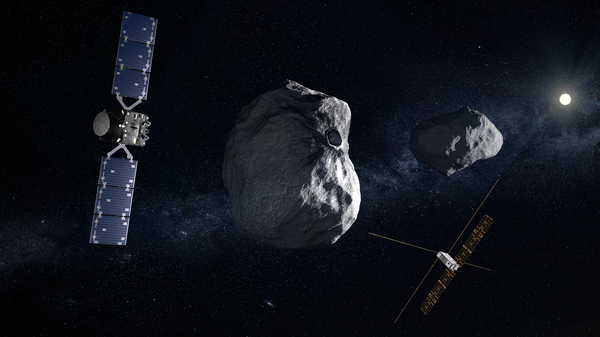
The Hera spacecraft in front of the Didymos and Dimorphos asteroids
The Hera spacecraft will study the binary asteroid system, comprised of Didymos and Dimorphos, for six months in 2026 to find out exactly how the orbital period and shape of the asteroids have changed since the impact of NASA's DART probe in 2022. Hera is equipped with 12 measuring instruments for this purpose. The most important of these are the two asteroid framing cameras – two redundant, monochromatic cameras – which will be used to determine the position of the space probe in the asteroid system. They are essential for navigating the probe. Hera is also carrying two CubeSats, Juventas and Milani, each the size of a shoebox. They will move closer to Dimorphos and even attempt to land on it in the final phase of the mission to determine its interior structure, surface properties and gravitational field.
ESA's planetary defence mission Hera is approaching the boulder-strewn asteroid Dimorphos. On 26 September 2022, NASA's approximately half-tonne DART space probe hit Dimorphos at a speed of 6.1 kilometres per second. This first experiment using the kinetic impact method to deflect asteroids was successful: Earth-based observations show that the 11-hour and 55-minute orbit of Dimorphos around the primary asteroid Didymos was shortened by around 33 minutes. Hera, which is expected to arrive in the Didymos binary asteroid system at the end of 2026, will collect data at close range and determine the mass and composition of Dimorphos, among other things. This large-scale experiment should enable the development of a reproducible planetary defence technique.
Didymos is a near-Earth binary asteroid with a diameter of approximately 800 metres. The smaller asteroid Dimorphos has a diameter of 170 metres and orbits Didymos. Originally, the distance was approximately 1.1 kilometres and the orbital period was 11 hours 55 minutes. The controlled impact of NASA's DART spacecraft on 26 September 2022 shortened the orbital period by 32 minutes to 11 hours 23 minutes, bringing it closer to Didymos.
The Hera spacecraft with one of its two solar wings during a test campaign at the ESTEC test centre in the Netherlands. The spacecraft, which is the size of a minibus (left), is powered by two solar wings with three panels each, which were supplied by Beyond Gravity in Switzerland. One of these five-metre-long wings was attached to the probe for the ‘cold deployment check’. This tests the correct position of the wing. As the solar wings are designed for operation in microgravity, they are supported by a frame during this test deployment.
The 1.1- metre-diameter ‘High Gain Antenna’ of the Hera spacecraft went through a week-long test campaign at the Compact Antenna Test Range, part of ESA's ESTEC technical centre in the Netherlands. The newly developed antenna made of carbon fibre-reinforced plastic was manufactured by the German company HPS.
This high-resolution view of Dimorphos was created by combining the latest ten full-frame images from the Didymos Reconnaissance and Asteroid Camera for Optical Navigation (DRACO) on NASA's DART spacecraft. Dimorphos is orientated so that its north pole is at the top of the image.
Views of the asteroids Dimorphos (left) and Didymos (right), with their north poles orientated upwards and with each asteroid and their distance to each other in scale. The views of Didymos and Dimorphos are both composites of images taken by NASA's DART spacecraft.
Simulation of the impact of the DART spacecraft with the asteroid Dimorphos
This graphic shows the results of a simulation of the impact of NASA's DART space probe on the asteroid Dimorphos. Boulders are depicted in blue and fine-grained material in yellow. The material ejected by the collision is clearly visible.