
NGT FuN and Energy
The main project goal is to maintain and increasethe attractiveness of rail passenger and freight transport within the overall transport system, from both an operator and a user perspective. A secondary goal is to meet all stakeholder requirements for a rail vehicle as effectively as possible.
Work started in the predecessor projects RoSto and ProCo (bogie, hybrid power pack, hydrogen tanks, aerodynamics) and established within the ERJU framework will be continued and brought to a higher technology readiness level (TRL). Over the next three years, test and demonstration projects will be conducted with industrial partners in the ERJU environment to demonstrate TRL and carry out technology transfer.
The DLR NGT TAXI concept serving as a reference application will be further specified with the results from NGT FuN and Energy (NGT FE), primarily for bogie, drive, energy supply, and energy storage.
Running gear and propulsion system


Innovative bogies and propulsion systems for rail passenger and freight transport are developed, tested, and evaluated in this sub-project in terms of performance, safety, ride comfort, and integrability. The aim is to provide highly automated, energy-efficient, low-maintenance bogie and drive structures usable across scenarios from urban light rail vehicles to heavy freight. Development combines model-based and experimental methods, supported by test benches, digital twins, and simulation.
For the NGT-HGV mechatronic lightweight single-wheel bogie with wheel-adjacent direct drive, the three core innovations, mechatronic track guidance, lightweight design, and wheel-adjacent direct drive, are further developed, with enhanced safety functions, intelligent control for slip and skid protection, and track guidance. For the electric drive, temperature management, vibration, and acoustic behaviour are optimised. The NGT FuN bogie is validated on performance and integration test benches to improve operational stability and raise the TRL. In parallel, the certifiability of condition-based maintenance systems is investigated, a prerequisite for approving safety-critical technologies.
For freight, the autonomous self-propelled ASINO bogie provides a plug-and-play solution for "last-mile" operation without a shunting locomotive. The aim is to upgrade existing freight wagons simply and cost-effectively by replacing their bogies with ones featuring an autonomous driving function. All components for autonomous operation, including the electric powertrain (battery, inverter, motor, gearbox), cooling, control electronics, air compressor for braking, communication and position sensors, are integrated directly into the bogie.
Further information:
Hybrid power pack and energy management

To reduce emissions, diesel rail vehicles will be replaced by zero-emission alternatives. Battery-hybrid and fuel-cell-hybrid multiple units are already in scheduled passenger service; no commercially available solution exists yet for mainline locomotives. This sub-project develops a locally zero-emission fuel-cell-hybrid power pack (FCHPP) for high power and energy demands. The FCHPP is a modular kit for scalable hydrogen/battery hybrid drives, providing a tailored energy supply on non-electrified lines.
The focus is on interface standardisation, energy efficiency and cost efficiency. The FCHPP is defined for use as an energy tender, enabling robust rail operation, optimised energy management, and improved battery charging and hydrogen refuelling. Data from the FCH2Rail and H2BAR projects is used to build and validate digital twins.
In addition, issues relating to sector coupling, the extension of the scope of application to stationary and maritime applications, and the extraction of electrical and thermal energy are being investigated, so that the concepts developed can be applied beyond rail transport.
Further information:
H₂ pressure tanks for rail applications
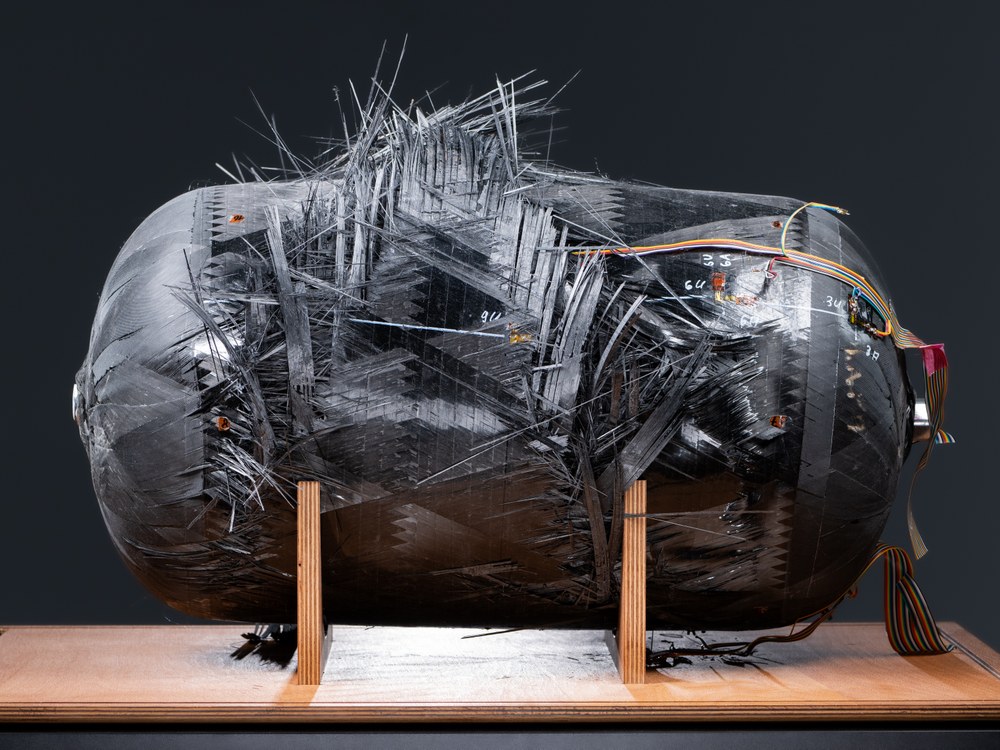

Hydrogen as a rail energy carrier has been demonstrated in FCH2RAIL and in vehicles such as the Coradia iLint and Mireo Plus H. For economic rail operation, H₂ pressure tank systems still require further optimisation.
A key target is to extend the service life of CFRP pressure tanks beyond that of conventional metallic systems. Custom numerical methods are developed to predict structural failure more reliably. A Structural Health Monitoring (SHM) system continuously records the structural state of the tanks; this data feeds the models and assessments.
The refuelling process is also addressed. As the maximum permissible temperature of 85 °C inside the tank must not be exceeded, the negative Joule–Thomson effect (the release of heat during hydrogen expansion, resulting in locally pronounced temperature peaks) has so far necessitated conservative refuelling strategies. To overcome this limitation, alternative material combinations with improved thermal conductivity are being investigated, which would enable accelerated refuelling processes.
Further information:
Aerodynamics

Aerodynamics directly affects ride safety and energy consumption, and therefore life-cycle costs, in both train operation and certification. Because flow complexity limits the reliability of numerical methods, full-scale experiments remain necessary. The aim is to simplify certification and reduce operating costs through the further development of numerical methods and the aerodynamic optimisation of trains and components.
Application areas:
- Regional train with variable geometry: Drag and crosswind forces are predicted using validated numerical methods.
- Modular pantograph: Aerodynamic and acoustic optimisation. Add-on components keep contact-wire pressure in the target range while reducing noise. Simulations in cooperation with ERJU project Rail4Earth account for the influence of mounting position on flow.
- Aerodynamic load measurement: A specially equipped measurement container records loads on train cargo under real operating conditions. The method has been verified in a wind tunnel. The data will be used to reduce train drag and crosswind loads on the container. Work is done in cooperation with ERJU projects TRANS4M-R and Future4Freight.
Further information:
Participating institutes and organisations: