
EML-OCS Arrives at the International Space Station (ISS)


After a five-day journey aboard a Cygnus spacecraft built by Northrop Grumman, the Oxygen Control Sensor (OCS) has successfully arrived at the International Space Station. The Cygnus capsule was launched as part of a SpaceX resupply mission (SpaceX – NG-23 Mission) from Cape Canaveral Spaceport in Florida on Sunday, 14 September, at around 18:00 local time, following an initial delay. After a successful docking manoeuvre, it safely reached the ISS on Thursday, 18 September, around midday GMT.
“OCS” stands for Oxygen Control Sensor. It is a device built by Airbus on behalf of the European Space Agency (ESA) to measure and regulate the partial pressure of oxygen in the Electromagnetic Levitator (EML), which has been in operation on the ISS since 2014. The EML is used for contactless measurements of the thermophysical properties of liquid metallic alloys and for studying solidification processes under conditions of deep undercooling. Residual gases in the surrounding process atmosphere or vacuum—such as oxygen—can significantly affect these measurements. For instance, as little as 30 ppm of oxygen can reduce the surface tension of liquid iron by more than 30%, and only a few solid oxide particles can entirely suppress the undercooled state.
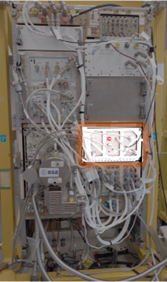
With the OCS, oxygen partial pressures in the range of 0.2 to 10⁻¹⁶ bar can not only be measured but also precisely stabilised. The arrival of the OCS on the ISS marks an important milestone in the accompanying scientific project OXYTHERM (Thermophysical Properties of Liquid Alloys under the Influence of Oxygen).
The OXYTHERM project has driven the development of the OCS since 2009 and proposed related experimental programmes. The project—conducted in collaboration with partners from the EU, Japan, South Korea, and the USA—is coordinated by the DLR Institute of Materials Physics in Space and supported by ESA.
The next steps involve integrating the OCS with the EML and conducting a series of test experiments over the coming year. If successful, the first scientific experiments are expected to begin in 2028—just in time before the ISS and all its on-board experiments are retired in 2030.