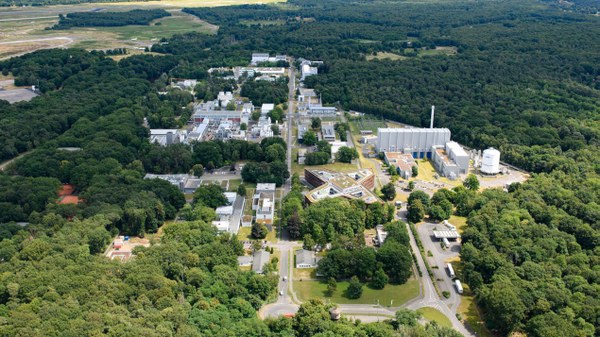
The Institute for Frontier Materials researches, develops and tests sustainable, digitally integrated and resilient solutions for aerospace, energy, transport, security and defence, covering all technology-driven stages of development through to system integration.
Resource conservation, technological sovereignty, competitiveness and the Zeitenwende (a fundamental shift in strategic priorities) are examples of pressing societal challenges. In this context, increasingly demanding requirements call for an integrated development approach that places system-level capability at its core. At the same time, innovation processes are accelerating significantly, driven primarily by the digital transformation.
Significantly reducing development times
This is achieved by integrating testing and manufacturing facilities, AI methods, robotic systems and data management systems, with the aim of reducing time to market by at least 50%.
Of particular importance in this context is autonomous data acquisition through experiments in microgravity, which helps to refine multiscale simulations, for example to improve the robustness of manufacturing processes such as the 3D printing of metallic components.
In addition, together with industrial partners, the Institute is creating the foundations for higher-quality simulations as part of the DLR Quantum Computing Initiative. By virtualising the development chain, these simulations accelerate the maturation of new aerospace applications.
Applications under investigation include the development and testing of 3D-printed components for climate-compatible aerospace propulsion systems and satellites, lightweight structures for reusable launch vehicles and energy-efficient aircraft, as well as new materials for acoustic and thermal insulation.
Comprehensive applications in aerospace, security and defence
Specific applications researched by the Institute in this field include protective coatings for aircraft propulsion systems and hypersonic vehicles, as well as manufacturing and repair using 3D printing on Earth and in space, including in-situ resource utilisation (ISRU).
In addition, technological solutions are being developed for new multifunctional applications. These include the integration of corrosion protection alongside physical and sensing functionalities. Target applications include self-sufficient, flexible sensors; energy conversion and storage systems (e.g. supercapacitors for powering satellites); and high-temperature materials for thermal and radiation protection in reusable space launch vehicles and hypersonic structures.
The Institute operates platforms that replicate realistic terrestrial and spaceflight conditions, integrating, in part or in full, technologies such as AI-based analytics and simulation systems, robotic testing, high-resolution multiscale in-situ analytics, and large-scale material processing facilities.
In particular, research under spaceflight conditions aboard space stations, during parabolic flights and on sounding rockets, including the DLR MAPHEUS® sounding rocket programme, provides unique platforms for the development of sustainable technologies.
Introducing the Institute for Frontier Materials on Earth and in Space
We research and develop materials at all stages of development and use interdisciplinary focal points to drive sustainable, digitally integrated and resilient material solutions through to system integration and technology transfer. The Institute's research activities are systematically organised along the four main stages of the materials development chain, namely design, development, demonstration and deployment.
Video: The new Institute for Frontier Materials on Earth and in Space introduced by the acting directors Prof. Dr. Guillermo Requena and Prof. Dr. Daniela Zander
Your consent to the storage of data ('cookies') is required for the playback of this video on Quickchannel.com. You can view and change your current data storage settings at any time under privacy.
Video: The new Institute for Frontier Materials on Earth and in Space introduced by the acting directors Prof. Dr. Guillermo Requena and Prof. Dr. Daniela Zander
We research and develop materials at all stages of development and use interdisciplinary focal points to drive sustainable, digitally integrated and resilient material solutions through to system integration and technology transfer. The Institute's research activities are systematically organised along the four main stages of the materials development chain, namely design, development, demonstration and deployment.