
Resilient energy systems to safeguard supply

ReESy

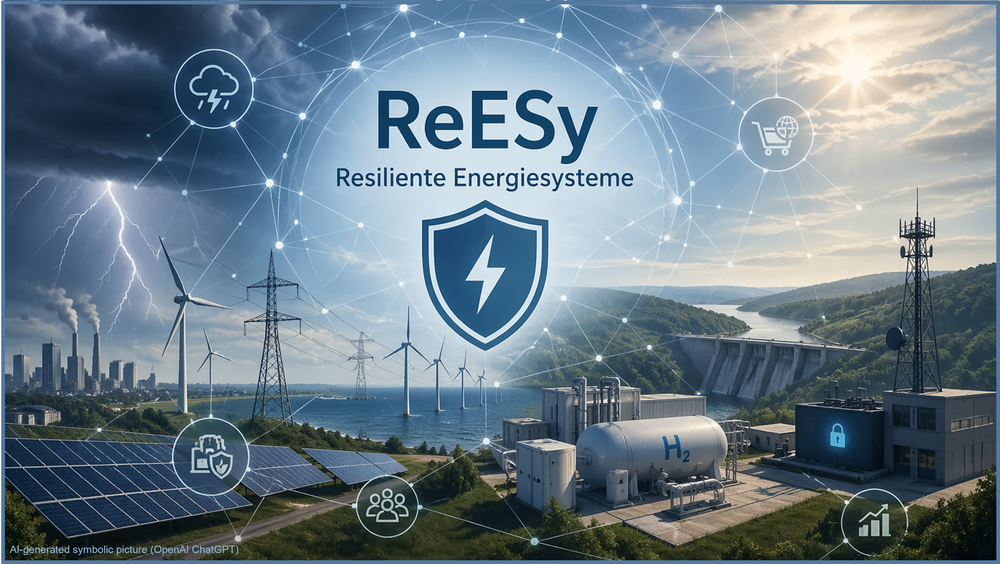
Symbolbild ReESy
Störungen der Energieversorgung durch Cyberattacken oder Extremwettereignisse
Credit:

KI-generiertes Symbolbild (OpenAI ChatGPT)

Designing reliable energy systems – even under extreme conditions

The ReESy (Resilient Energy Systems) project investigates the design and operation of energy systems under extreme conditions. While most previous research has focused on normal operation, ReESy specifically addresses rare but critical events that could jeopardise the stability of the energy supply. This is in response to recent major disruptions, such as blackouts, and the increasing risks posed by climate change and geopolitical developments.
The project aims to design energy systems that can operate resiliently even under external disturbances, minimise the probability of widespread outages, and guarantee rapid restoration (e.g. black start capability) in the event of a disruption.

ReESy considers extreme situations at three levels:

  • Regional: damage scenarios caused by terrorism or war
  • National: weather-related extreme situations with widespread impacts
  • Global: impacts on markets and supply chains.

To this end, existing DLR system models are being consolidated and developed further to simulate extreme scenarios and identify vulnerabilities in the energy system.
The work is divided into four key areas: ensuring a secure energy supply in the event of damaged infrastructure; ensuring a secure energy supply during weather-related extreme situations; increasing the resilience of energy sector structures and transformation pathways; and establishing and implementing a laboratory infrastructure to validate the results.

Contribution Institute for AI Safety and Security

The DLR Institute contributes its expertise in cybersecurity and data quality.
In cybersecurity, the focus is on analysing cyberattacks on energy systems. The aim is to identify typical attack vectors, determine critical system areas, and derive suitable protective measures. Investigations are carried out using offshore wind farms and vehicle-to-grid applications, among other things.
In the area of data quality, the Institute examines the potential consequences of data quality issues, particularly during extreme weather events. Realistic disturbances are introduced into simulation data to assess their impact on analytical methods and grid stability. The ultimate goal is to enhance the resilience of data-driven methods within the energy system.

Participating DLR institutes and facilities

Contact

Dr. Michael Karl

Head of Department
German Aerospace Center (DLR)
Institute for AI Safety and Security
Safety-Critical Data Infrastructures
Rathausallee 12, 53757 Sankt Augustin
Germany

Karoline Bischof

Consultant Public Relations
German Aerospace Center (DLR)
Institute for AI Safety and Security
Business Development and Strategy
Rathausallee 12, 53757 Sankt Augustin
Germany