
Earth System Model Evaluation and Analysis (EVA) Department
The department Earth System Model Evaluation and Analysis plays a pioneering role in the development and application of machine learning (ML) techniques in combination with Earth observations to improve Earth system models (ESMs). Its overarching goal is to reduce long-standing systematic model errors and, through these hybrid (physics + ML) Earth system models, to provide robust climate projections and technology assessments in aeronautics, space, transport, and energy research, as well as reliable information to support climate adaptation and mitigation strategies. The department also leads the international development of the Earth System Model Evaluation Tool (ESMValTool), which drives the routine and comprehensive evaluation of Earth system models against Earth observations. In addition, the department is among the international leaders in exploring and testing quantum computing as an emerging technology for Earth system modelling.
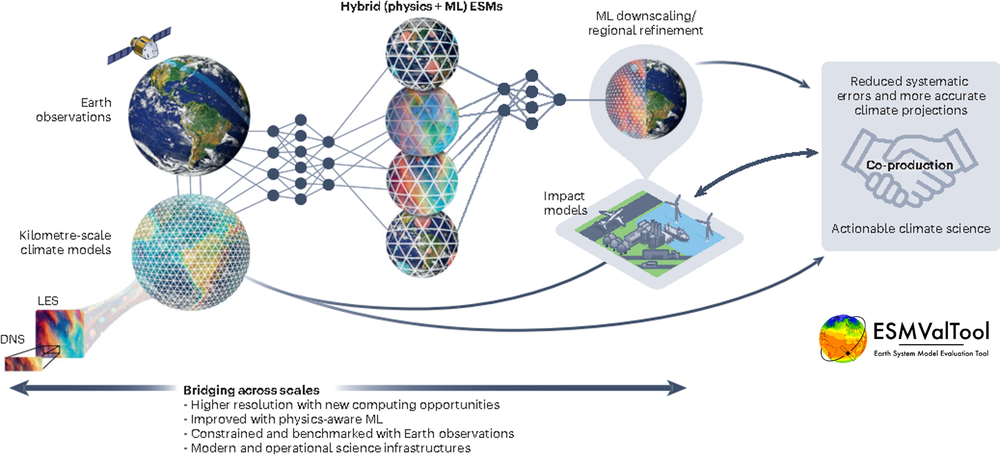

Adapted from Eyring et al. (2024)
Our research topics are:
- Improving Earth system models through machine learning in combination with Earth observation data
- Reducing uncertainties in climate predictions and technology assessments for aerospace, transport and energy applications using ML and Earth observations
- Developing innovative benchmarks for traditional and hybrid (physics + ML) Earth system models
- Identifying and reducing systematic errors in climate models and formulating recommendations for targeted model improvements
- Enhancing process understanding and parameterizations of climate-relevant processes through machine learning
- Developing and applying ML-based methods for regional climate projections and uncertainty quantification
- Advancing and applying the ESMValTool for the systematic evaluation of Earth system models using observations
- Exploring quantum computing and quantum machine learning to accelerate and enhance Earth system models
- Contributing to international model intercomparison projects, in particular the Coupled Model Intercomparison Project (CMIP) under the World Climate Research Programme (WCRP)
Our main tools and data are:
- Machine learning methods for improving and analysing climate models
- Eyring Group GitHub Repository – development hub for machine-learning-based Earth system modelling tools, hybrid (Physics + ML) approaches, and evaluation workflows
- ESMValTool for comprehensive evaluation of Earth system models with Earth observations – a community-developed, open-source software package for the comprehensive evaluation of Earth system models with Earth observations
- Quantum computing as an emerging technology for Earth system modelling
- Simulations with the ICON (Icosahedral Nonhydrostatic) climate model
- Climate simulations from international model intercomparison projects (e.g., CMIP)
- Earth observations and reanalysis products for model evaluation and development
The department collaborates closely with the Department of Climate Modelling at the University of Bremen (Chair: Prof. Veronika Eyring) and with the Co-PIs of the European Research Council (ERC) Synergy Grant “Understanding and Modelling the Earth System with Machine Learning (USMILE)”: Prof. Pierre Gentine (Columbia University, New York, USA), Prof. Gustau Camps-Valls (Universität Valencia, Spanien), and Prof. Markus Reichstein (Max-Planck-Institut für Biogeochemie, Jena). Close collaborations also exist with the National Center for Atmospheric Research (NCAR) in Boulder, CO, USA. The department is actively involved in international research activities of the World Climate Research Programme (WCRP), contributing substantially to CMIP, and regularly participates in major climate and ozone assessments of the Intergovernmental Panel on Climate Change (IPCC) and the World Meteorological Organization (WMO).