CO2Image: A Brazilian-German satellite mission focussing on greenhouse gases
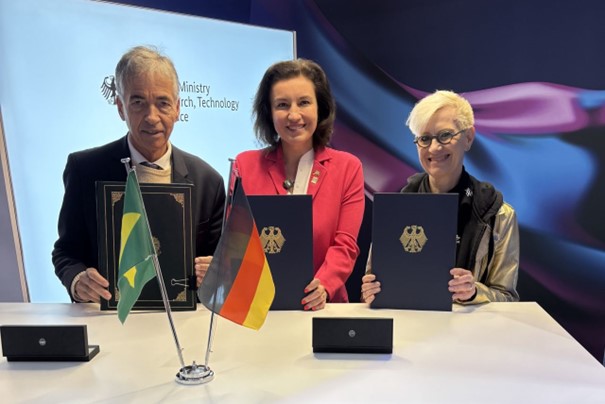
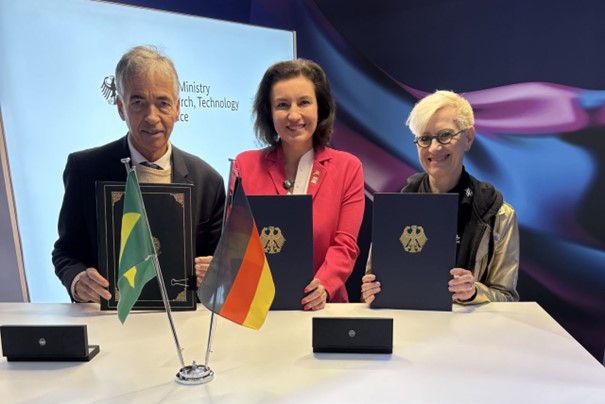
With the signing of a Joint Declaration of Intent by representatives of Brazil and Germany, the way forward for the CO2Image greenhouse gas mission has been established. On Monday, 20 April, Germany’s Federal Minister of Research, Technology and Space, Dorothee Bär, and Brazil’s Deputy Minister for Science, Technology and Innovation, Luis Manuel Rebelo Fernandes, signed the agreement at the Hannover Messe, where Brazil was featured as this year’s partner country. Representatives from INPE and DLR introduced the mission during a panel discussion at the trade fair on Tuesday, 21 April, highlighting the importance of the international collaboration for CO2Image.
This agreement marks an important milestone for the CO2Image mission, which will now be jointly realized through a collaboration between DLR and INPE, the Brazilian National Institute for Space Research. The mission payload is the COSIS instrument (CO2 Sensing Imaging Instrument), which is being developed by DLR. INPE designs the multi-mission, agile P100 platform, which will provide the service module for the mission. Having recently completed the system requirement review, the mission can now enter Phase B2, with a projected launch readiness date in early 2030.
CO2Image aims to detect and quantify emissions from point sources as small as 1 MtCO2/year. Thus, CO2Image will be able to resolve plumes from individual, localized sources, providing super-resolution nests in areas of interest for survey missions like the upcoming Copernicus Sentinel mission CO2M. The mission’s key feature is its facility-scale targeting approach: it measures approximately 75 tiles, each measuring ~50 x 50 km2 per day at a resolution of 50 x 50 m2. Through the choice of the spectral window, the mission will be able to measure CH4 as well, detecting point sources as small as 100 kg CH4/hr.