
Human Models for safe and cooperative Mobility
Systems of any kind involve interaction with a human user in some form. Since Humans and (autonomous) Systems are fundamentally different, and if a System is not designed to work together with the human user, failure is pre-programmed.
Especially in safety critical systems a Human Factors Evaluation is very important to make the system as safe as possible. However, Human Factors Processes are often difficult to integrate into the usual system-engineering process itself, since these need specialized knowledge that is not available to most developers. Therefore often expert teams exist, who perform the human factors evaluation after or in parallel to the development of a system, coordinated by requirements. In case significant human factor related issues arise, this might result in significantly higher cost. With our human models, preliminary human factors evaluation can be integrated into the system design process, allowing system developers to perform human factors analysis in early design phases. We develop three human models for the design of automation systems:
KONECT - HMI Design Support
KONECT is a tool for supporting system designers in the development of User Interfaces. In KONECT, the designer starts with a formal task analysis, detailing exactly which information is needed, for what, in which task. Based on this, KONECT provides guidance on a) how to visualise this, for example use colour, to visualise if a certain value is okay, and b) in combining the defined elements into a coherent user interface. The provided guidance is based on existing literature, studies and published guidelines for HMI design, and thus scientifically proven.
CASCaS: Virtual Testers - HUman Factors Analysis
Simulation is a method that is widely used in model-based system engineering, to test and verify the functional design of a system. However, the human is usually not represented in this simulation. With our Virtual Tester CASCaS, this gap can be closed. CASCaS is a cognitive architecture, combining physiological and psychological models of human cognition into an executable simulation tool. With the input of a detailed task model (for example a driver model), the virtual tester can be used for automated and reproducible simulations, including human behaviour. The output of the simulation(s) can be used to analyse aspects such as workload, situation awareness, or amount of distraction the system under test causes in a human user.
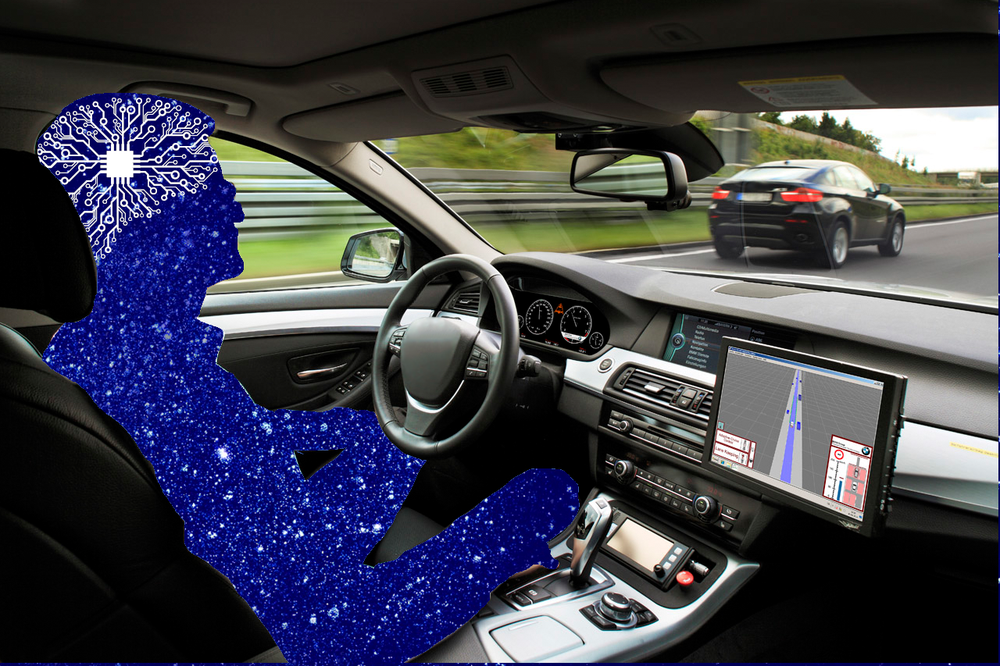

Liam Huang on flickr, George Hodan, BP63Vincent
Virtual Co-Pilot – Human Models as Assistance System
Our Virtual Co-Pilot is a system that runs in the background of an (partially)-autonomous vehicle, and sensors the human drivers to infer the state of the human, for example current task, or situation awareness. In combination with profiles (for example driver profile), it helps the user to understand the AI, and to configure it to the drivers’ needs and wishes.