
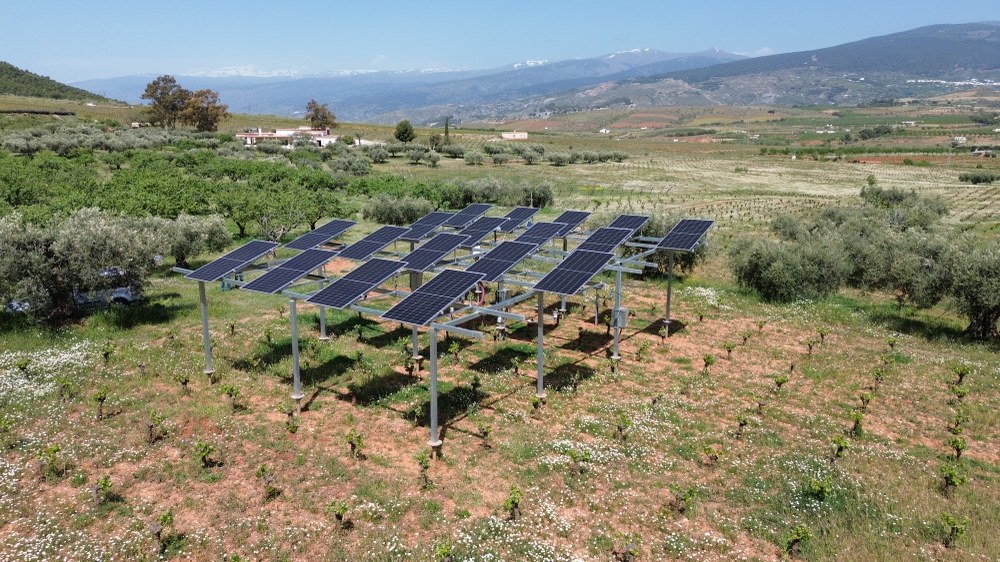
A dual use of land areas is possible, for example, through the combination of elevated photovoltaic (PV) modules above cultivated areas, the integration of PV modules on greenhouse roofs and vertical PV modules between low plants or on pastureland that absorb sunlight from both sides (bifacial photovoltaic modules).
The technology has great potential to make a significant contribution to the overall energy system of the future and is therefore a key technology for realising the energy transition in Germany. The German Aerospace Center (DLR) is developing the necessary tools and methods as well as scenario analyses with the aim of understanding, designing and evaluating agrivoltaic concepts in detail.
An innovative pilot project has been implemented in the Almería region in southern Spain. The agrivoltaic system (APV) integrates photovoltaics into sustainable, ecological viticulture and contributes to optimising water and energy efficiency. The DLR is researching the effects on plant development, soil conditions and climate adaptability in order to systematically evaluate the potential of APV under different climatic conditions.
Determining the most economical agrivoltaic combination
At the Institute of Solar Research, researchers are working on a model that determines the most economically promising combination of agricultural activity and solar power generation. The model takes into account meteorological conditions, different types of cultivation and the influence of economic and political framework conditions. The APV system design, a photovoltaic yield model, a microclimate model, a plant growth model and an economic model are used here. The researchers include various possible combinations of PV modules for optimisation purposes. They compare the results obtained with the economic potential of conventional PV systems and purely agricultural land. This model, which can be used worldwide, represents an innovative solution for the simultaneous utilisation of land for agriculture and the production of solar power.
Validation of the agrivoltaic model
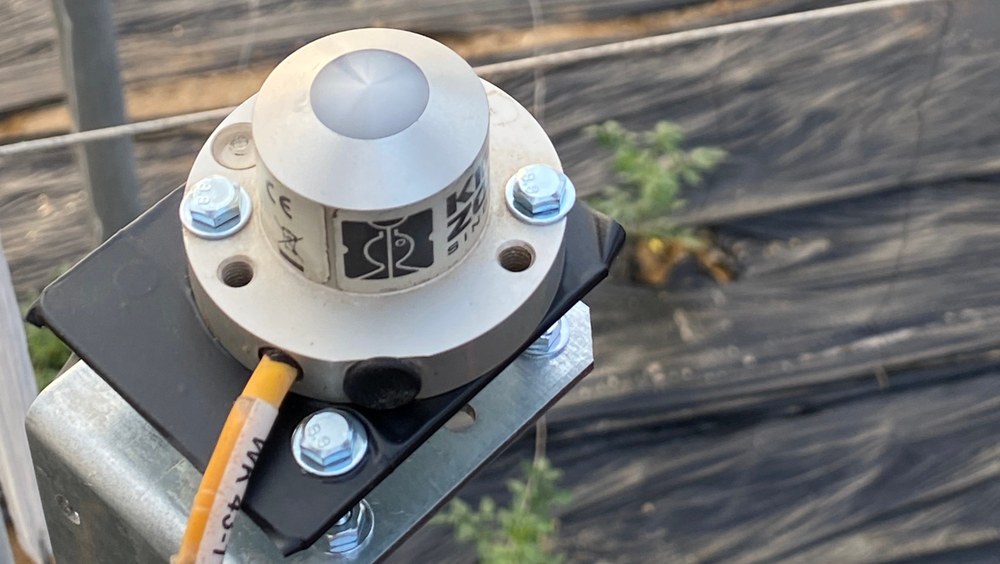
Validation of the APV model is crucial to ensure that the results of the model are realistic and reliable. Scientists determine and check the accuracy of the simulations and whether the model's calculations match the actual observations and measurements. In this way, they establish confidence in the model results – also with the aim of using the model for the planning, optimisation or evaluation of agrivoltaic systems. Validation also makes it possible to optimise and adjust the model parameters so that they match real conditions. This makes it possible to adapt the APV model to different locations and ensure that it is robust and applicable regardless of local conditions. This significantly improves the quality of the simulation.
The Institute of Solar Research validates the APV model in various plants. The Institute's many years of experience and further developments in the field of measuring, modelling and analysing meteorological data for solar fields are also incorporated into the investigation of the microclimate and plant growth.
In the field of agrivoltaics, DLR is actively cooperating with experts within the framework of PVPS Task 16 and PVPS Task 13 of the International Energy Agency (IEA).



Water management in agrivoltaics
The homogeneous distribution of rainwater in APV systems is of crucial importance in order to avoid drought, waterlogging or soil erosion and the resulting lower crop yields. Crop plants have different water requirements and can be optimally supplied through targeted irrigation. The Institute of Solar Research is working on engineering solutions to enable an even and targeted distribution of rainwater and thus an increase in water utilisation efficiency. The aim is to avoid damage caused by extreme precipitation and at the same time to investigate the extent to which we can continue to enable agricultural operations in arid regions in the future using such methods.
Research into the durability and ageing of PV modules
The German Aerospace Center operates laboratories in Almería and Oldenburg to research the durability and efficiency of photovoltaic modules. In addition to semi-transparent and opaque (light-impermeable) PV modules, employees are also investigating wavelength-selective PV cells (PV cells that are transparent at certain wavelengths of light) in collaboration with the DLR-Institute of Networked Energy Systems.

Supporting the energy transition through agrivoltaics research
Findings in the field of agrivoltaics bring many benefits – for agriculture as well as for the environment and the climate. With the help of research, it is possible to develop new systems and technologies that are particularly well suited to the needs of farms. The specially developed APV software helps us to optimise the arrangement of solar modules over agricultural land. This allows us to increase light and land utilisation efficiency and produce more energy.