
Study on remote driving of vehicles – Do we really need "motion feedback"?
Remote Driving: The Human Backup for Self-Driving Cars
Your consent to the storage of data ('cookies') is required for the playback of this video on Youtube.com. You can view and change your current data storage settings at any time under privacy.
TU Delft / Dr. Georgios Papaioannou
- In a study with the Delft University of Technology (Netherlands), DLR scientists have investigated how motion simulation influences remote driving performance.
- The authors came to the conclusion that so-called "motion feedback" does not offer any measurable advantages for performance or driving experience in slow driving scenarios.
- More research is needed to design the remote driver's workplace in such a way that the performance corresponds to driving in the vehicle.
- Focal points: Road traffic, remote driving, real driving study, human factors
Controlling vehicles remotely: From 1 December 2025, this will be possible on public roads in Germany. From this date, the Remote Road Traffic Control Ordinance (StVFernlV) will apply, creating a legal framework for the first time for the practical testing of remotely driven vehicles on public roads.
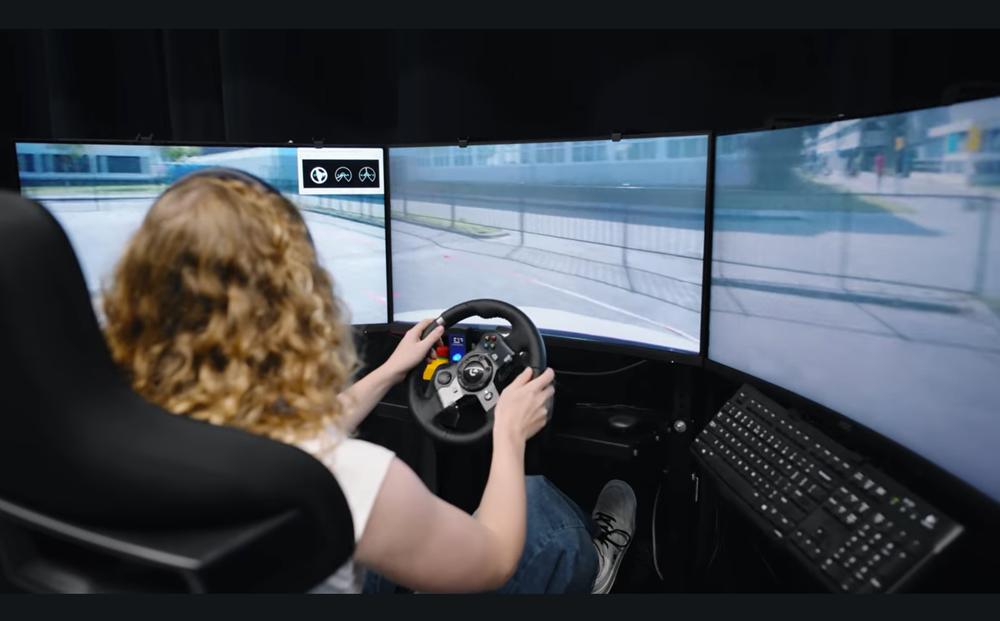
In line with this, DLR and its partners are researching how the remote driving of vehicles can be improved. In a recent study, the scientists investigated whether feedback on the vehicle's movements can support the remote driver in their task. These movements are forces and accelerations that drivers normally feel in the vehicle and are referred to as "motion feedback". This physical feedback is lacking in remotely driven vehicles, whether automated or not. The vehicle is usually controlled from a distance on the basis of video images transmitted by the vehicle. Motion feedback is intended to artificially replicate these missing movement stimuli, for example through moving seats or platforms that simulate acceleration, braking and cornering.
The study by the German Aerospace Center (DLR) and Delft University of Technology in the EU Hi-Drive project investigated whether such motion feedback actually improves driving from a distance - especially in low-speed situations. Three conditions were compared: Driving in the vehicle, remote driving with motion feedback and remote driving without motion feedback.
The result: motion feedback did not bring any noticeable improvements in remote driving. If you compare remote driving with driving in the vehicle, both the driving performance and the driving experience are significantly worse with remote driving. In its current form, motion feedback therefore does not appear to offer any added value in slow driving scenarios. A simplified remote driving station without complex motion technology could therefore be sufficient for such situations - which could reduce costs and speed up the introduction in areas such as car parks, logistics centers or industrial sites. Whether motion feedback is helpful in other scenarios, such as at higher speeds, has yet to be researched.
Link to the complete study: