
Groundbreaking Development in Hydrogen Research: New Ion-Solvating Membrane Achieves Record Performance at Low Alkalinity

An international research team involving the German Aerospace Center (DLR) has published a groundbreaking study on the advancement of water electrolysis in the renowned journal Nature Energy (2025). The paper is titled “Sulfonated polybenzimidazole for low-alkalinity ion solvating membrane water electrolysis.”
The study presents a novel form of water electrolysis based on ion-solvating membranes, achieving a record-high current density at exceptionally low KOH concentrations. This innovation represents a major step forward in electrolysis technology and shows great potential for cost reduction in electrolyzer systems.
Conventional alkaline water electrolyzers have relied on diaphragms that require high electrolyte concentrations (15–30 wt% KOH) for effective ion transport and stable operation. However, the newly developed ion-solvating-based membrane can operate efficiently at much lower KOH concentration while maintaining high current density performance. Moreover, this new type of membrane eliminates the need for crosslinkers, simplifying membrane fabrication and preserving high ionic conductivity (135 mS cm⁻¹ at room temperature in 1 M KOH) and excellent chemical stability: no degradation was observed after six months of exposure at 80 °C.
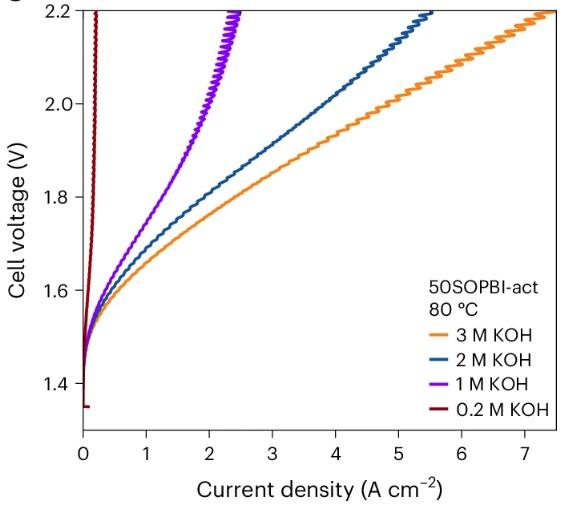
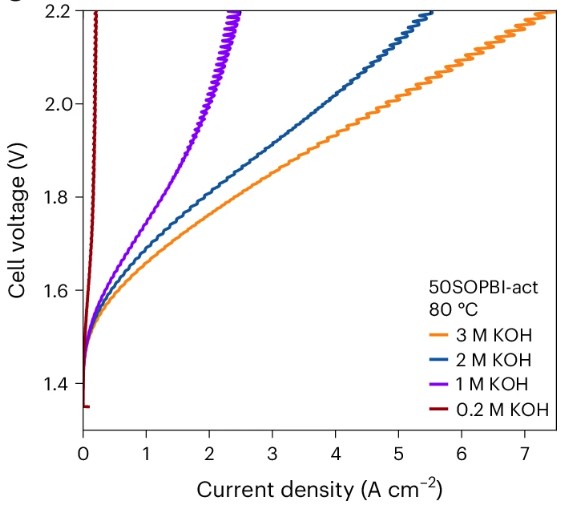
When tested in a water electrolyzer, the membrane achieved a current density of 4.8 A cm⁻² at 2 V (3 M KOH, 80 °C), with hydrogen crossover below 2%. This new generation of low-alkalinity water electrolysis overcomes the performance limitations of conventional alkaline electrolyzers and demonstrates clear cost advantages compared to state-of-the-art anion exchange membrane (AEM) electrolyzers.
By combining durability, efficiency, and economic viability, this innovation brings the technology one step closer to practical implementation in the kilowatt power range, paving the way for more accessible and scalable production of green hydrogen.
The research was carried out in close international collaboration between several leading institutions, including the German Aerospace Center (DLR), with contributions from the Institute of Engineering Thermodynamics under the leadership of Dr. Fatemeh Razmjooei (Group Leader) and team members Kamal Ghotia, Franz Egert, and Dr. Asif Ansar (Head of Department TT-ESI). Additional partner institutions include the Korea Institute of Science and Technology (KIST), the Technical University of Denmark (DTU), and the Jagiellonian University in Poland.
The publication in Nature Energy underscores the scientific importance and future relevance of this work for advancing sustainable energy technologies.
Kontakt
Dr. Syed Asif Ansar
Dipl.-Kff. Sabine Winterfeld