
5th International Workshop on Carnot Batteries Unites Global Energy Storage Community in Stuttgart
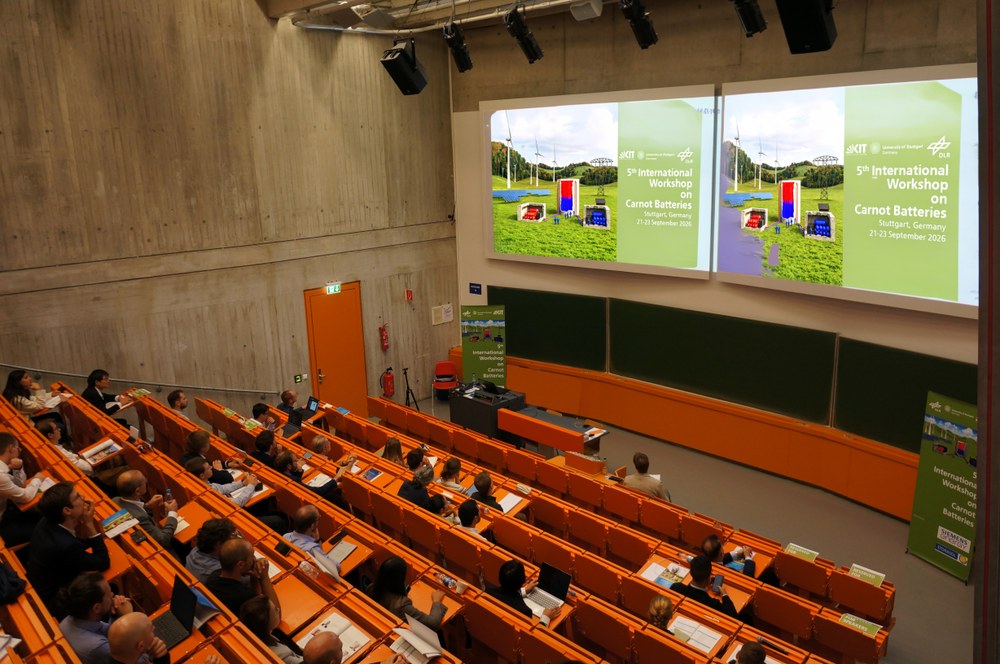

A keynote about industrializing Carnot Batteries, five invited lectures from across Europe, and an EERA-sponsored poster award for early-career researchers headlined three days of exchange on thermal energy storage.
From 21 to 23 September 2026, the German Aerospace Center (DLR), the University of Stuttgart and the Karlsruhe Institute of Technology (KIT) jointly hosted the 5th International Workshop on Carnot Batteries (IWCB 2026) on the University of Stuttgart campus, welcoming around 100 researchers, engineers and industry representatives from around the world. The event brought together the international community to discuss the latest research, demonstration projects and industrial deployment of the technology.
A Carnot Battery, also known as Pumped Thermal Energy Storage (PTES, works by converting electricity into heat, storing that heat in an inexpensive medium such as water or molten salt, and converting it back into electricity on demand. Because storage capacity can be scaled up simply by adding more low-cost thermal storage material, and the technology does not depend on specific geography, it is considered a strong candidate for the long-duration, gigawatt-hour-scale energy storage required in a power grids with a high share of renewable energy.
The workshop opened on Monday evening with a public lecture series on "Failure as a Pathfinder for Technical Progress," featuring Prof. Mike Schlaich (schlaich bergermann partner) presemting the solar updraft tower, while Prof. Eduard Heindl (Hochschule Furtwangen) discussed gravity-based energy storage. The two-day scientific programme began on Tuesday morning.
Keynote: Industrializing Carnot Batteries
The scientific programme opened with a keynote lecture by Honggang Wang of the National Institute of Clean-and-Low-Carbon Energy (NICE), the research arm of China Energy (CHN Energy). In his talk "Industrializing Carnot Battery in China: From Research to Demonstration," Wang described how Chinese research institutions and industry are advancing the technology from laboratory research to industrial-scale demonstration plants — a clear sign of the momentum Carnot Batteries have gained internationally in recent years.
Invited lectures: from market design to turbomachinery
Five invited lectures from science and industry complemented the keynote, alongside a packed programme of close to 30 contributed talks and a well-attended poster session:
- Valentin Bertsch (Chair of Energy Systems and Energy Economics, Ruhr-Universität Bochum) opened the series with "How can energy system and market research inform technology development? Insights for the example of Carnot Batteries," examining how energy system and market analysis can help guide technology development.
- Tim de Haas (KYOTO Group) presented "Green Heat. Lower Costs. Stronger Energy Security. How Heatcube's Proven Technology Decarbonizes Industry," introducing the company's commercial thermal battery for decarbonizing industrial heat.
- Stefan Glos (Siemens Energy) spoke on "From Air to CO₂ – How Working Fluids Shape Turbomachinery for Large-Scale Carnot Batteries," addressing the influence of working fluid selection on turbomachinery design at large scale.
- Günter Schneider (STORASOL GmbH) gave an overview in "TES – Core Element of Carnot Batteries – Types and Applications," covering the different types of thermal energy storage and their respective application areas.
- Christos N. Markides (Imperial College London) closed the series with "Twenty Years of Pumped-Thermal Electricity Storage: A Personal Journey from Fundamentals to Technology Development," reflecting on two decades of research and technological development in the field.
Best Poster Award, sponsored by EERA, honors early-career researchers
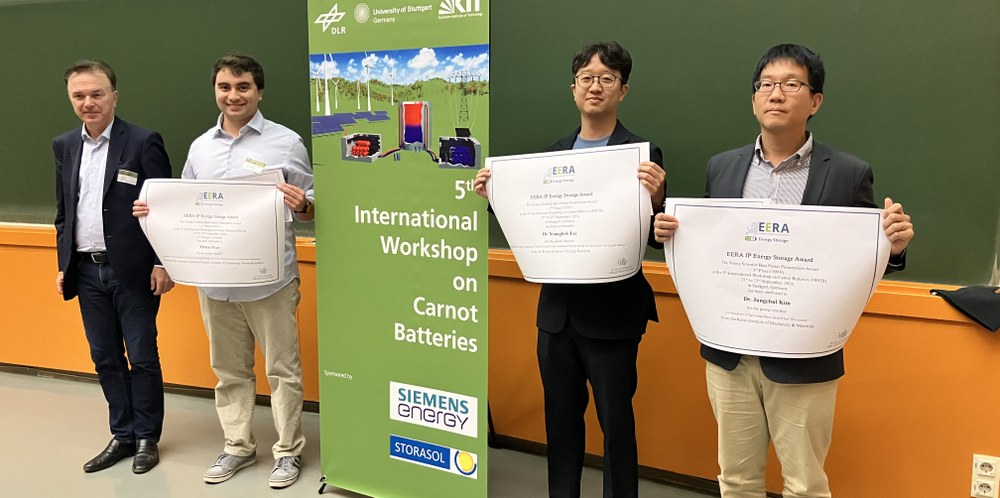
A highlight of the second day was the Best Poster Award ceremony, sponsored by the EERA Joint Programme Energy Storage (JP ES 3) of the European Energy Research Alliance to recognize outstanding contributions by early-career scientists. Three posters were honored:
- First prize: Matias Pezo Perez, DLR – "Geometric Optimization of Latent Heat Energy Storage for Carnot Batteries based on Multiscale"
- Second prize: Youngbok Lee, Korea Institute of Energy Research – "Development of High-Temperature Sensible-Latent Heat Combined Thermal Energy Storage System for Carnot Battery"
- Third prize: Jungchul Kim, Korea Institute of Machinery & Materials -"Investigation of high temperature packed bed TES system"
The organizers congratulate all three winners on their excellent work and thank the EERA Joint Programme Energy Storage for once again supporting the next generation of Carnot Battery researchers.
Thanks to the sponsors
The 5th IWCB was made possible through the generous support of Siemens Energy and STORASOL, both of which also contributed to the scientific programme through invited lectures, reflecting of the close collaboration between research and industry that defines the Carnot Battery community. The organizers thank both companies for their support.
Looking ahead
With its keynote and invited lectures, close to 30 contributed talks and a lively poster session, the 5th International Workshop on Carnot Batteries once again showed highlighted the progress being made in advancing Carnot battery technologies from research towards industrial application. The organizers thank all speakers, participants and sponsors for three inspiring days in Stuttgart and look forward to welcoming the community back for the next International Workshop on Carnot Batteries