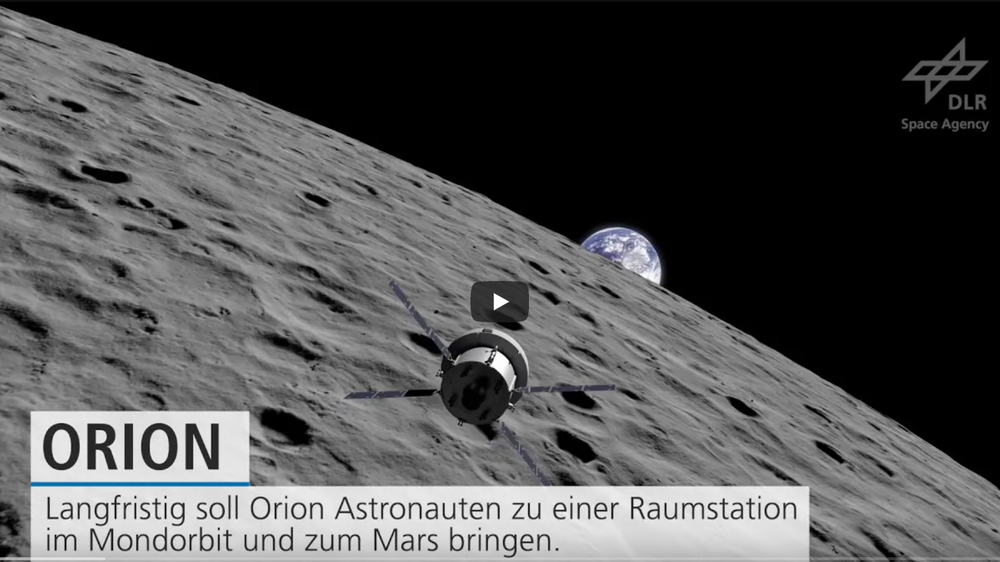
The US Orion spacecraft, also known as the Multi-Purpose Crew Vehicle (MPCV), was launched into space for the first time in November 2022 as part of NASA's Artemis programme. The spacecraft lifted off from the Kennedy Space Center in Florida on board NASA's new heavy-lift rocket, the Space Launch System (SLS), bound for low Earth orbit. From there, the European Service Module (ESM) transported it to the Moon. The spacecraft, which flew without a crew, orbited the Earth several times during the Artemis I mission and then returned to Earth. The second lunar mission, Artemis II, which will take place in September 2025, will be crewed. The third mission, Artemis III, will then see the first woman and the next man land on the Moon.
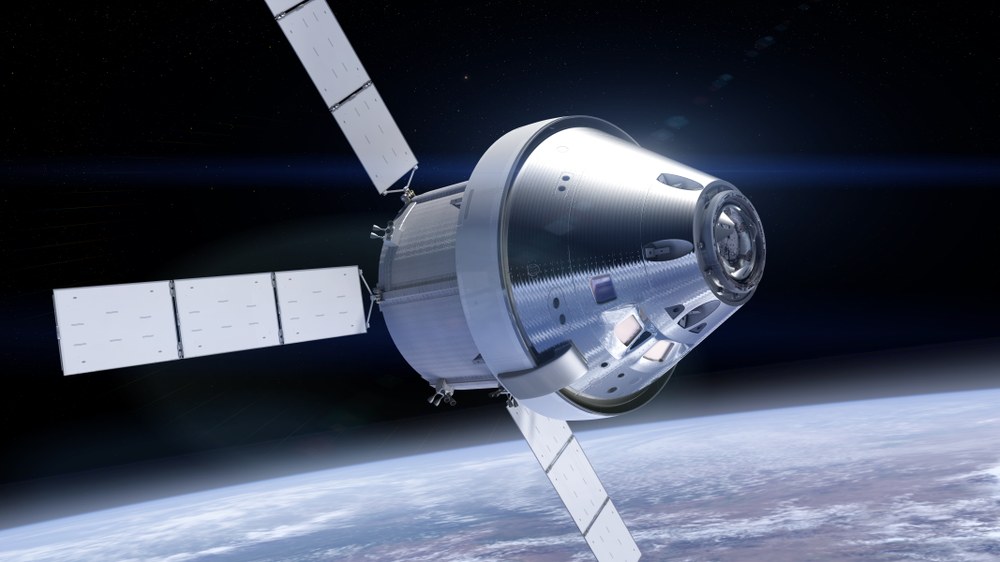
Orion consists of two main parts: the US crew module, which is usually also referred to as Orion, and the European Service Module (ESM). The crew module resembles the shape of the Apollo spacecraft capsule, but is about twice as large, with space for up to four astronauts instead of three. The capsule, which weighs around ten tonnes, also houses the life support system and the flight control system. At the end of a mission, the capsule re-enters Earth's atmosphere and lands in the Pacific Ocean using parachutes. The crew is then rescued by ships and helicopters.
NASA's Orion programme is developing an interplanetary spacecraft for astronauts to travel to the Moon and Mars. The European Service Module (ESM) is a central component of the Orion spacecraft.
Space technology ‘Made in Germany’: the European service module of the Orion spacecraft
Your consent to the storage of data ('cookies') is required for the playback of this video on Youtube.com. You can view and change your current data storage settings at any time under privacy.
Space technology ‘Made in Germany’: the European service module of the Orion spacecraft
NASA's Orion programme is developing an interplanetary spacecraft for astronauts to travel to the Moon and Mars. The European Service Module (ESM) is a central component of the Orion spacecraft.
However, the service module is a crucial part of every Orion mission. The cylindrical ESM contains the main engine and uses four solar arrays to supply the spacecraft with power. Its climate control systems ensure that the temperature inside the spacecraft is optimally regulated for astronauts and cargo. The ESM also stores the crew's fuel, oxygen and water supplies. The ESM weighs approximately 15 tons when fully loaded at launch. It only separates from the Orion capsule at the end of the mission and burns up in the Earth's atmosphere.
The ESM continues to build on the experiences of the ATV programme
NASA assumes responsibility for operating the ISS on behalf of the international cooperation partners Canada, Japan and Europe. The partners settle the costs incurred by NASA not by transferring foreign currency, but through the delivery of technologies. The European Space Agency (ESA) has so far settled its share of these so-called barter elements with the development of the Automated Transfer Vehicle (ATV) cargo spacecraft and its deliveries to the ISS.
By 2015, five successful ATV missions brought supplies to the ISS. In 2013, the ESA member states decided not to build any more ATVs and to develop a new system instead. In the course of this, an agreement was reached with NASA that Europe should build the ESM for the new Orion spacecraft. But the technology used in the ATV has not been lost: it lives on in the ESM, because the experience gained from the ATV programme is being put to good use in the development of the service module. This can be seen from the outside, with the x-shaped solar modules for power generation: these were already an important feature of the ATV. But overall, the ESM is a new development.
New level of cooperation between NASA and ESA
The Orion collaboration is the first time that NASA has relied on an international partner for a human spaceflight mission. Under the industrial leadership of Airbus Defence and Space in Bremen, a European consortium is responsible for developing and building the first flight unit of the ESM.
Germany contributes around 40 percent to the European ISS programme. For the ESM programme, this share is approximately 50 percent. Germany was a major supporter of the decision to build the ESM at the ESA ESA Council Meeting at Ministerial Level in Naples in 2012. The German Space Agency at DLR manages the German ESA contributions.